Campgrounds on municipal water supplies receive pre-treated water that meets federal drinking water standards. But a significant portion of campgrounds — particularly those in rural areas — operate on private wells or surface water sources where water treatment is the operator’s responsibility.
Understanding the treatment technologies available, what they address, and how to monitor treated water quality helps campground operators provide safe, acceptable-quality water to guests while meeting regulatory requirements.
Understanding Your Source Water
The starting point for any water treatment decision is understanding what’s actually in your source water. Source water quality varies significantly by geology, land use, and seasonal factors.
Well water common concerns:
- Hardness (calcium and magnesium) — not a health concern but affects appliances, leaves mineral deposits
- Iron and manganese — causes staining, taste/odor issues
- Hydrogen sulfide — rotten egg odor, even at very low concentrations
- Nitrates — health concern, particularly for infants; associated with agricultural land use
- Bacteria and parasites — E. coli, coliforms, Giardia; require disinfection
- Radon and heavy metals — geological, vary by region
- PFAS compounds — emerging concern in some areas
Surface water concerns:
- Turbidity (particulate matter)
- Bacterial and viral contamination
- Organic compounds from decomposition
- Seasonal variations that may challenge treatment systems
A comprehensive water test from a certified laboratory — covering the full suite of parameters relevant to your region — is the essential starting point. Many states require periodic water testing for campground water systems; even where not required, annual testing is standard practice.
Filtration Technologies
Filtration addresses particulate matter, sediment, and some contaminants depending on filter type.
Sediment filters: Remove particles (sand, silt, rust) from water. Typically the first stage in multi-stage treatment systems. Whole-house sediment filters with automatic backwash reduce maintenance requirements compared to cartridge filters.
Iron and manganese filters: Oxidation filtration specifically addresses iron and manganese — either through chemical oxidation (chlorination, potassium permanganate) followed by filtration, or through biological iron filters that use naturally occurring iron bacteria to convert dissolved iron to filterable form.
Activated carbon filters: Remove chlorine, taste and odor compounds, and some organic chemicals. Often used as a final polishing stage after other treatment processes.
Softeners: Ion exchange water softeners address hardness by replacing calcium and magnesium ions with sodium. Reduce mineral scale in plumbing and appliances. The resulting slight sodium increase is not a health concern for most people but may be relevant for guests on sodium-restricted diets — appropriate labeling or signage is warranted.
Disinfection Technologies
Disinfection kills or inactivates bacteria, viruses, and parasites (like Giardia and Cryptosporidium) that can cause illness.
Chlorination: Adding chlorine (liquid sodium hypochlorite or solid calcium hypochlorite) to water is the most common campground disinfection method. Maintains a residual disinfectant throughout the distribution system. Contact time matters — water must be in contact with chlorine for a sufficient period to achieve adequate disinfection.
UV disinfection: Ultraviolet light systems expose water to UV radiation that destroys the DNA of microorganisms. UV is highly effective against bacteria, viruses, and Giardia/Cryptosporidium. Advantages: no chemical addition, no taste or odor effect, immediate action. Limitations: UV provides no residual protection once water leaves the UV system, making it best used in combination with a residual disinfectant.
Reverse osmosis: RO systems push water through a semipermeable membrane under pressure, removing the vast majority of dissolved contaminants including bacteria, viruses, heavy metals, nitrates, and PFAS. The most comprehensive treatment option, typically used for point-of-use applications (drinking water station, camp store) rather than whole-facility treatment due to flow rate limitations and water waste.
Remote Monitoring for Water System Quality
Continuous or frequent monitoring of water quality provides real-time assurance that treatment is functioning correctly.
Chlorine residual monitoring: Automated chlorine residual sensors at key points in the distribution system (after treatment and at representative endpoints) verify that adequate disinfection is maintained throughout. Alerts if residual drops below acceptable levels.
Turbidity monitoring: Real-time turbidity sensors detect increases in particulate matter that might indicate filter failure or source water quality changes. Important for surface water systems where turbidity events can be sudden.
Flow monitoring for dosing control: Water treatment chemical dosing should be proportional to flow rate — a fixed dose rate that’s adequate at normal flow rates may be insufficient during peak demand or excessive during low-flow periods. Flow-paced dosing systems automatically adjust disinfectant dosing to maintain consistent residual.
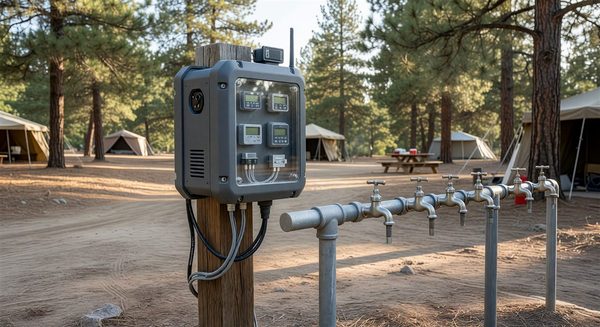
Remote access and alerts: Connecting treatment monitoring systems to a cloud platform allows operators to receive real-time alerts on their smartphone when parameters fall outside acceptable ranges — critical for systems that may not be visited daily.
Regulatory Requirements
Campground water systems that serve the public are subject to regulation under the Safe Drinking Water Act (SDWA) at the federal level, with state primacy for implementation. The specific requirements depend on the classification of your water system:
Transient Non-Community Water Systems (TNCWS): Most campground water systems fall into this category. TNCWS must test for total coliform bacteria, nitrate, nitrite, and other regulated contaminants on defined schedules. Many states have additional requirements beyond federal minimums.
Surface water systems: If your water source is a river, lake, or stream, surface water treatment rules apply — typically requiring filtration and disinfection meeting specified performance standards.
Reporting requirements: Campground water systems must report test results to the state and must notify guests if drinking water standards are violated. Failure to notify is itself a regulatory violation.
Working with your state health department to understand the specific requirements for your water system type and location is essential. State drinking water programs typically have helpful resources for small system operators.
Frequently Asked Questions
How do I know if my campground’s well water is safe without testing? You don’t. Water quality is not visible, tastable, or smellable for most health-relevant contaminants. Annual testing by a certified laboratory is the only way to verify safety. Some health concerns (nitrates, PFAS) produce no sensory evidence whatsoever.
What’s the most important water quality parameter to monitor for a campground? Coliform bacteria — used as an indicator of potential pathogenic contamination — is the most critical parameter for any water system serving the public. Total coliform testing should be done on the schedule required for your system type and immediately after any event (flooding, system repair) that might introduce contamination.
Can I tell guests to use bottled water if my water quality is uncertain? If your water quality is uncertain or known to fail standards, you must not serve it to the public as drinking water and must notify guests appropriately. Providing bottled water does not substitute for a properly functioning treatment system for a water system that’s regulated. If you have a failing water quality situation, contact your state health department for guidance.
What’s the typical cost of a water treatment system upgrade for a campground well? Basic sediment filtration and chlorination for a small campground water system: $3,000–$8,000 installed. Adding UV disinfection and iron treatment: $8,000–$20,000. Full multi-stage treatment systems for surface water or heavily impaired well sources: $25,000–$75,000+. Ongoing costs include chemical supplies, filter media replacement, electricity, and testing.
Further Reading from Authoritative Sources
- EPA Safe Drinking Water Act requirements for Transient Non-Community Water Systems — The EPA administers the Safe Drinking Water Act and publishes authoritative compliance guidance for TNCWS operators — the classification most campgrounds with private water systems fall under — including testing requirements, treatment standards, and public notification obligations.
- CDC water quality testing and pathogen treatment guidance for campground water systems — The CDC publishes authoritative guidance on drinking water pathogens including E.