Water system problems are among the most operationally disruptive issues a campground can face. A main line break during a busy weekend affects every guest on the property. Chronic leaks quietly drain thousands of dollars per year from the water budget. Low pressure complaints come in from guests at the far end of the distribution loop while guests near the main service experience overpressure that damages their RV regulators.
Water pressure management technology helps campground operators get ahead of these problems rather than responding to them after they’ve become complaints or failures.
Understanding Your Water System
Before optimizing pressure management, map your water system. This documentation is valuable for maintenance, for new employee training, and for troubleshooting problems when they arise:
- Source (municipal connection, well, or combination)
- Storage tanks or pressure tanks, their location and capacity
- Main shutoff valve location
- Distribution main routing through the property
- Section shutoff valve locations
- Site hookup riser locations and valve types
- Water meter location (municipal) or flow meter location (well)
Many campgrounds — particularly those that have grown incrementally over decades — lack accurate as-built documentation of their water systems. If yours is undocumented, a plumber can create a system diagram during a routine service visit, and that investment pays dividends many times over when troubleshooting.
Pressure Regulation Across a Campground
Water pressure requirements at campgrounds must balance two competing concerns: enough pressure to serve sites at the far end of the distribution system, and not so much pressure that sites near the main experience damaging overpressure.
Typical RV regulator requirements: RV manufacturers generally recommend that campground water pressure not exceed 50–60 PSI. Many RV owners carry portable pressure regulators as protection against high-pressure sites. But guests shouldn’t have to rely on their own equipment to protect their RV’s water system — the campground should maintain appropriate supply pressure.
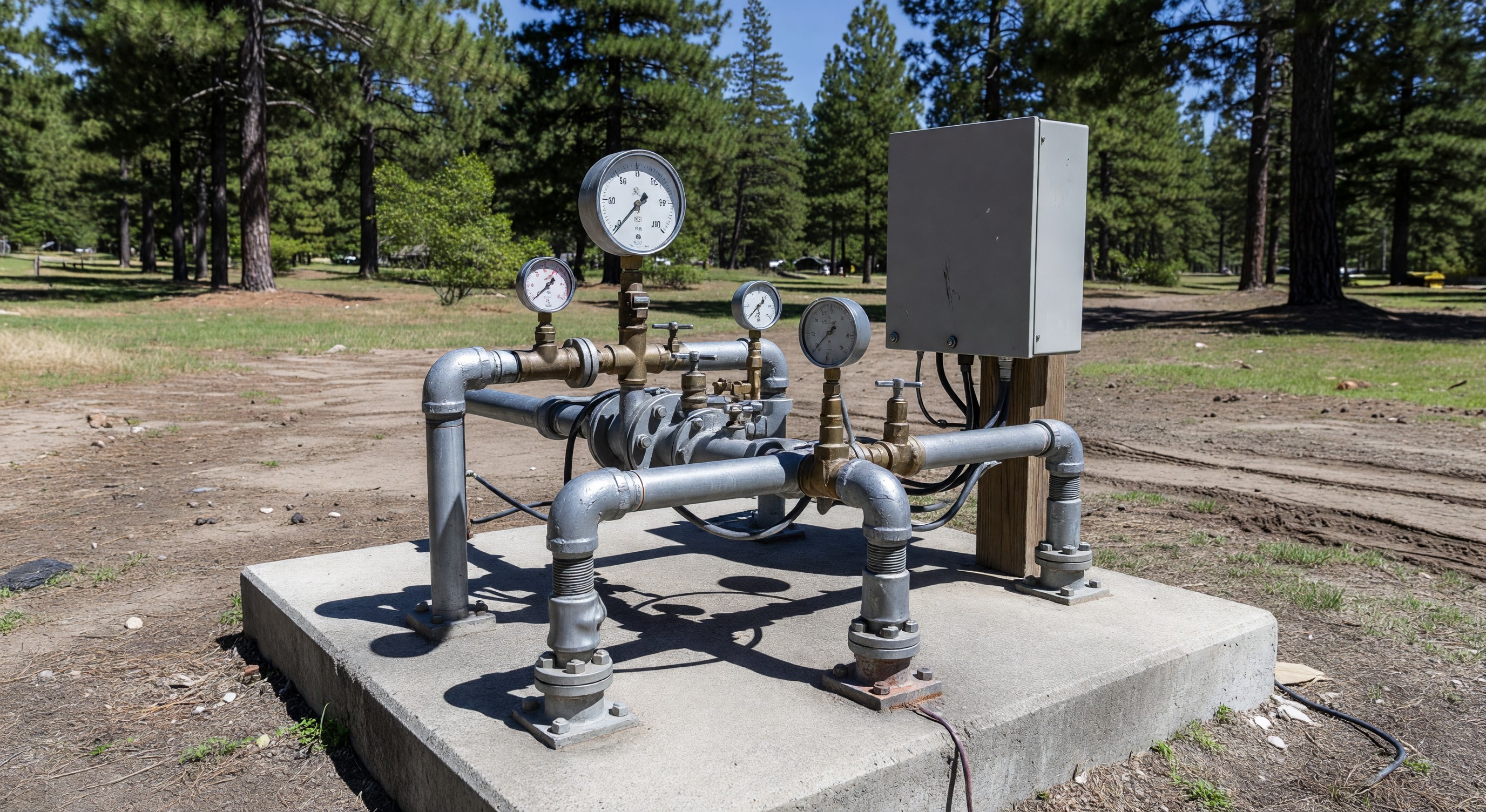
Pressure reducing valves (PRVs): Zones or sections of a campground with higher supply pressure can have pressure reducing valves installed at the feed point to maintain pressure within the appropriate range. PRVs are passive mechanical devices that maintain downstream pressure at a set point regardless of upstream variation.
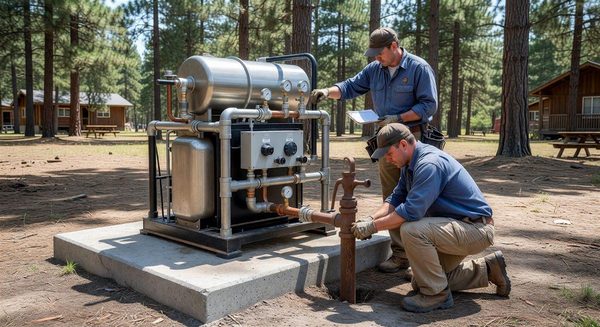
Pumping systems and pressure tanks: Campgrounds on well water typically use pressure tanks to maintain distribution pressure between pump cycles. Properly sized pressure tanks reduce pump short-cycling, extend pump life, and maintain more stable distribution pressure. A pressure tank that has lost its air charge runs the pump continuously — a sign of a problem that’s easily corrected before it causes pump failure.
Leak Detection Technology
Water losses from leaks are often underestimated. A 1/4-inch diameter hole in a pressurized line loses roughly 50 gallons per hour — over 1,000 gallons per day. At $0.01/gallon water cost plus equivalent sewer charge, that’s $20/day or $6,000/year from a single undetected leak.
Flow monitoring for leak detection: The simplest leak detection approach is monitoring total system flow and comparing it against known consumption. If flow during hours when no one should be using water (2am–4am) shows continuous baseline flow, a leak is likely. Smart water meters and flow loggers can provide this data continuously with alerts when unusual nighttime flows are detected.
Pressure transient monitoring: Water distribution systems experience pressure waves (water hammer) from valve operations, pump starts, and demand changes. Chronic pressure transients stress pipe joints and connections over time, contributing to leak development. Pressure transient monitoring identifies systems with significant transient problems that merit engineering analysis.
Acoustic leak detection: Professional leak detection services use ground microphones and correlating equipment to listen for the distinctive sound of water escaping from pressurized pipes. This service is typically called in when a leak is suspected but can’t be located by flow monitoring alone. It’s particularly effective on PVC and HDPE pipe systems and can pinpoint leak locations with enough accuracy to minimize excavation.
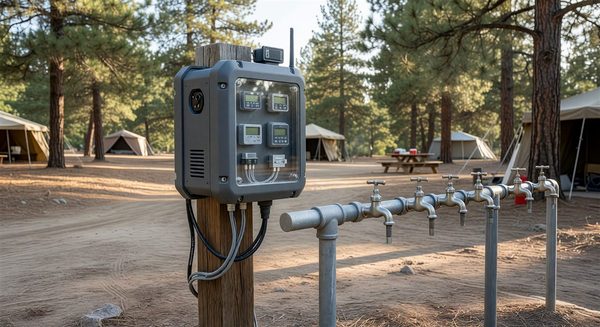
Smart site hookup monitoring: Smart pedestal systems with per-site water metering can identify when a site has continuous water flow — indicating either a guest leaving their connection open, a running faucet inside the RV, or a site-level leak.
Protecting Against Water Hammer
Water hammer — the banging or shuddering in pipes caused by rapid flow changes — is both a nuisance symptom and a long-term system health concern. In campground systems with many guests opening and closing connections, water hammer events are common.
Causes of water hammer in campground systems:
- Rapid closure of distribution main valves during repair or maintenance
- Fast-acting solenoid valves in irrigation systems
- Pump starts and stops without soft-start or variable frequency drive controls
- Guests rapidly opening or closing site connections
Mitigation approaches:
- Pressure-rated water hammer arrestors installed at vulnerable locations
- Slow-closing valves for main distribution applications
- Variable frequency drives on pump motors to provide soft starts and stops
- Checking and properly charging pressure tanks (an uncharged pressure tank provides no water hammer absorption)
Campground Well Water System Management
Campgrounds on well water face additional monitoring considerations compared to those on municipal supply:
Well pump monitoring: Well pump systems should be monitored for runtime, pumping rate, and power consumption. Gradual increases in pump runtime to maintain the same pressure tank cycling can indicate well yield decline, screen clogging, or pump wear. Catching these trends early enables planned maintenance rather than emergency response.
Water quality monitoring: Well water quality can change seasonally or as a result of agricultural activity, construction, or drought. Minimum annual water quality testing is standard practice; more frequent testing in areas with known groundwater quality concerns is advisable.
Storage tank level monitoring: Campgrounds with large storage tanks need level monitoring to ensure adequate supply for peak demand periods and to detect slow leaks from tanks themselves.
Frequently Asked Questions
What water pressure should campground hookups deliver to guests? The industry standard is 40–55 PSI at the site hookup under normal flow conditions. Below 35 PSI, some RV appliances and water fixtures underperform. Above 60 PSI, RV water systems are at risk of damage, though most RV regulators are set to prevent pressure above 40–60 PSI from entering the vehicle. Testing pressure at representative sites throughout your property — especially those at the end of long distribution runs — verifies that your system is delivering appropriate pressure.
How can I tell if my campground has significant water leaks? Compare your water meter reading overnight (10pm to 6am) when guests are generally asleep and consumption should be minimal. If your meter is advancing significantly during this window, you likely have leaks. A more precise approach is to shut off all known uses one at a time (irrigation, ice machine, bathhouse) while monitoring the meter to isolate which systems are contributing to nighttime flow.
Should campground water systems have backflow prevention? Yes. Backflow prevention is required by code in most jurisdictions wherever a campground potable water system connects to guest RV hookups. RV gray water and tank-flushing activities create the potential for cross-contamination without proper backflow prevention devices. This is not an optional safety measure.
How often should campground water system pressure be professionally tested? Annual pressure testing at representative points throughout the distribution system — conducted by a licensed plumber or water system professional — is good practice for any campground with more than 50 sites. The testing should include measuring pressure at both the most proximate and most distant points from the water source, testing all section shutoff valves for operation, and inspecting accessible valve and fitting conditions.
Further Reading from Authoritative Sources
- ARVC campground water system standards and utility management — ARVC provides operational standards for campground utility infrastructure including water system pressure requirements, making it the most relevant trade authority for the pressure specifications and management practices in this article.
- EPA drinking water infrastructure and distribution system guidance — The EPA’s water infrastructure programs publish guidance on distribution system leak detection and water conservation for public water systems, relevant to the monitoring technology and leak detection practices that campground water systems should follow.