Bathhouse hot water is among the highest operating costs at most campgrounds. Guests expect reliable hot water on demand — and during peak weekend periods at a busy park, that demand can be substantial. Water heating technology has evolved significantly over the past decade, and operators upgrading aging systems or planning new facilities have a wider range of efficient options than ever before.
Understanding Your Hot Water Demand
Before evaluating heating system options, accurately sizing your demand is essential. Undersizing leads to cold-shower complaints; oversizing means paying for capacity you never use.
Key inputs for a bathhouse water heating calculation:
- Number of shower heads in the facility
- Peak concurrent usage (typically estimated at 50–70% of total shower capacity during morning rush)
- Flow rate of your shower fixtures (typically 1.5–2.5 GPM for modern low-flow showerheads)
- Temperature rise required (difference between incoming cold water temperature and target supply temperature — typically 100°F target supply requires 50–70°F rise depending on climate)
- Usage duration of peak period
A small bathhouse with 8 showers might require 3–4 gallons per minute of hot water during morning rush. A large resort facility with 20+ showers might peak at 15–20 GPM or more. These numbers drive equipment sizing dramatically.
Storage Tank Water Heaters
Traditional storage tank heaters remain common in campground bathhouses. Large commercial units — 80–120 gallon tanks with high-recovery burners — maintain a reservoir of hot water ready for immediate use.
Advantages:
- Delivers large volumes of hot water consistently without demand spikes affecting supply
- Relatively straightforward installation and maintenance
- Well-understood technology with wide availability of parts and service
Disadvantages:
- Standby heat loss — the tank continuously loses heat to the surrounding environment, requiring the burner to cycle on even when no hot water is being used
- Large space footprint
- Recovery rate limitations — during extended high-demand periods, tank capacity can be exhausted before recovery catches up
For most campground bathhouses, the standby losses on large storage tanks are significant. A 100-gallon commercial tank may lose 1–2 therms of natural gas per day to standby heat loss alone, regardless of how much hot water is actually used.
Tankless (Demand) Water Heaters
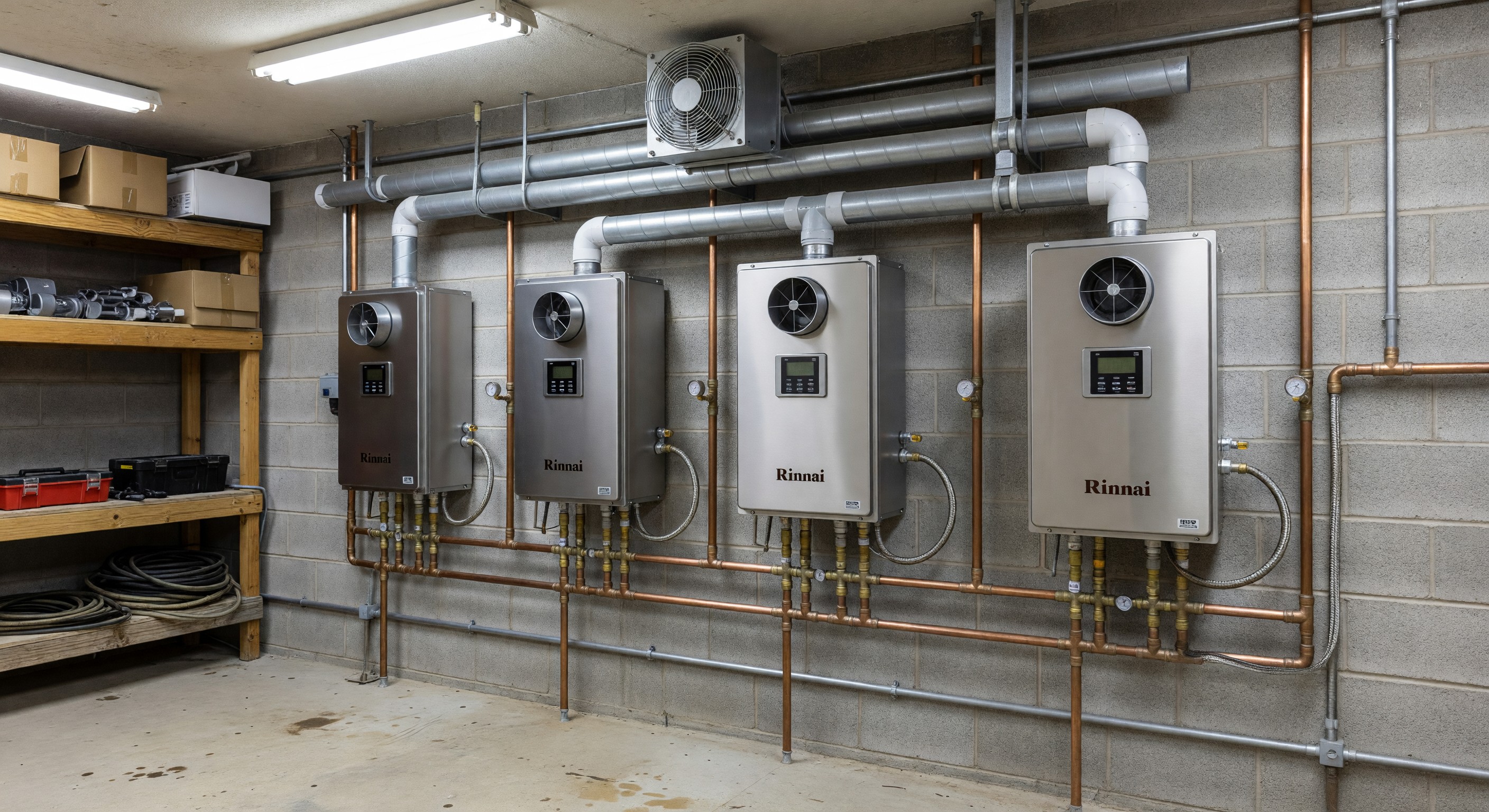
Tankless or instantaneous water heaters heat water only when it’s flowing, eliminating standby heat loss. Commercial tankless units are available in high flow rates suitable for multi-shower facilities.
Advantages:
- No standby heat loss — significant efficiency improvement over storage tanks
- Unlimited hot water supply limited only by the heater’s flow capacity
- Compact footprint — important in bathhouses with limited utility space
Disadvantages:
- High peak power demand — commercial gas tankless units require very high BTU input; electric tankless requires heavy-gauge wiring and significant electrical capacity
- May require multiple units in series or parallel for larger facilities
- Incoming water temperature fluctuations can affect performance during demand spikes
Modern commercial gas tankless units achieve 0.90–0.96 energy factors, compared to 0.60–0.80 for conventional tank heaters. The efficiency advantage is most pronounced at campgrounds with highly variable hot water demand — periods of low use don’t waste energy on standby losses.
Heat Pump Water Heaters
Heat pump water heaters work by extracting heat from surrounding air (or a water source if available) rather than generating heat directly. Because they move heat rather than create it, they can achieve efficiencies of 200–350% (every unit of electrical energy input yields 2–3.5 units of water heating).
Commercial heat pump water heaters are increasingly available in the capacities needed for campground bathhouses. They typically combine a heat pump with a storage tank for buffer capacity.
Advantages:
- Exceptional electrical efficiency — significantly lower operating costs than electric resistance water heating
- Doubles as air conditioning for the mechanical room in warm weather (the heat extraction cools the surrounding air)
- Qualifies for federal efficiency incentives under current programs
Disadvantages:
- Heat extraction is less efficient in cold ambient air — performance degrades below 40–50°F without backup electric resistance elements
- Requires adequate airflow around the unit — typically 1,000 cubic feet of air space minimum
- Higher upfront equipment cost than conventional units
For campgrounds in warm to moderate climates with electric utility service, heat pump water heaters offer compelling economics. In colder climates or for winter operation, a hybrid system with electric resistance backup is typically specified.
Solar Thermal Hot Water
Solar thermal systems use roof-mounted collector panels to capture solar energy and transfer it to domestic hot water. Unlike photovoltaic solar panels that generate electricity, thermal collectors heat water (or a heat transfer fluid) directly.
System types for campgrounds:
- Flat plate collectors: Most common for temperate climates. Lower cost, good efficiency in moderate sunlight.
- Evacuated tube collectors: Higher efficiency in cold weather and diffuse light conditions. Better suited to northern climates.
Solar thermal can provide 40–70% of a campground bathhouse’s annual hot water demand depending on climate, collector area, and usage patterns. A conventional backup system (gas or electric) handles demand during periods of low solar input.
Economic considerations: Solar thermal installation costs have become more competitive as the technology has matured. The federal ITC (30%) applies to solar thermal systems installed at commercial facilities. In climates with high solar irradiance and expensive conventional energy, solar thermal payback periods of 5–10 years are achievable.
Operational consideration: Campgrounds with significant winter operation need to specify freeze-protected systems (drain-back or glycol antifreeze loop) to avoid pipe damage during cold periods when the system isn’t actively heating water.
Hybrid and Combined Systems
Most modern campground bathhouse water heating systems combine multiple technologies:
- Solar thermal pre-heating → gas tankless backup
- Heat pump storage tank → electric resistance emergency backup
- Central tankless units → recirculation loop for consistent delivery temperature
System design should account for seasonal demand variation. Many campgrounds have drastically different demand in peak summer weekends versus shoulder season weekdays. Modular systems — multiple smaller units rather than one large unit — allow capacity to be adjusted seasonally.
Recirculation and Distribution Efficiency
The efficiency of a water heating system is partly determined by the distribution system delivering hot water to fixtures. Long runs of pipe between the water heater and shower fixtures lose heat and require guests to run water until it turns hot — wasting both water and energy.
Hot water recirculation systems maintain water at the set temperature throughout the distribution loop, so hot water is immediately available at any fixture. The energy cost of continuously running the recirculation pump and maintaining pipe temperature is offset by reduced water waste and guest satisfaction improvements.
Smart recirculation controls — scheduling circulation to run only during high-demand periods rather than 24/7 — further optimize the energy balance.
Frequently Asked Questions
What’s the most energy-efficient option for a new campground bathhouse? In most cases, a combination of solar thermal pre-heating with a commercial heat pump or high-efficiency gas tankless backup offers the best long-term operating economics. The right answer depends on your climate, utility rates (gas vs. electric pricing), facility usage patterns, and available incentives. An energy engineer can model the options for your specific situation.
How often do commercial water heaters require replacement? Commercial storage tank water heaters typically last 10–15 years in campground service. Commercial tankless units may last longer — 20 years is achievable with proper maintenance. Heat pump water heaters are newer technology and have shorter track records, but quality commercial units are generally warrantied for 10 years. Annual maintenance (anode rod inspection for tank units, heat exchanger cleaning, filter maintenance) significantly extends service life.
Can I convert from gas to electric water heating if my electrical service is being upgraded for EV charging? Yes, and this can make sense if the EV service upgrade brings substantial additional electrical capacity. Electric heat pump water heaters are significantly more efficient than electric resistance, so the electrical demand addition is less than you might expect. However, the economics depend on the relative cost of gas vs. electricity in your area — gas is often cheaper per BTU even accounting for heat pump efficiency advantages.
What water temperature should campground hot water systems be set to? The standard recommendation for safety and Legionella prevention is to maintain tank temperature at 140°F (60°C) with tempering valves at fixtures to deliver water at 110–120°F to prevent scalding. Tankless systems can be set to deliver at the target mixing temperature directly. This temperature management requirement is particularly important in storage systems where legionella bacteria can proliferate at water temperatures between 77°F and 113°F.
Further Reading from Authoritative Sources
- DOE commercial water heating efficiency standards and solar thermal incentives — The U.S.
- CDC Legionella prevention and water temperature management for building water systems — The CDC publishes authoritative guidance on Legionella prevention in building water systems, including the temperature management requirements for commercial hot water systems that apply to campground bathhouse water heating installations.