The shift from flat-rate site pricing to consumption-based utility billing is one of the most financially significant changes a campground can make — and smart metering technology is what makes it practical.
The business case is straightforward: when guests pay for what they actually use, consumption decreases, cost recovery improves, and the operators who invested in low-consumption infrastructure are better positioned competitively. Understanding how smart metering billing works in practice is the foundation for evaluating whether it’s right for your operation.
The Case for Consumption-Based Billing
Cost recovery: Electrical costs at full-hookup campground sites have grown significantly as RVs have become more like homes — residential refrigerators, residential air conditioners, multiple TVs, washers and dryers. A heavy-use guest might consume $15–$25 worth of electricity per night. If this cost isn’t recovered in the site rate or through direct billing, it’s absorbed into your operating cost.
Fairness: Guests who conserve electricity (or arrive in more efficient rigs) are effectively subsidizing guests who run everything at maximum. Consumption-based billing creates a fair relationship between use and payment.
Conservation incentive: When guests know they’re paying for electricity consumed, they tend to use less. Industry experience suggests 20–30% reductions in per-guest electrical consumption when billing is introduced.
Competitive positioning: Parks that charge a fair site rate plus actual electrical use can post lower base rates, attracting price-sensitive guests while recovering true costs from heavy users.
How Smart Metering Systems Work at Campgrounds
The components of a campground smart metering system:
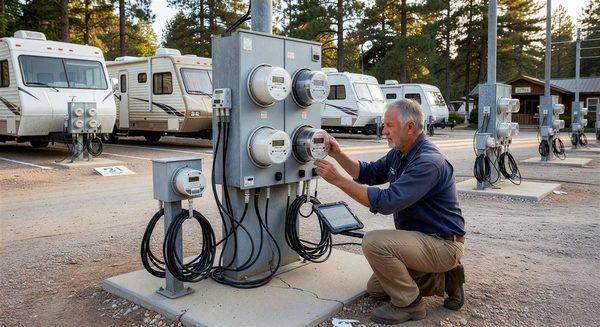
Pedestal-mounted electric meters: Smart meters installed at or in each RV site’s electrical pedestal measure consumption in kWh. Modern meters communicate wirelessly (cellular, LoRaWAN, or ZigBee) rather than requiring a wired network run to each pedestal.
Data collection network: The wireless signals from site meters are received by a gateway device (often a single gateway can serve an entire campground) and transmitted to a cloud platform.
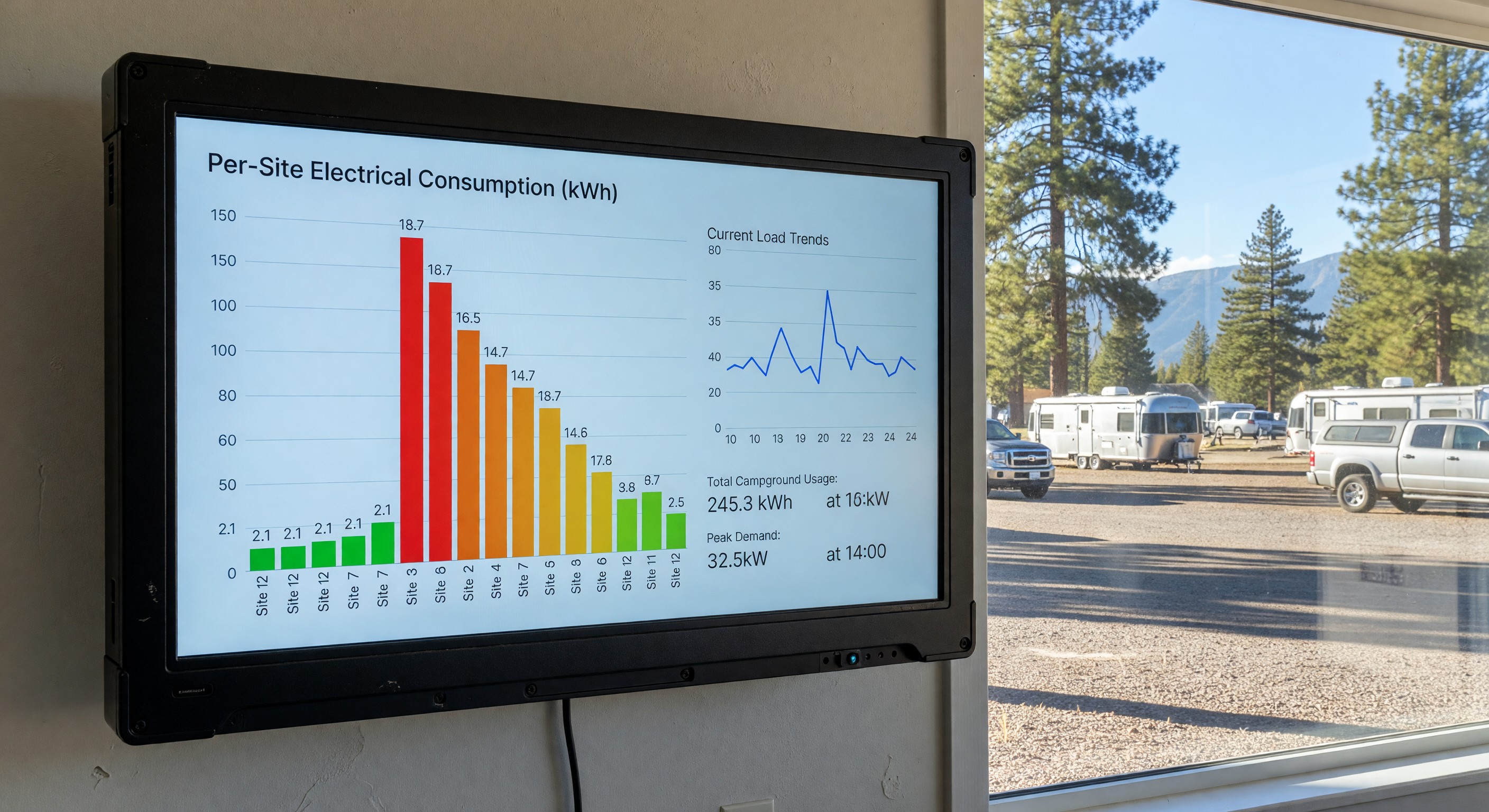
Management software: A cloud-based platform displays real-time and historical consumption data per site, links meter readings to reservation records, and generates billing data.
Billing integration: The billing data from the metering platform feeds into your reservation system or generates standalone invoices for consumption charges.
Billing Models
Per-kWh billing: Guest is charged the actual kWh consumed at a defined rate. The rate is typically the operator’s cost plus a margin (often 10–25%) to cover administration and infrastructure. This is the most transparent model.
Included allowance + overage: A fixed amount (e.g., 10 kWh/night) is included in the site rate; consumption above that is billed at a per-kWh rate. This approach maintains simplicity for light users while recovering costs from heavy users.
Flat-rate electrical surcharge: A defined nightly fee for electrical hookup access, regardless of consumption. Simpler than true metered billing but doesn’t create conservation incentives.
For EV charging specifically, per-kWh metered billing is strongly recommended — the consumption variation is too high for flat-rate recovery to be fair.
Guest Communication and Transparency
Introducing electrical billing requires careful guest communication:
Disclose at booking: Guests should know before they book that electricity is metered and billed separately. This is a material factor in their decision and should not be a surprise at checkout.
Provide consumption visibility: A portal or app where guests can see their real-time and daily consumption gives them the ability to manage their usage. Guests who can see what they’re consuming are less likely to dispute bills.
Provide consumption context: “Your average daily consumption was 22 kWh, which is typical for a rig with air conditioning running” helps guests understand their bill rather than just receiving a number.
Dispute process: Define a clear process for guests who dispute a consumption reading. Meter audit (checking that the meter is functioning correctly) and comparison to neighboring site consumption are the standard investigation steps.
Frequently Asked Questions
Can I install smart meters at only some sites and not others? Yes, and this is a common incremental approach. Starting with your highest-consumption site types (50A full hookup sites, EV charging sites) captures the highest-dollar billing opportunity and allows you to develop your processes before rolling out to all sites.
What rate should I charge for electricity in campground billing? Most campground operators charge between their utility cost and 2x their utility cost. Retail rates for campground electricity billing typically run $0.15–$0.35/kWh in the US depending on region. Charging significantly above this generates guest complaints and can create regulatory issues in some jurisdictions that have utility billing rules.
How do I handle electricity theft or meter tampering? Meters with tamper detection alert you if the meter is physically accessed without authorization. Smart meters that communicate wirelessly to your platform allow you to see consumption gaps that might indicate meter bypass. Physical security of pedestal electrical access (locked compartments) reduces opportunity.
Do smart meters require a dedicated communication infrastructure or cellular connectivity? Many modern campground smart meter systems use LoRaWAN (a long-range, low-power wireless protocol) that allows a single gateway to serve an entire campground — no cellular subscription per meter required. Cellular-based meters exist but carry higher per-unit data costs. WiFi-based meters exist but require WiFi coverage at every site.
Further Reading from Authoritative Sources
- DOE smart metering standards and utility billing technology guidance — The U.S.
- Smart meter wireless communication protocols and billing system integration — Wikipedia’s smart meter article provides authoritative technical background on the wireless communication protocols, data collection architectures, and billing integration capabilities that distinguish smart metering options for campground operators.