Heating, ventilation, and air conditioning represents a major utility cost at campgrounds with enclosed facilities — bathhouses, laundry rooms, camp stores, rental cabins, and recreation halls all require climate control that varies seasonally and by occupancy. Yet most campground HVAC operates on simple time-clock schedules or basic thermostats, leaving significant energy savings on the table and creating comfort issues that drive guest complaints.
Modern HVAC monitoring and control technology offers campground operators better visibility, better control, and better outcomes — at investment levels appropriate for the scale of typical campground operations.
The Challenge of Campground HVAC
Campground facility HVAC has some characteristics that make it more complex than a typical commercial building:
Variable occupancy patterns: A bathhouse might handle 200 guests on a peak Saturday morning and 20 on a Tuesday afternoon. HVAC systems sized for peak load run inefficiently during low-demand periods unless they can modulate output accordingly.
High humidity environments: Shower rooms and laundry facilities generate substantial moisture. Poor ventilation design or controls lead to condensation, mold growth, and accelerated corrosion of fixtures and structural components. Managing ventilation — not just temperature — is critical.
Multiple separate facilities: A campground might have 4–8 separate buildings requiring climate control, each with different usage patterns and occupancy levels. Managing them individually with separate thermostats is time-consuming; managing them centrally through a building automation system is more efficient.
Unmanned operation: Many campground facilities operate without staff present most of the time. If HVAC equipment fails, no one notices until guests start complaining — or until a winter freeze damages plumbing.
Basic Controls: Programmable and Smart Thermostats
The simplest HVAC upgrade is replacing basic mechanical thermostats with programmable or smart thermostats.
Programmable thermostats allow different setpoints for different times of day and days of the week. A bathhouse thermostat programmed to 72°F during morning and evening peak periods and 65°F (or 55°F in winter) during midday and overnight reduces heating energy consumption without affecting comfort during high-use periods.
Smart thermostats add remote access (adjustable from a smartphone or web browser), learning capability (some models learn usage patterns and optimize schedules automatically), and integration with building automation systems. For small campgrounds with a few facilities, smart thermostats represent an accessible entry point — typically $150–$300 per unit — that provides immediate operational benefit.
Key limitation: Thermostats measure temperature at one point and control one or a few zones. They don’t provide the performance monitoring, equipment diagnostics, or multi-building coordination of full building automation systems.
Building Automation Systems for Multi-Facility Campgrounds
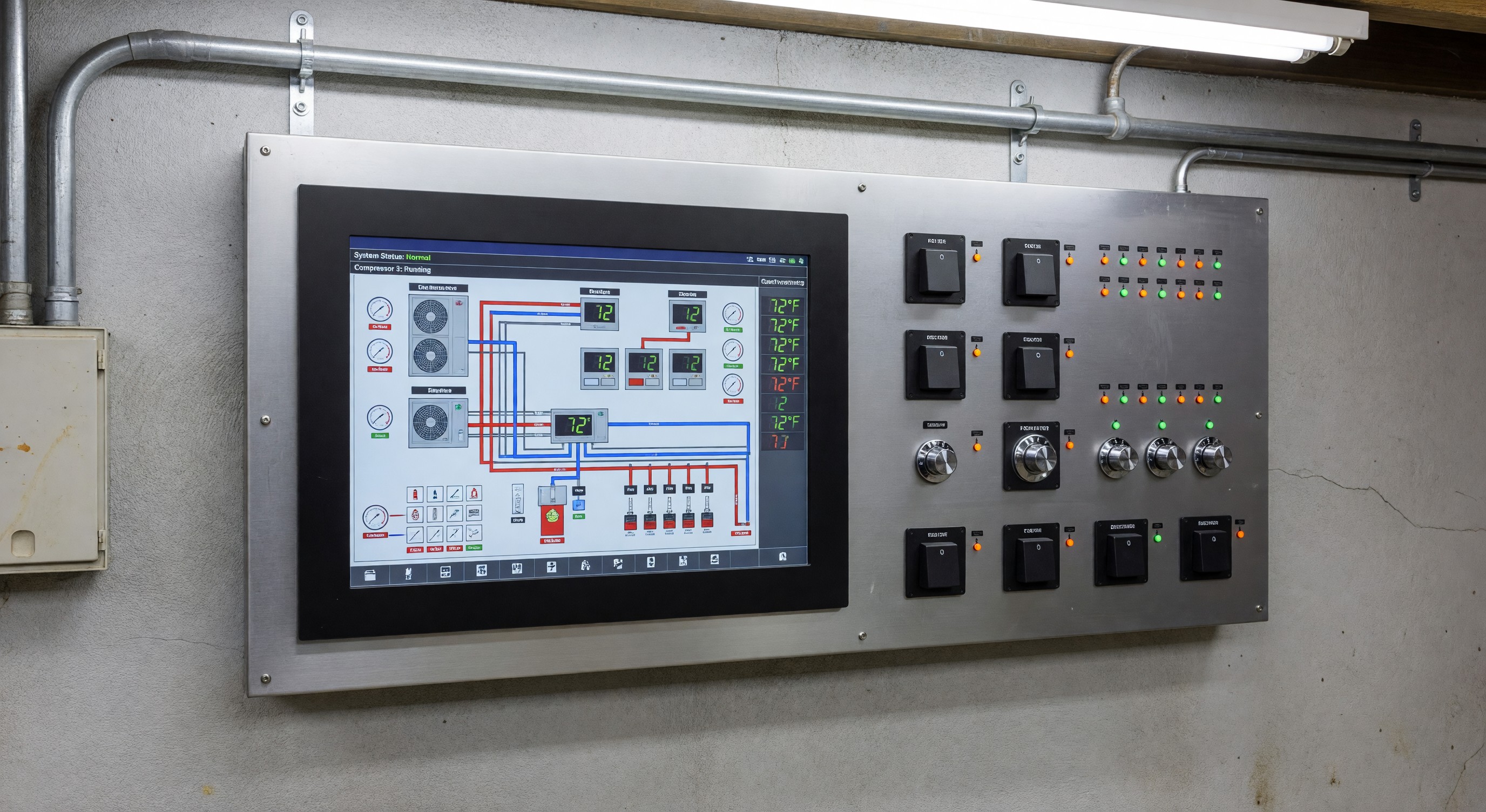
Building automation systems (BAS) integrate HVAC, lighting, and other building systems into a centralized control platform. For campgrounds with multiple facilities, a BAS provides capabilities that standalone thermostats can’t match:
Centralized visibility and control: All HVAC units across all facilities visible in a single dashboard. Set schedules, adjust setpoints, and review performance from one interface.
Demand coordination: When demand peaks approach the threshold that would trigger a demand charge, a BAS can automatically adjust setpoints across multiple facilities simultaneously — raising cooling setpoints 2°F in the bathhouse, laundry, and camp store at the same time — for significant load reduction.
Occupancy-based control: Integration with reservation systems or occupancy sensors allows HVAC to adjust automatically based on whether cabins or facilities are actually occupied. An unoccupied cabin can run at setback temperature; an occupied cabin adjusts to comfort setpoints.
Fault detection and diagnostics: BAS platforms monitor HVAC equipment performance and flag anomalies — a unit running longer than expected to achieve setpoint, a refrigerant issue indicated by abnormal temperature differentials, a fan motor drawing more power than normal. Early warning of equipment problems allows scheduled maintenance rather than emergency repair.
Equipment-Level Monitoring
Beyond controlling HVAC, monitoring the performance of individual units provides operational insight that supports better maintenance decisions.
Runtime tracking: How many hours per day is each unit running? A unit that runs 20 hours per day to maintain temperature is either sized too small or losing efficiency. Tracking runtime trends over time reveals gradual efficiency degradation before it becomes a failure.
Temperature differential monitoring: HVAC efficiency can be assessed by measuring the temperature difference between supply air and return air. A shrinking differential on a cooling system often indicates low refrigerant, dirty coils, or failing compressor performance.
Refrigerant pressure monitoring: Smart HVAC units with refrigerant pressure monitoring can detect low refrigerant conditions — which reduce efficiency and can damage compressors — before they become critical failures.
Filter maintenance tracking: Clogged air filters are among the most common causes of HVAC inefficiency and early equipment failure. Pressure differential sensors across filter banks automatically detect when filters are loaded and need replacement, rather than relying on calendar-based replacement schedules that may not match actual conditions.
Ventilation and Indoor Air Quality
Bathhouse ventilation deserves specific attention. In enclosed shower rooms, inadequate ventilation creates:
- High relative humidity leading to mold and mildew growth
- Condensation on cold surfaces and structural components
- Unpleasant odors
- Reduced comfort for guests
Demand-controlled ventilation (DCV) adjusts exhaust and supply fan speeds based on actual occupancy, measured by CO2 sensors, motion detectors, or integration with shower stall sensors. High occupancy periods get high ventilation rates; low occupancy periods get reduced fan speeds, saving fan motor energy while maintaining acceptable air quality.
CO2 monitoring in enclosed facilities provides a real-time proxy for occupancy and ventilation effectiveness. Elevated CO2 levels indicate insufficient air exchange; monitoring CO2 alongside temperature and humidity gives a complete picture of indoor air quality.
Integration with Energy Management
HVAC monitoring and energy management platforms are natural partners. When your energy management platform detects that your campground is approaching a demand threshold, it can signal the HVAC control system to shed load. When solar production is at peak output, the HVAC system can take advantage of clean, cheap energy for pre-cooling or pre-heating thermal mass.
Modern HVAC control systems increasingly support open communication protocols (BACnet, Modbus, OpenADR) that allow integration with third-party energy management platforms. Verifying protocol compatibility before purchasing HVAC equipment ensures you can integrate it into a broader energy management system as your infrastructure evolves.
ROI Expectations
HVAC control investments deliver returns through several mechanisms:
- Energy savings from schedule optimization: 15–30% reduction in HVAC energy consumption is typical when moving from basic thermostats to properly programmed controls
- Demand charge reduction: HVAC coordination during demand events can reduce peak demand by 5–15%
- Extended equipment life: Early fault detection and proper maintenance timing can extend major equipment life by 2–5 years
- Staff time reduction: Remote monitoring and control reduces the need for facility walkthroughs to check equipment status
For a mid-sized campground spending $20,000–$40,000 per year on HVAC energy, achieving 20% savings while extending equipment replacement cycles represents significant financial value against a building automation investment of $15,000–$40,000 — suggesting payback in 3–5 years.
Frequently Asked Questions
Can I retrofit building automation to existing HVAC equipment? Yes, in most cases. Many BAS solutions work with existing HVAC units by adding network-connected controllers that interface with the unit’s existing wiring. You don’t necessarily need new HVAC equipment to implement centralized monitoring and control. An HVAC controls specialist can assess your existing equipment’s compatibility.
What’s the difference between a building automation system and a smart thermostat system? Smart thermostats (like Ecobee or Nest commercial versions) provide remote access and basic scheduling for individual zones. Building automation systems integrate multiple facilities, provide equipment-level monitoring, support more complex control logic, and typically connect to broader energy management platforms. For a campground with more than 3–4 separate climate-controlled buildings, a BAS typically provides better ROI.
How do I handle HVAC in cabins rented nightly? Smart thermostats with remote access and guest-specific access codes (or PIN codes that reset between guests) allow operators to set baseline setpoints and allow guests to adjust within a comfortable range. This prevents guests from setting extreme temperatures that stress equipment and drive up costs. Some campground management systems integrate directly with smart thermostat platforms for automatic setpoint management tied to reservation check-in and checkout.
Is HVAC monitoring worth it for a campground with only one or two bathhouses? At smaller scale, full BAS investment may not pencil out. Smart thermostats with remote access, basic programmable scheduling, and regular manual monitoring provide most of the benefit at a fraction of the cost. The BAS investment case strengthens as facility count, HVAC system size, and energy costs increase.
Further Reading from Authoritative Sources
- Department of Energy HVAC efficiency and smart thermostat resources — The Department of Energy publishes HVAC efficiency guidance and building automation resources for commercial facilities, providing the technical context for the energy savings claims and smart thermostat recommendations in this article.
- EPA ENERGY STAR certified HVAC equipment and building controls — The EPA’s ENERGY STAR program certifies HVAC equipment and building control systems for commercial applications, providing the performance standards and efficiency ratings relevant to campground facility HVAC investment decisions.