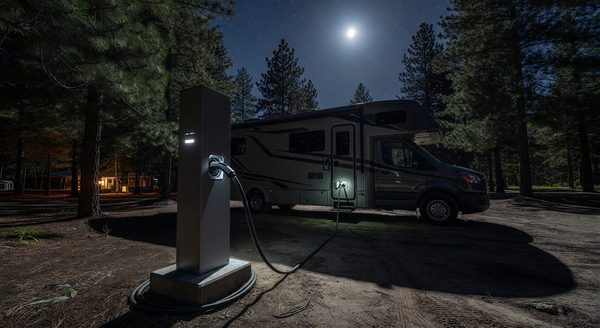
Electric vehicle adoption is accelerating, and campground operators are confronting the infrastructure implications earlier than many expected. What started as a niche amenity request has become a competitive differentiator — and in some markets, a reservation decision factor for a meaningful percentage of guests.
The challenge is that EV charging isn’t simply an amenity like a swimming pool or dog park. It’s an electrical infrastructure investment with implications for your utility costs, your electrical system capacity, and your billing model. Treating it as a utility rather than an amenity — planning it like you’d plan an upgrade to your electrical distribution system — leads to better outcomes.
Understanding the Demand Landscape
The electrical demand from RV shore power and EV charging are fundamentally different. A typical RV on 50-amp service draws 8–12 kWh overnight. An EV on a Level 2 charger (7.2 kW–11.5 kW) adds another 7–23 kWh depending on how depleted the battery is at arrival and how long the vehicle charges.
As more guests arrive in electric tow vehicles, hybrid RVs, and fully electric campervans, the electrical draw per site increases. A campground that sized its electrical infrastructure based on historical RV shore power patterns may find that infrastructure inadequate as EV use increases — particularly if multiple EVs charge simultaneously.
Key demand scenarios to model:
- Current peak demand on your worst weekend
- Projected demand if 10%, 25%, and 50% of guests have EVs charging overnight
- Demand concentration risk if EVs predominantly charge during the same time window (typically 10pm–6am)
This modeling — best done with an electrical engineer or energy consultant — determines whether your existing service entrance and distribution infrastructure can accommodate growing EV demand or whether upgrades are required before adding dedicated EV charging.
Equipment Options for Campground EV Charging
Level 2 EVSE at RV sites: Installing a Level 2 charging outlet (NEMA 14-50 or J1772 connector) at existing RV sites gives guests access to standard EV charging from their existing shore power hookup. Many electric tow vehicle drivers carry a portable EVSE that connects to a 50-amp RV outlet. Some operators add a dedicated J1772 EVSE on a separate circuit at each site for cleaner integration.
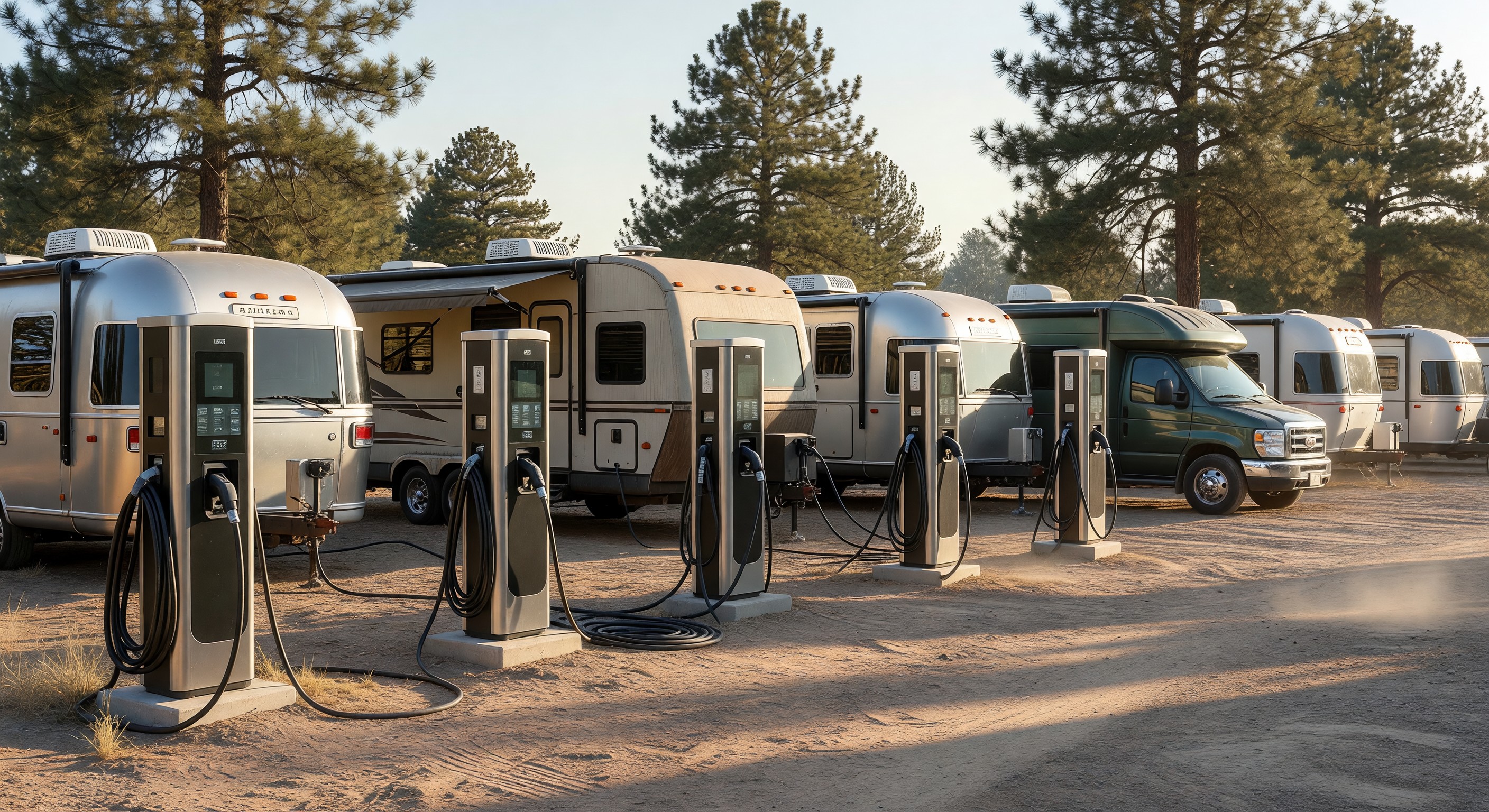
Dedicated EV charging stations: Purpose-built EV charging stations, typically with J1772 connectors (compatible with all non-Tesla EVs with an adapter) or NACS connectors (Tesla-native, now being adopted by other manufacturers), provide a more professional installation. These stations typically include access control, usage tracking, and integrated billing.
DC Fast Charging: DC fast chargers (50–350 kW) provide significantly faster charging than Level 2 equipment but come with substantial cost: $25,000–$150,000 per charger for equipment alone, plus high installation cost and significant electrical infrastructure requirements. For most campgrounds, DC fast charging makes sense only for a small number of designated “fast charging” spots near the entrance, not throughout the site inventory.
The NACS Connector Transition
Through 2023, the campground EV charging market navigated a significant connector transition. Tesla vehicles used a proprietary connector (now called NACS, or North American Charging Standard) while all other EVs used the J1772/CCS standard. In 2023, major automakers began announcing adoption of NACS, and the Society of Automotive Engineers moved to standardize it.
For campground operators planning EV charging installations:
- J1772/CCS charging equipment installed before the transition remains compatible with non-Tesla EVs using their existing connectors and Tesla vehicles with an adapter (now widely available and commonly included with Tesla vehicles)
- New equipment installations may increasingly offer NACS as an option
- Some equipment supports dual connectors or swappable connector heads
- The transition creates complexity but not an installation crisis — existing equipment isn’t immediately obsolete
For most campground operators, the safest approach for new installations through 2024-2025 is J1772 Level 2 equipment with high-quality NACS adapters available at the office, or dual-connector equipment where available.
Electrical Infrastructure Planning
The electrical infrastructure requirements for campground EV charging depend on your site count, the charging level offered, and how many EVs might charge simultaneously.
Starting with a service capacity assessment: Your electrical utility can tell you your current service entrance capacity and the cost to increase it. Utility service upgrades are often the most expensive and time-consuming part of campground electrification — lead times of 6–18 months are common, and costs can range from $10,000 to over $100,000 depending on distance from the utility’s distribution infrastructure.
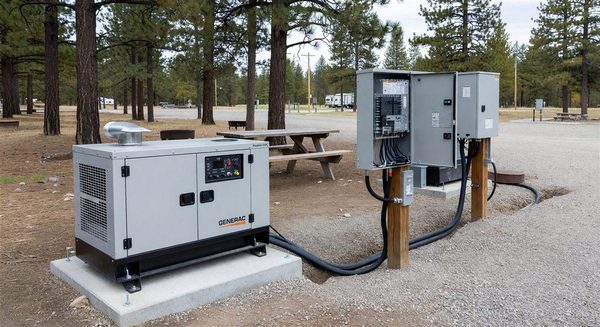
Distribution infrastructure: Beyond the service entrance, you need adequate transformer capacity, distribution panel capacity, and feeder conductor sizing to deliver power to EV charging locations. An electrical engineer’s single-line diagram of your existing system is the starting point.
Managed charging to defer infrastructure costs: Load management — automatically regulating charge rates across all EVs to stay within your available capacity — can significantly defer or even eliminate the need for service upgrades. A managed charging system can serve more EVs from the same electrical infrastructure by spreading charging over more hours and preventing simultaneous peak demand.
Billing for EV Charging
EV charging billing at campgrounds follows two main models:
Included in site rate: Some operators include reasonable EV charging in the site rate rather than billing separately. This approach is simpler to administer and avoids guest friction, but it means electricity costs increase as EV adoption grows. Best suited for operations where electricity is already a small percentage of operating costs or where EV use remains a small minority.
Separate EV charging fees: Metered billing per kWh is increasingly standard, particularly for dedicated EV charging stations. Rates typically run $0.30–$0.60/kWh, reflecting electricity cost plus convenience premium. Smart charging equipment tracks consumption by session, integrates with payment processing, and can interface with your reservation management system.
Per-session flat fees (e.g., $10–$15/night for unlimited charging) are a simpler alternative to per-kWh billing but can create equity issues if one guest uses 80 kWh and another uses 10 kWh under the same flat fee.
Working with Utility Programs and Incentives
Many electric utilities have programs specifically supporting commercial EV charging installation:
- Make-ready programs that bring electrical capacity to the meter point at no cost or reduced cost
- Rebates on charging equipment purchase
- Special EV charging rate schedules with lower overnight rates
- Technical assistance with load analysis and infrastructure planning
The landscape varies significantly by utility and changes frequently as programs are updated or exhausted. Contact your utility’s commercial accounts team to understand what programs are available before finalizing your EV charging investment plan.
Federal incentives under the Infrastructure Investment and Jobs Act and Inflation Reduction Act have provided funding for EV charging infrastructure in various forms, including the Alternative Fuel Vehicle Refueling Property Credit (30C) which covers commercial charging equipment.
Frequently Asked Questions
How many EV charging spots should I install? A reasonable starting point is 5–10% of your total site inventory as dedicated EV charging spots, with all RV sites upgraded to 50-amp service to accommodate portable EVSEs. As adoption grows, you can add dedicated charging equipment. The key is ensuring your electrical infrastructure can support future expansion without a complete service upgrade.
Should I add EV charging to existing 30-amp sites? Most EVs require a 240V circuit for practical Level 2 charging. Existing 30-amp/120V outlets provide very slow charging (approximately 1 kW, or 3–5 miles of range per hour). Upgrading to 50-amp/240V service at existing sites provides the foundation for meaningful EV charging. If you’re planning pedestal replacements, 50-amp should be the minimum standard for new installations.
What’s the liability situation if a guest’s EV malfunctions while charging? Consult your insurance provider and legal counsel on specific liability questions. Generally, providing standard electrical service through properly installed and maintained equipment places responsibility for EV charging equipment (the EVSE and the vehicle’s charging system) on the equipment manufacturers and vehicle manufacturer. Documented regular maintenance of your electrical infrastructure is important protection.
Can solar power campground EV charging? Solar can offset a portion of EV charging electricity costs, but the math requires careful analysis. A single Level 2 charger at full capacity (7.2 kW) needs substantial solar to fully offset — roughly 20–24 solar panels running at peak output. The more realistic framing is that solar reduces your overall grid electricity consumption across all uses, and EV charging benefits from that reduction proportionally.
Further Reading from Authoritative Sources
- DOE EV charging infrastructure standards and Alternative Fuel Vehicle Refueling Property Credit — The U.S.
- SAE J1772 and NACS EV charging connector standards — Wikipedia’s SAE J1772 article provides authoritative technical background on the EV charging connector standards — J1772, CCS, and the NACS transition — that determine equipment compatibility decisions for campground EV charging installations.