Energy is typically the largest controllable operating expense at a campground. Electrical costs for running bathhouses, laundry facilities, lighting, office buildings, and infrastructure can easily reach $30,000–$80,000 or more per year at a mid-sized park. Yet most operators have limited visibility into exactly where that energy is going or what’s driving month-to-month fluctuations.
Energy management platforms have matured significantly, bringing capabilities once reserved for industrial facilities into a package appropriate for campground operators. Understanding what these systems can do — and where they fit in your operation — helps you evaluate whether the investment makes sense.
What an Energy Management Platform Does
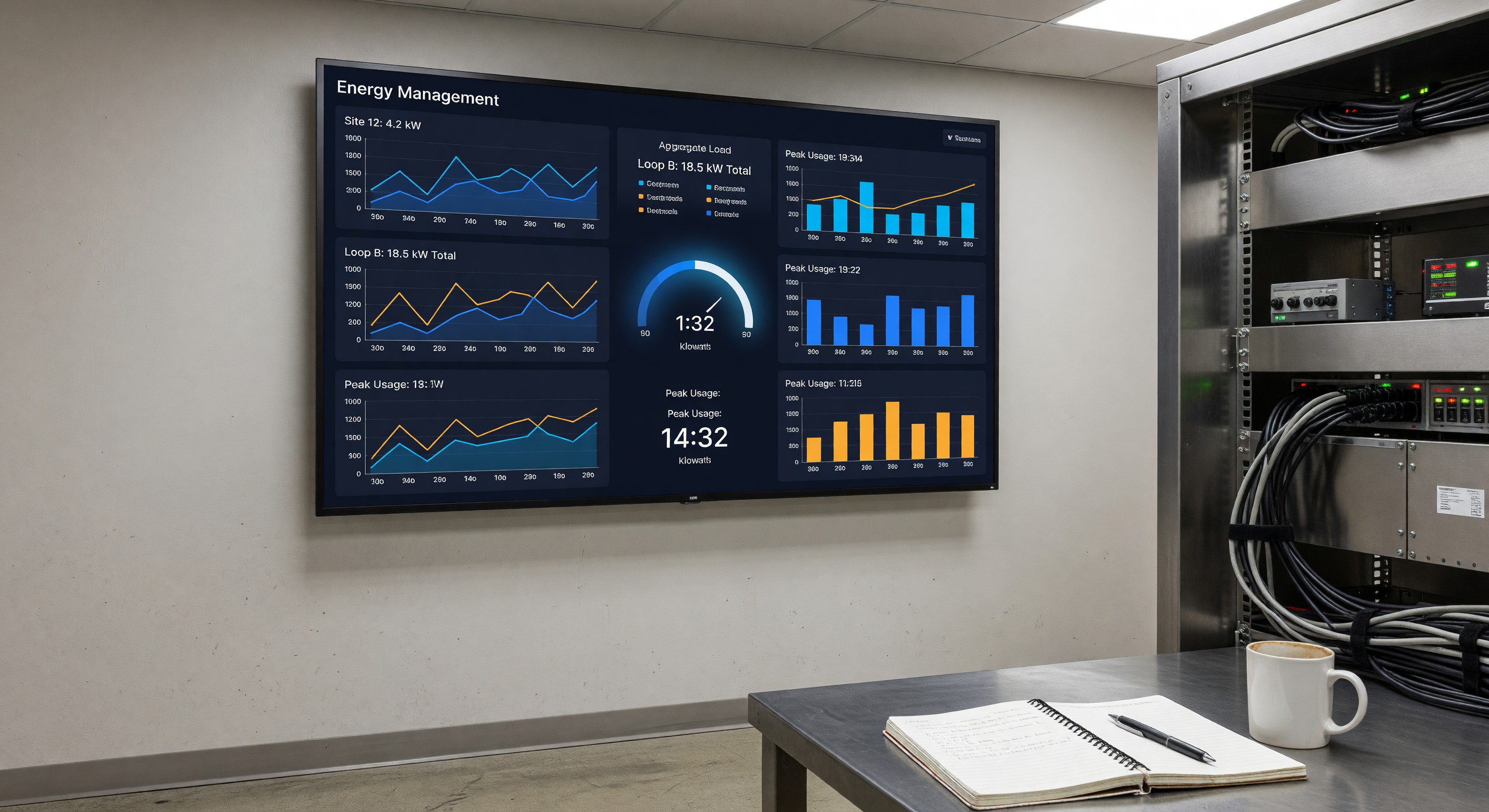
At its core, an energy management platform collects electrical consumption data from meters across your property, aggregates it into a central dashboard, and provides tools for analysis and optimization. The most capable platforms also include controls that can automatically adjust loads based on pricing signals or preset demand limits.
The key capabilities to look for:
Real-time monitoring: Current power consumption visible by facility, circuit, or individual device depending on your meter granularity. Not just end-of-month totals — live data updated every few minutes or in some cases every few seconds.
Historical analysis: Trend data showing how consumption changes over time, across seasons, and in response to occupancy levels. The ability to compare this month to last month and last year’s equivalent period.
Anomaly detection: Automated alerts when consumption spikes unexpectedly, which often indicates equipment malfunction, HVAC issues, or leaks in heated water systems.
Demand management: Tools for tracking and controlling peak demand, which drives a significant portion of commercial electric bills through demand charges.
Reporting: Exportable reports for accounting, budget planning, and sustainability documentation.
Demand Charges: The Hidden Driver of Electricity Costs
Many campground operators are surprised to learn that their electric bill isn’t driven purely by kilowatt-hours consumed. Commercial and industrial electricity rates typically include a demand charge — a fee based on your peak consumption during a 15-minute or 30-minute interval within the billing period.
Demand charges can represent 30–50% of a commercial electric bill. And the way they work creates a painful dynamic: a single hour of unusually high consumption can inflate your demand charge for the entire month, even if your average consumption is modest.
Common campground demand peaks occur when:
- Large HVAC units start up simultaneously in hot weather
- Laundry facilities, showers, and camp store all reach peak load at the same hour
- Pool heating equipment runs concurrently with other major loads
- Electric vehicle charging stations — if unmanaged — pull significant power simultaneously
Energy management platforms with demand control can monitor power consumption in real-time and shed or delay non-critical loads when the system detects a potential peak. EV charging is an excellent candidate for demand management — a brief delay or charge rate reduction during a demand event has minimal impact on guests while potentially avoiding a demand charge spike.
Site-Level Metering and Billing
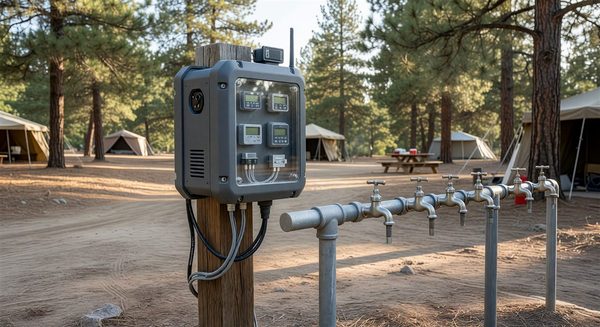
Beyond monitoring your facility’s overall consumption, energy management platforms integrate with site-level smart meters to track electrical use by individual sites. This capability is essential for campgrounds that bill guests for electricity based on actual usage rather than including power in the site rate.
Platforms in this space connect with smart pedestal meters, read consumption data automatically, and generate per-site billing that can flow into your reservation management system. Guests receive an accurate accounting of what they used rather than a flat charge or no charge at all — an arrangement that tends to reduce overall consumption because guests have direct financial incentive to manage their RV’s power draw.
Site-level metering data also reveals usage patterns across your inventory. If certain site types or locations consistently generate higher electrical use, that’s valuable information for pricing decisions and capacity planning.
Integrating Renewable Sources
Campgrounds with solar arrays face additional complexity: understanding not just what you’re consuming but what you’re generating, storing in battery systems, and feeding back to the grid or neighboring loads.
Energy management platforms designed for campgrounds with renewables track:
- Real-time solar generation output
- Battery state of charge and charging/discharging rates
- Grid import and export
- Self-consumption percentage (how much of your solar generation you’re using on-site vs. exporting)
This data is essential for understanding the actual financial performance of a solar investment and for optimizing battery dispatch strategies. Should the battery be discharged to cover morning demand before solar comes online? Or held in reserve as backup for an evening demand peak? Platforms with machine learning capabilities can optimize these decisions automatically based on weather forecasts, historical patterns, and utility rate structures.
HVAC and Equipment Monitoring
Energy management at a campground extends beyond the electrical main meter. HVAC systems in bathhouses, offices, and rental accommodations often account for the majority of electricity consumption and are among the most maintenance-intensive equipment on the property.
Equipment-level monitoring — tracking runtime hours, energy consumption, and temperature differential across HVAC units — provides early warning of efficiency degradation. An air conditioner that’s consuming 20% more power than it should while delivering less cooling than expected is heading toward a compressor failure. Catching that through data rather than a breakdown mid-summer is significantly less expensive.
Some energy management platforms extend their monitoring to non-electrical systems: gas consumption, water heating, and pool heating equipment. A comprehensive view of all energy inputs — electrical, gas, propane — gives operators a complete picture of operational energy costs.
Reporting for Sustainability Documentation
Environmental sustainability has become an increasingly important part of campground positioning. Operators seeking green certifications, looking to attract eco-conscious guests, or managing properties with sustainability commitments need accurate energy data to document their performance.
Energy management platforms generate the underlying data needed for:
- Calculating carbon footprint from electricity and fossil fuel consumption
- Tracking year-over-year improvement in energy intensity (consumption per occupied site-night)
- Documenting renewable energy generation and self-consumption
- Supporting third-party certification programs that require verified consumption reporting
Even without a formal certification goal, having organized energy data makes it much easier to respond to guest questions about your environmental practices and to tell a credible sustainability story.
Choosing a Platform
The energy management platform market spans from simple monitoring dashboards tied to specific meter hardware to sophisticated integrated systems that handle metering, billing, demand control, and renewable integration in one package.
Key selection criteria for campgrounds:
- Compatibility with your existing or planned meter hardware — some platforms are hardware-agnostic, others require their own equipment
- Integration with your reservation management system for seamless guest billing
- Demand management capabilities if you’re on a rate with demand charges
- Renewable integration if you have or plan solar
- Scalability as your property grows or adds sites
Pricing typically follows a software-as-a-service model with monthly fees based on meter count, with hardware costs for meters and monitoring equipment on top. Expect total first-year costs in the range of $5,000–$20,000 depending on property size and capability level.
Frequently Asked Questions
Do I need an energy management platform if I’m already using smart meters? Smart meters provide the raw data; an energy management platform gives you the tools to understand and act on that data. Many campgrounds start with basic meter data accessed through their utility’s portal and find that the limited analysis tools leave questions unanswered. If your electrical bill is a significant operating expense and you have multiple facilities to monitor, dedicated energy management software usually pays for itself.
How difficult is the installation process? Complexity varies considerably. Cloud-connected current transformer (CT) meters can often be installed at electrical panels without interrupting power and typically take 1–2 hours per panel. Full site-level pedestal meter upgrades require panel work at each site and more significant installation time. Most vendors have installation partners who can scope the project accurately.
Can energy management platforms reduce my electric bill immediately? Demand management features can reduce demand charges relatively quickly once configured. Behavioral changes driven by better visibility — adjusting equipment schedules, identifying and fixing inefficient equipment — typically show results within a billing cycle or two. Total bill reduction of 10–20% is commonly reported in the first year by campgrounds actively using platform data to make operational changes.
Will guests notice if their EV charging is throttled for demand management? Most EV charging demand management works by reducing charge rates during brief demand events (15–30 minutes) rather than stopping charging entirely. A reduction from 32 amps to 16 amps during a demand peak adds a small amount of time to the total charge cycle — typically imperceptible to guests unless they’re specifically watching their charging rate. Communicating demand management policies transparently in your EV charging terms helps prevent misunderstandings.
Further Reading from Authoritative Sources
- Department of Energy commercial energy management guidance — The Department of Energy publishes commercial facility energy management guidance and maintains the Building Energy Software Tools directory, making it the authoritative federal source for energy management system frameworks relevant to campground utility management.
- EPA ENERGY STAR commercial energy benchmarking tools — The EPA’s ENERGY STAR program provides commercial energy benchmarking tools and resources for documenting energy performance improvements, relevant to campground operators using energy management platforms to track and report their efficiency gains.