Electrical service at RV campground sites is one of the largest variable operating costs that most parks don’t track at the site level. The electricity flowing through your pedestals to guest RVs is metered and billed by your utility company at the property level — but most parks have no visibility into how much each site is consuming, or how to identify the guests or sites driving high consumption.
Understanding electrical metering fundamentals is the starting point for better electrical management.
How Campground Electrical Service Works
The typical campground electrical distribution path:
- Utility connection at the property boundary (the meter that your utility company bills you against)
- Main distribution panel at a central location on the property
- Sub-distribution panels (sometimes called distribution boxes) serving sections or loops of sites
- Site pedestals providing the actual outlet connections for RV hookups
Most campgrounds have a single utility meter at the property boundary. All the electricity consumed by all sites, all facilities, and all buildings runs through that meter, and you pay the total.
Without additional metering at the sub-panel or pedestal level, you have no way to know:
- Which sites or loops are consuming the most electricity
- Whether consumption has changed over time
- What share of your total bill comes from RV hookup sites vs. facilities
Why Sub-Metering Matters
Cost allocation: For campgrounds that include electricity in the site rate (flat rate, all-inclusive pricing), sub-metering provides data on actual consumption per site. This data is informative even without per-guest billing — it tells you whether your all-inclusive rate is accurately priced.
Fair billing for high-consumption guests: An RV with multiple large air conditioners, a residential refrigerator, multiple electronics, and a coffee maker can easily consume 50–100 kWh per day during summer. A traditional tent camper uses essentially nothing. Flat-rate pricing that doesn’t account for this variance is a subsidy from light users to heavy users.
Problem detection: A site consuming 3x its typical average may indicate a faulty appliance, a tripped breaker that’s auto-resetting, or unauthorized electrical use. Site-level metering makes these anomalies visible.
EV charging billing: As discussed in the guest experience section, EV charging requires metering to bill accurately. This is the fastest-growing driver of sub-meter adoption in the campground industry.
Sub-Metering Technology Options
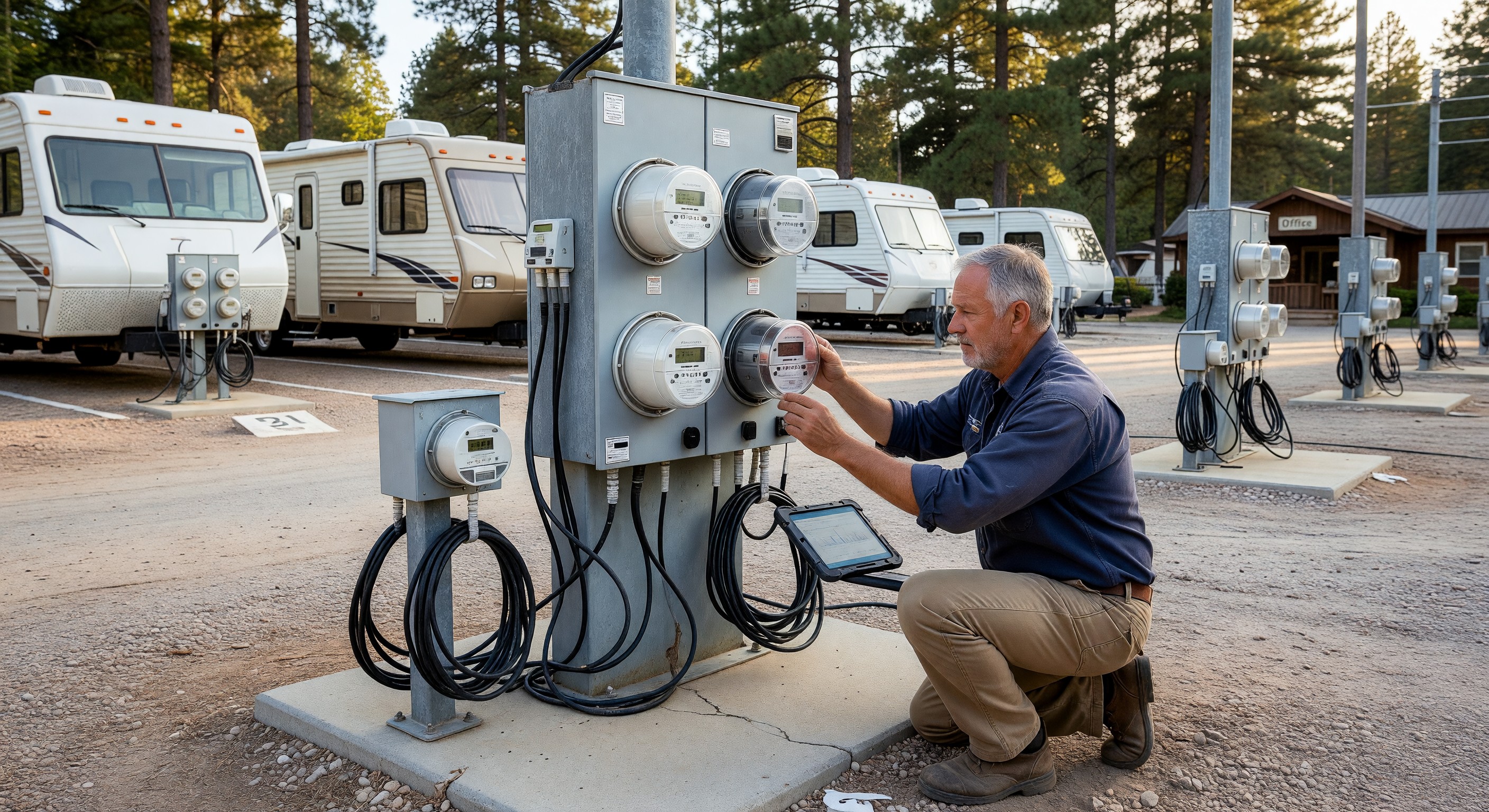
Mechanical sub-meters: Older-style mechanical electricity meters installed at each pedestal. They provide accurate consumption readings but require manual reading (a staff member physically visits each pedestal and records the meter reading). At any significant scale, manual reading is time-prohibitive.
AMR (Automatic Meter Reading) meters: Meters that transmit their readings wirelessly to a central receiver, eliminating manual reads. Readings are typically transmitted daily or on-demand. Less expensive than full smart meter systems.
AMI (Advanced Metering Infrastructure) / Smart Meters: Two-way communication meters that transmit readings in near-real-time, support remote disconnect/reconnect (useful for managing unpaid balances or checking out long-term residents), and often integrate with billing software. Higher cost per meter but the most functionality.
Pedestal-integrated metering: Some modern campground pedestal manufacturers include metering built into the pedestal unit, eliminating the need for separate meter installation.
Getting Started With Electrical Metering
For parks considering sub-metering:
Start with your highest-consumption areas — RV hookup sites, especially full-hookup sites with 50A service, benefit most from metering. Tent sites with minimal electrical access are lower priority.
Define your billing approach before installing meters — will you bill per kWh? Set a consumption threshold included in the site rate with billing above that threshold? Understand the policy before you have the data.
Verify regulatory requirements — in many jurisdictions, sub-metering of utility services requires compliance with utility commission rules. Check your state’s requirements before installing meters intended for billing purposes.
Select meters compatible with your billing/management system — meters that can’t easily export data to where you need it create manual work that defeats the purpose.
Frequently Asked Questions
Is campground electrical sub-metering required by law? Not universally. Requirements vary by state and depend on whether you’re billing guests for electrical consumption (which may require certified meters and compliance with utility commission rules) or just using metering for internal management. Consult with your state utility commission if you plan to bill based on metered usage.
What’s the cost of installing sub-meters at campground sites? Per-site metering costs vary by meter type and installation complexity. Smart meters installed at existing pedestals typically run $200–$500 per site installed, plus the cost of the data collection infrastructure. A 100-site park with 70 metered hookup sites might spend $15,000–$35,000 for a complete smart metering system.
Can I retrofit existing RV pedestals with sub-meters? Yes, in most cases. External meter sockets that mount on or near the existing pedestal are available for most pedestal types. The more complex the existing electrical configuration, the more involved the retrofit — consult with a licensed electrician familiar with RV park electrical systems.
How do I handle guests who dispute their electrical bill? Metered electrical billing disputes require meter data as evidence. Your management system should be able to produce a daily consumption report for the guest’s site during their stay. If the reading is accurate, present the data and stand by the charge. If there’s genuine reason to suspect a meter error, a re-read or meter test is the appropriate response.
Further Reading from Authoritative Sources
- DOE advanced metering infrastructure standards and smart meter technology — The U.S.
- Smart meter technology and automatic meter reading systems — Wikipedia’s smart meter article provides authoritative technical background on the metering technologies available to campground operators, explaining the differences between AMR and AMI systems that determine billing capability and operational flexibility.