Battery energy storage is transitioning from a novelty to a practical tool for campground operators. Falling lithium-ion battery costs, improving inverter technology, and increasingly sophisticated energy management software have made storage systems viable for properties ranging from small family campgrounds to large RV resorts. Understanding how these systems work and where they create value helps operators evaluate whether the economics make sense for their situation.
What Battery Storage Actually Does
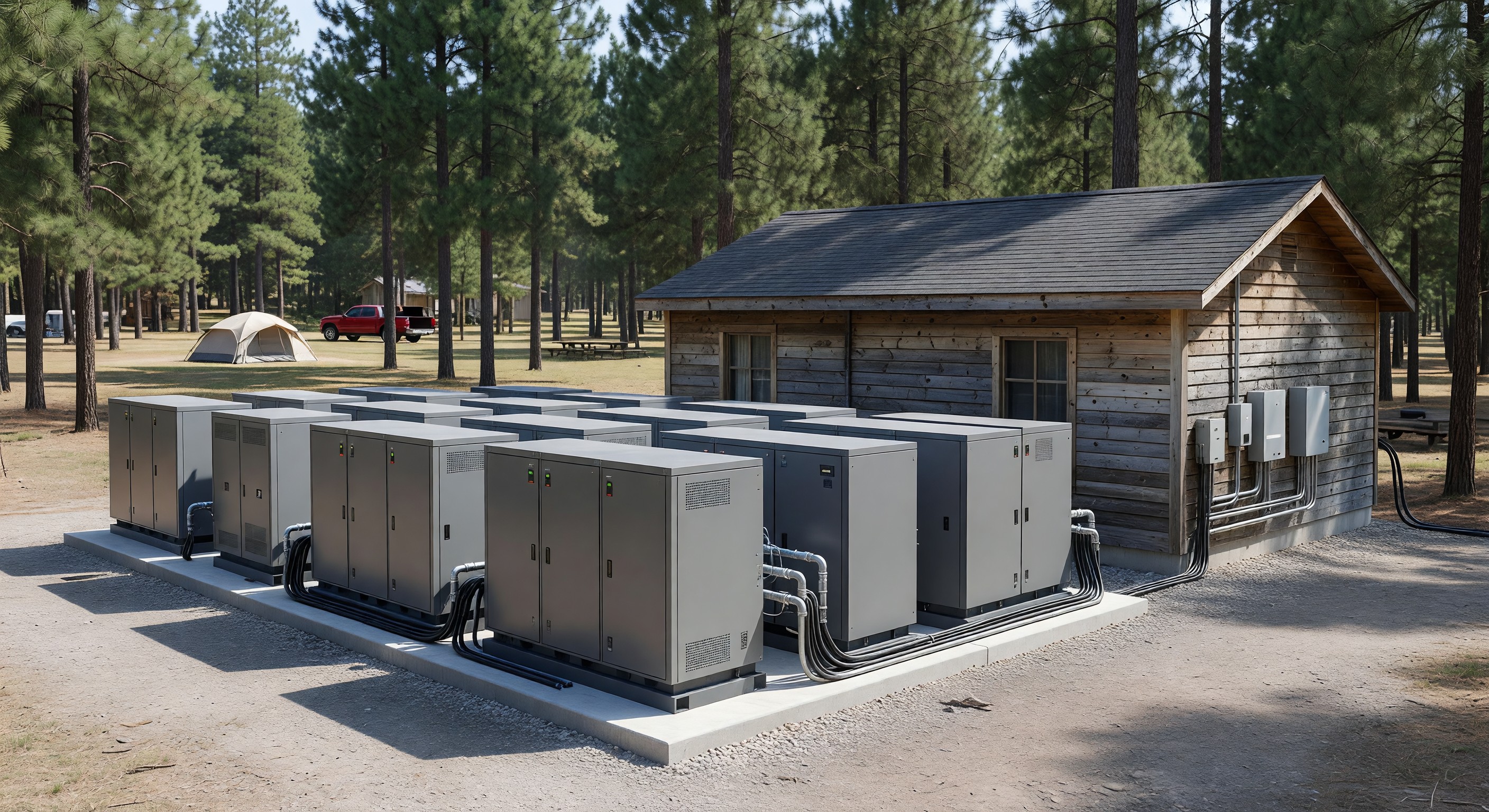
A battery energy storage system (BESS) charges from the grid or solar panels when electricity is cheap or abundant and discharges to power your facilities when electricity is expensive or unavailable. The fundamental value proposition has three distinct applications, each relevant in different circumstances:
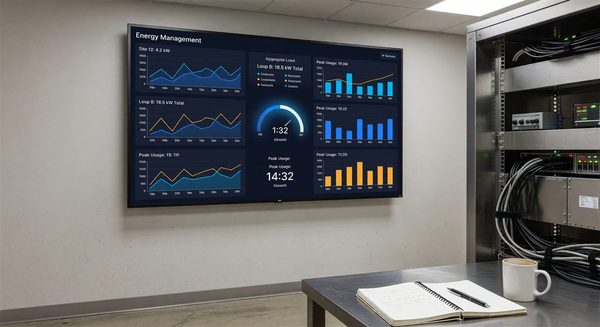
Demand charge reduction: Commercial electricity rates typically include a demand charge — a fee based on your peak power consumption in any 15-minute window during the billing period. Battery systems can monitor power consumption in real-time and discharge to prevent that consumption from exceeding a target threshold, effectively capping your demand and the associated charge.
Solar self-consumption optimization: Campgrounds with rooftop or ground-mount solar often generate more power than they can use during midday hours. Without storage, that excess goes to the grid — often at a low export rate. With storage, that excess charges the battery for use in morning and evening hours when solar generation is lower but demand is high. This increases the percentage of your total consumption covered by your own solar generation.
Backup power: Batteries can provide emergency power to critical systems during utility outages. Depending on system size and what loads are prioritized, a battery system can keep lights on, maintain gate access systems, and preserve refrigeration for hours or in some cases days.
Sizing Considerations for Campgrounds
Battery systems are sized in two dimensions: power (kilowatts, kW) and energy (kilowatt-hours, kWh). Power determines how much load the battery can support at once; energy determines how long it can sustain that output.
For demand management, the power rating matters most — you need enough power capacity to offset your peak demand events. For backup power, energy capacity matters more — enough stored energy to run critical loads for the required duration.
A mid-sized campground might have peak demand events of 50–150 kW that last 30–60 minutes. A battery system sized for demand management in this scenario would typically be in the 50–100 kW / 100–200 kWh range. Backup power applications targeting critical loads only (gates, office, minimal lighting) might be achievable with smaller systems.
Economic Analysis
The economics of battery storage depend heavily on your local utility rate structure. Demand charges vary enormously by utility and rate class — from nearly zero in some jurisdictions to $15–$25 per kW per month in others. High demand charges are the primary economic driver for commercial battery storage.
Demand charge savings calculation: If your peak demand regularly reaches 100 kW and your demand charge is $15/kW per month, you’re paying $1,500/month in demand charges — $18,000 per year. A battery system that consistently caps your demand at 70 kW reduces that charge by $9,000 annually. Against a battery system cost of $80,000–$150,000 (depending on size and installation complexity), that’s an 8–17 year simple payback from demand savings alone.
The economics improve when solar is part of the picture. Pairing storage with solar installation typically qualifies the battery system for the federal Investment Tax Credit (ITC) and potentially state-level incentives, which can significantly reduce net system cost.
Current incentive landscape (2023): The Inflation Reduction Act extended and enhanced the federal ITC for solar-plus-storage systems at 30%. Some states offer additional incentives, rebates, or utility programs specifically for demand management battery systems. The incentive landscape is evolving; consult with a qualified energy advisor for current program availability in your area.
Installation and Integration
Battery systems require installation by licensed electrical contractors and typically require utility interconnection approval. The process from purchase agreement to commissioned system commonly takes 3–6 months, including equipment lead time, permitting, and utility review.
Integration with your facility’s electrical system typically happens at the main service entrance or at a subpanel feeding critical loads. Modern battery systems include built-in inverters and energy management controllers; the integration challenge is primarily ensuring the system communicates properly with your utility meter and any on-site solar or monitoring systems.
Remote monitoring is standard on commercial battery systems. Operators can view battery state of charge, current charge/discharge rate, and cumulative performance data through a vendor app or web portal. Most systems also connect to energy management platforms (covered in a separate article), allowing battery dispatch to be coordinated with site-level consumption data and demand management algorithms.
Lithium Iron Phosphate vs. Other Chemistries
Campground operators evaluating battery storage will encounter several battery chemistries. Lithium iron phosphate (LFP) has become the dominant choice for commercial stationary storage for several reasons:
- Excellent cycle life — 3,000–6,000 cycles at 80% depth of discharge
- Stable thermal characteristics with significantly lower fire risk than other lithium chemistries
- Tolerance for partial state of charge — doesn’t require full charge/discharge cycles for longevity
- 10–15 year expected service life with moderate capacity degradation
Other lithium chemistries (NMC, NCA) offer higher energy density but with higher cost and greater thermal management requirements. Flow batteries (vanadium redox, zinc-bromine) offer extremely long cycle life and no capacity degradation but at higher cost and with more complex installation requirements. For most campground applications, LFP provides the best combination of cost, safety, and longevity.
Backup Power Planning
Not all campground systems are equally critical during a power outage. Developing a load priority hierarchy before specifying a backup battery system helps ensure the system is sized appropriately and that critical functions remain operational during the longest likely outage.
Tier 1 (critical — must maintain):
- Gate access systems and perimeter security
- Emergency lighting in bathhouses and common areas
- Office and communications systems
- Refrigeration for food storage
Tier 2 (important — maintain if capacity allows):
- Some bathhouse hot water heating
- Wi-Fi access points
- Camp store point-of-sale systems
Tier 3 (defer during outage):
- EV charging
- Pool and spa heating
- Laundry equipment
- Non-essential outdoor lighting
Automatic transfer switches can configure the system to drop Tier 3 loads immediately during an outage and Tier 2 loads as battery state of charge declines, maintaining Tier 1 loads until grid power is restored.
Frequently Asked Questions
How long can a battery system power a campground during an outage? Duration depends entirely on system size and which loads are maintained. A large-scale system (500+ kWh) maintaining only critical loads might sustain operations for 8–12 hours. Most campground battery systems are not sized for multi-day full-property backup — that scenario is better addressed by combining battery backup with a diesel or propane generator.
Do battery systems require regular maintenance? Commercial LFP battery systems require relatively minimal maintenance compared to lead-acid alternatives. Annual inspection of connections, software updates, and thermal management system checks are typically recommended. Battery vendors usually offer service contracts that include scheduled maintenance and performance monitoring.
Can I add storage to an existing solar installation? AC-coupled battery systems can be added to existing solar installations without replacing the solar inverter. DC-coupled systems are more efficient but typically require the battery and solar systems to be designed together. An energy storage installer can assess your existing solar installation and recommend the best integration approach.
What permits are required for battery storage installation? Requirements vary by jurisdiction but typically include a building permit, electrical permit, and fire department review (particularly for systems above a certain capacity threshold). Utility interconnection approval is also required. Your installation contractor should manage the permitting process, but the timeline — often 4–8 weeks — should be factored into your project schedule.
Further Reading from Authoritative Sources
- U.S. Department of Energy battery storage technology resources and commercial investment tax credit guidance — The Department of Energy’s Office of Energy Efficiency and Renewable Energy provides campground operators with technical resources on battery storage systems, including chemistry comparisons, sizing guidance, and federal incentive programs applicable to commercial installations.
- ARVC campground energy management and battery storage implementation resources — ARVC’s utility management resources for campground operators cover energy storage technology evaluation, ROI analysis frameworks, and implementation guidance specific to the outdoor hospitality sector.