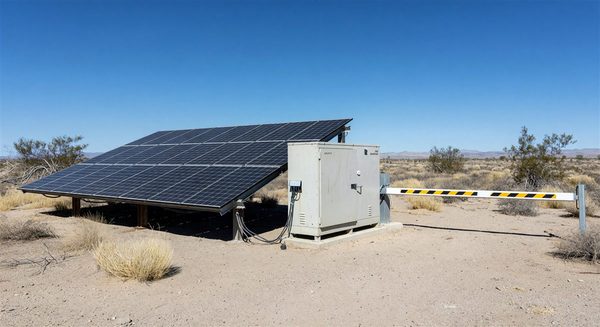
The 2026 RV coverage cycle has produced a lot of concept vehicles. AC Future’s AI-THd offers a choice of EV or diesel powertrain with more than 5 kW of roof solar. Skydream’s intelligent travel trailer promises self-hitching, towing assistance, and automatic camp leveling. A transformable AI-powered travel trailer launched at CES 2026 and remains, by the coverage’s own admission, largely a mystery.
Very few of those are going to pull into a site next season. But two things behind the headlines are already at the gate, and only one of them needs capital.
The electrical problem is real and it is arriving through the pedestal
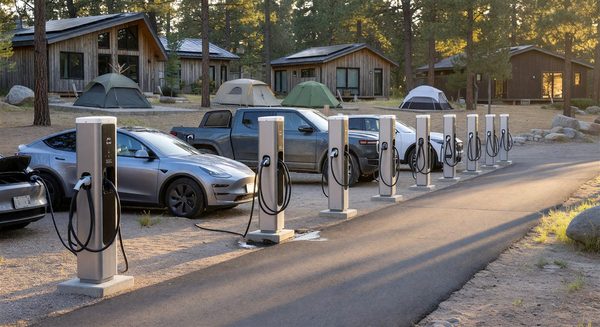
Around 45% of private campgrounds currently prohibit EV charging, against roughly 1% of public parks that publish a refusal. Among the private parks that refuse, 52% cite electrical capacity, pedestal design, or risk of damage. That is not resistance to change — it is an accurate read of what the wiring was built for.
The technical reason is a load-shape mismatch, not a headline number. An RV draws in cycles: the air conditioning kicks on, runs, and drops out. An electric vehicle draws a constant maximum load for ten hours straight. Old conductors that handle a duty-cycled load fine will run hot under a continuous one.
The code numbers make the gap explicit. A park wired to 2023 NEC compliance should have 12 kVA available per 50-amp pedestal under 551.73(A)(1), raised from the earlier 9,600 VA calculation. But the standard permits designers to apply a demand factor, and that factor assumes the 30-amp and 50-amp outlets on a pedestal are not drawing simultaneously and continuously. An EV charger plugged into the 50 is precisely the case the demand factor was never sized for. A 50-amp outlet supports a 40-amp continuous draw at the 80% rule, and most portable chargers are rated at 32 or 40 amps — right at the ceiling.
So the honest answer for most existing parks is that the pedestals cannot absorb this, and the ban that 45% have already imposed is a legitimate engineering position rather than a customer-service failure.
The three postures, and what each one costs
Parks have converged on three responses, and they differ mainly in where the capital goes.
Prohibit at the pedestal, full stop. Zero capital, and it protects the distribution system. The cost is entirely reputational, and it is rising: guests increasingly check charging policy before booking, and third-party directories now publish per-park EV policies, so the prohibition is visible whether or not the park advertises it.
Separate metered EV service at the site. Kings River RV Resort in Kingsburg, California runs a distinct metered 50-amp plug for EVs alongside the standard RV connection at every site. This is the highest-capital option and the only one that preserves charge-at-your-site convenience without gambling the pedestal. It also solves the billing question cleanly, which pedestal charging never does.
Centralised Level 2 stations, pedestal charging prohibited. A middle path that concentrates the new load on purpose-built circuits, keeps it off the campsite distribution entirely, and can be advertised as an amenity. Some parks run these free to lift occupancy; others meter them.
The decision hinges on whether the park’s service entrance and distribution have headroom at all. That is an electrician’s answer, not a vendor’s, and it should be established before any of the three is chosen.
The AI layer costs nothing but attention
The second shift needs no infrastructure. Trip planning has moved into natural-language tools — AdventureGenie’s Personal Genie takes plain-language prompts, imports trips from other apps, exports to Google Maps, and generates routes and activity suggestions. Charging-network availability is now one of the attributes those tools surface.
The operational consequence is narrow and specific: parks are increasingly being selected by software reading structured attributes, not by a human reading a nicely written description. Whether a park’s EV policy, site dimensions, hookup amperage, pet rules, and rate are published as clean, current, machine-readable fields now determines whether it appears in the shortlist a guest is handed.
That is a data-hygiene job. It costs a staff afternoon and it is almost certainly the highest-return item on this list, because a park with a defensible EV prohibition still loses bookings if its listings simply say nothing and get filtered out as unknown.
What to do before next season
Get the electrical assessment done and written down — service entrance capacity, distribution headroom, and what the demand factor actually assumed when the park was designed. That single document determines which of the three postures is even available, and it is the thing every subsequent decision depends on.
Then publish the policy plainly, whatever it is. A park that says “no charging at pedestals, Level 2 available at the office” will be chosen by planning tools over a park that says nothing at all. The prototypes at CES can wait. The load calculation cannot.