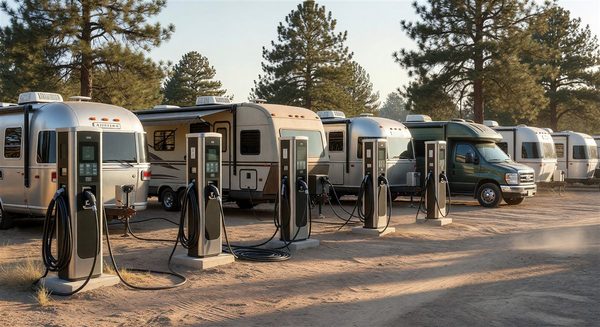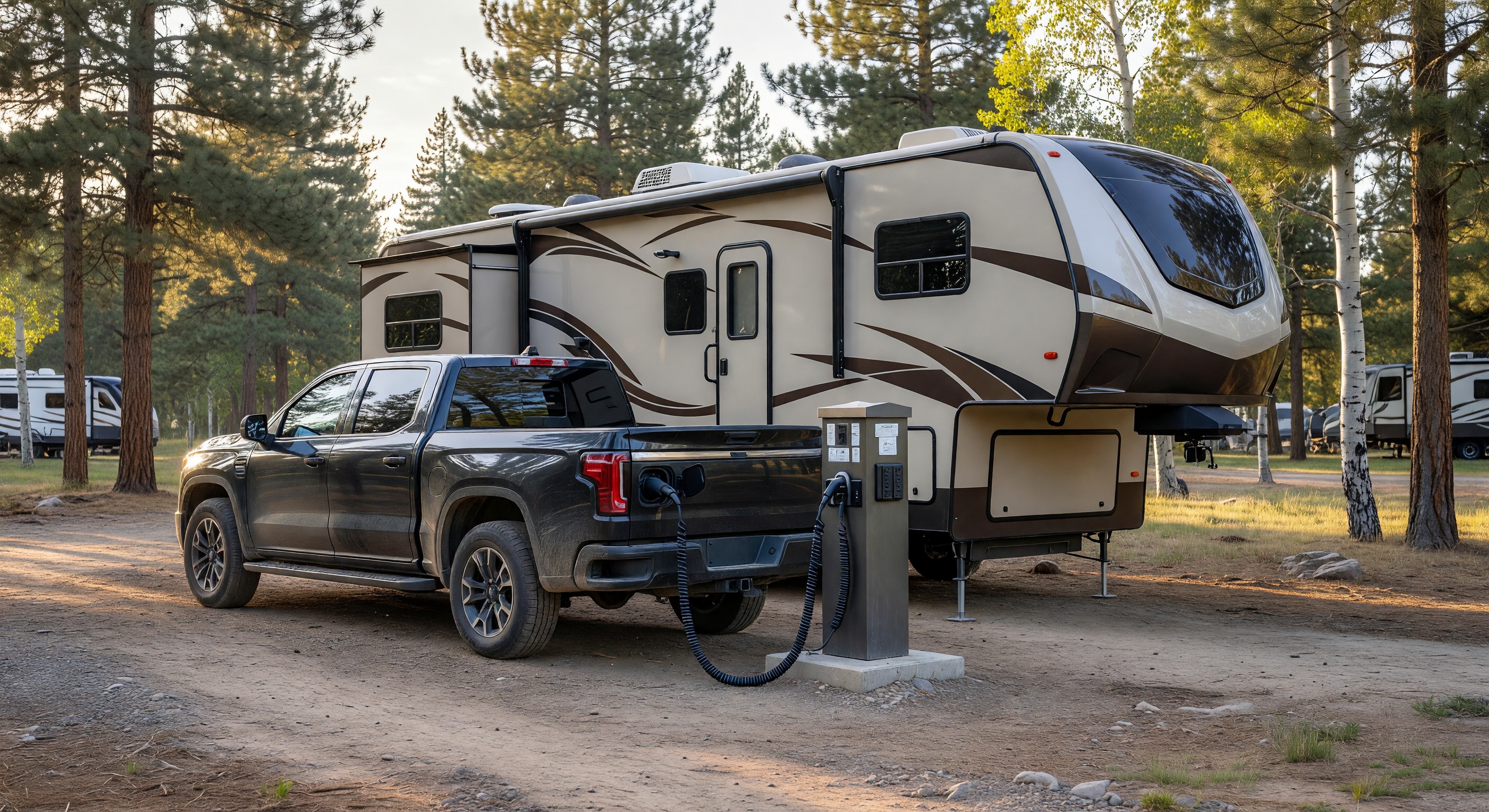
The growing population of EV campers — those towing with electric trucks or arriving in electric motorhomes — is creating new demands on campground reservation systems. These guests have needs that traditional reservation workflows weren’t designed to capture: high-amperage charging requirements, site placement relative to electrical infrastructure, and arrival logistics that differ from conventional campers.
As the EV camper segment grows through 2024 and beyond, operators who build EV-specific reservation capabilities will have a meaningful advantage in attracting and retaining this higher-spending guest segment.
What EV Campers Need That Others Don’t
High-amperage electrical access. An EV towing a heavy trailer — a Ford F-150 Lightning pulling a fifth wheel, for example — may need 50-amp service to adequately charge overnight. Not all sites with “full hookup” designation have 50-amp service. Your reservation system needs to accurately represent the electrical specifications of each site.
Reliable charge rate information. EV campers plan their itinerary around charging. They need to know not just that a site has 50-amp service but whether that means 11.5 kW of actual available charging capacity (standard for 50A/240V RV service) or something less if the park’s infrastructure is constrained.
Proximity to charging infrastructure. EV campers at parks with dedicated EV charging pedestals (as opposed to standard electrical hookups) need site assignments near that infrastructure. A reservation system that doesn’t track this spatial relationship assigns EV guests to sites where they can’t use the charging equipment they booked for.
Arrival time considerations. EV campers arriving with depleted batteries need to get to their site and plug in quickly. Long check-in queues or site assignment confusion is more costly for them than for a gasoline camper who isn’t dependent on plugging in immediately.
Updating Your Reservation System for EV Guests
The changes needed are relatively straightforward to implement in a modern PMS:
Add Electrical Specification Fields
Each site’s attribute data should include:
- Amperage: 20A, 30A, 50A
- Voltage: 120V or 240V (50A sites should be 240V to deliver true RV charging capacity)
- Dedicated EV charging pedestal: Y/N
- Maximum simultaneous charge rate (kW)
Make these fields visible to guests during site selection. EV campers will specifically filter for 50A/240V service — give them the ability to do so.
Create an EV-Optimized Site Category
Consider creating a dedicated “EV-Ready” or “High-Amperage” site category with appropriately premium pricing. This allows EV campers to search specifically for what they need and allows you to charge a rate premium for the electrical infrastructure investment.
Capture Vehicle Data at Booking
Adding a vehicle type field to your booking form helps you in two ways: it identifies EV arrivals before they get to your gate, and it allows you to proactively assign them to appropriate sites rather than handling it at check-in.
A simple dropdown — gasoline, diesel, electric, hybrid plug-in — plus a field for “charging adapter type” (J1772, NACS, CCS, CHAdeMO) gives you the information to assign appropriately.
EV-Specific Pre-Arrival Communication
Automate a pre-arrival message specifically for EV campers that includes:
- Confirmation of the electrical service type at their site
- Instructions for locating the charging pedestal
- Backup options if they arrive with insufficient range (park courtesy charge, nearest Level 2 or DC fast charger off-property)
- Check-in instructions that expedite their arrival
Pricing EV Sites
EV site pricing in 2024 remains inconsistent across the industry. Common approaches:
Flat rate premium: A set premium ($10–$20/night) for 50A/240V service or dedicated EV charging. Simple to administer.
Consumption-based electrical pricing: Guests pay for the actual electricity consumed, metered at the pedestal. This is the most equitable approach — an EV camper drawing 40 kWh overnight should pay more for electricity than a conventional camper drawing 5 kWh. It requires electrical submetering but is increasingly standard for new EV infrastructure.
Flat all-inclusive rate: Some parks set a site rate that includes unlimited electricity. This is simplest for guests but may result in underpricing for heavy EV users.
Consumption-based billing requires electrical metering hardware that integrates with your billing system — not all PMS platforms support this natively.
Demand Signals Worth Tracking
Start collecting EV-specific reservation data now, even before you’ve made major infrastructure investments:
- What percentage of your inbound inquiries mention EV charging?
- How many guests are requesting 50A sites specifically?
- What’s your current conversion rate on those requests (can you fulfill them or are you turning guests away)?
This data supports the capital investment case for additional high-amperage sites or dedicated EV charging infrastructure.
Frequently Asked Questions
Can standard RV hookups charge electric vehicles? A standard 50A/240V RV hookup provides adequate overnight charging for most EV applications — it’s essentially the same as a Level 2 home charging circuit. A 30A/240V hookup charges more slowly. 20A/120V (standard household) outlets provide very slow charging — typically insufficient for EV tow vehicles overnight.
How do I handle EV campers who use more electricity than expected? Without electrical submetering, you can’t accurately charge for excess consumption. If you’re seeing very high electrical bills attributable to EV charging, consumption-based metering is the right long-term answer. In the near term, a per-night electrical surcharge for EV vehicles disclosed at booking is a workable interim approach.
Should I invest in DC fast charging at my campground? DC fast charging (Level 3) is expensive to install ($50,000–$150,000+ per station) and is better suited to highway corridors than overnight stays, where Level 2 is adequate. Most campground operators should focus on robust Level 2 infrastructure rather than DC fast charging.
Will EV camper demand be significant enough to justify infrastructure investment? EV penetration in light trucks — the primary tow vehicles — is growing rapidly. By 2026, every major truck manufacturer will offer an EV option. Operators in markets with high EV adoption (California, Pacific Northwest, Northeast) should be planning infrastructure now. Others have a 2–3 year runway but should be watching the demand signals.
Further Reading from Authoritative Sources
- Department of Energy EV charging infrastructure guidance — The Department of Energy publishes EV charging infrastructure standards, connector type guidance, and charging level definitions (Level 1, Level 2, DC fast charging) that campground operators need to accurately describe their EV charging capabilities to guests.
- RV Industry Association EV and electrification standards — RVIA tracks RV electrification trends and publishes electrical standards for RV shore power connections, making it the appropriate authority for the vehicle-side electrical standards (50-amp service requirements, outlet types) relevant to EV camper reservation planning.