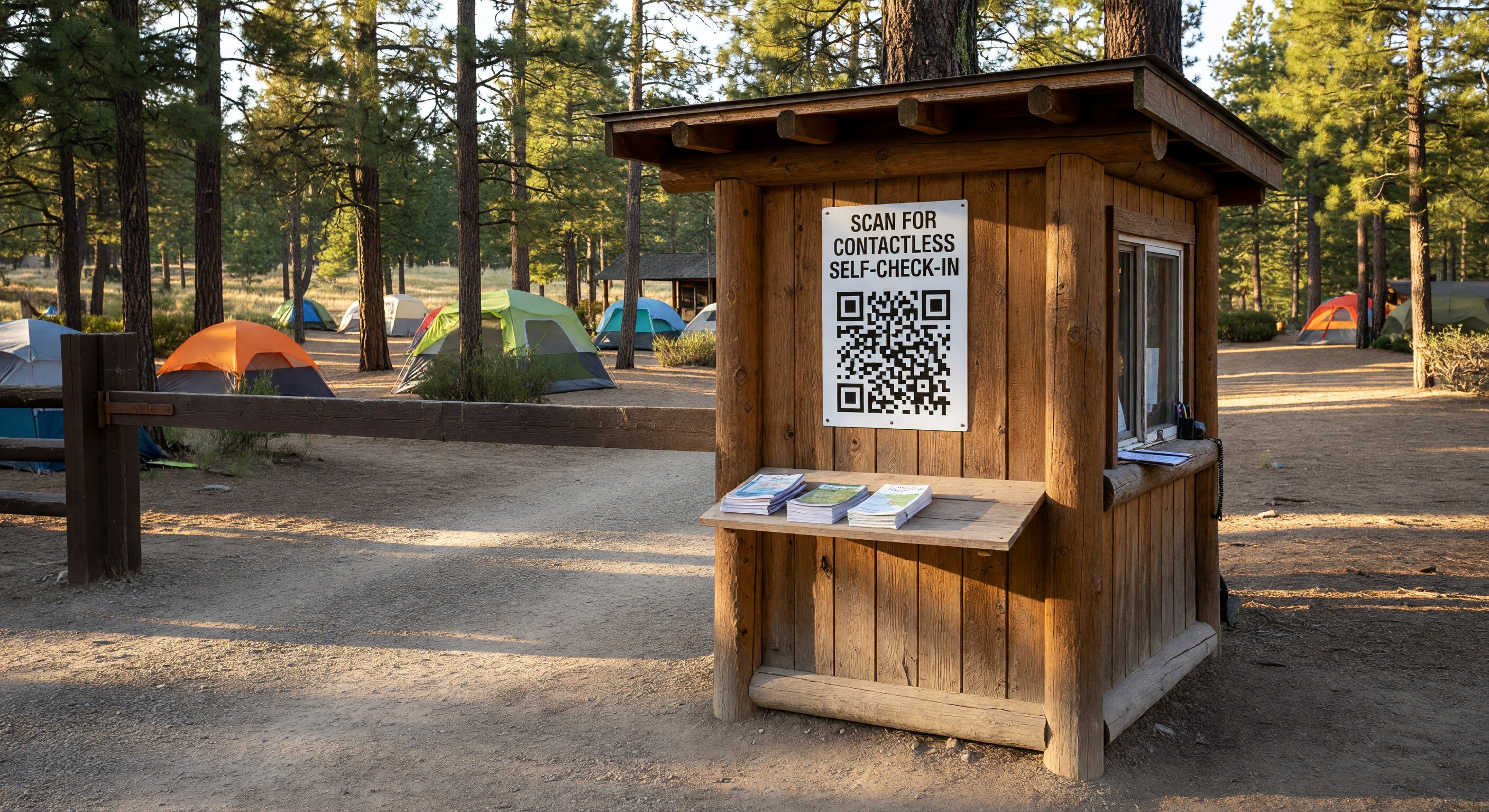
The pandemic accelerated a shift that was already beginning in the campground industry: the move toward contactless arrival experiences. When face-to-face interactions at check-in desks became a liability, many parks scrambled to implement alternatives. What emerged from that period is a set of practices that a significant portion of guests now actively prefer — even as health restrictions have eased.
For campground operators evaluating their arrival workflows in 2021, contactless check-in is worth understanding not just as a COVID response, but as a genuine improvement to the guest experience.
What Contactless Check-In Means in Practice
A fully contactless arrival workflow typically involves:
- Pre-arrival communication — The guest receives an email or text before arrival with their site assignment, directions to the site, gate access code or RFID credential, and park rules.
- Self-guided site location — The guest arrives and drives directly to their assigned site without stopping at a front desk.
- Access control integration — If the park has a gated entry, the guest uses a code, RFID card, or license plate recognition to enter without staff interaction.
- Digital registration — Required registration paperwork (emergency contact, vehicle information, pet acknowledgment) is completed via a form linked in the pre-arrival email.
- On-property support — A phone number or text line gives the guest a way to reach staff if they have questions, without requiring in-person interaction.
Not every park needs to implement all of these elements. Even moving just the registration form and site assignment communication to a digital pre-arrival process reduces desk congestion and improves efficiency.
Technology Requirements
The core technology needed for contactless check-in:
Reservation management system with guest communication tools. You need to be able to send automated, personalized emails or texts that include site-specific information. Most modern campground management platforms support this, but the quality of the communication templates and the level of automation varies.
Digital registration form. A simple web-based form — Google Forms works, as do dedicated campground registration tools — captures the information you need without requiring physical paperwork. Responses should feed into your management system or a spreadsheet you can reference.
Gate access credentials delivery. If you have a gated entry, your access control system needs to support issuing unique codes per reservation. Permanent codes for all guests undermine the security and monitoring value of your gate system.
Clearly marked site numbering. This is the most frequently overlooked element. If guests are navigating to their site without staff assistance, your site numbers need to be large, consistent, and visible from the driving lane. New arrivals in an unfamiliar park should be able to find Site 47 without circling twice.
Common Implementation Challenges
Capturing vehicle information before arrival. Many parks need vehicle license plate or make/model for site allocation and emergency purposes. Getting this before arrival requires either collecting it at booking or via a pre-arrival form — both of which are workable but require process changes.
Handling late arrivals. Contactless workflows work best when they’re the default. When a guest arrives after the office closes, contactless systems shine. But parks that were previously handling late arrivals through a physical key lockbox or paper envelope system will need to think through how digital credentials reach guests who arrive late.
Staff habits and guest support. Some staff find it hard to transition away from a desk-based arrival process. And some guests — particularly older travelers — may need more hand-holding than a purely digital workflow provides. Building in a clear fallback (call this number) is important.
Guest Reception
Surveys from 2020 and 2021 consistently showed that guests were more receptive to contactless check-in than many operators expected. A significant minority actively preferred it — the ability to arrive at any hour, go straight to their site, and skip a queue was appealing even outside the pandemic context.
Negative reactions were most common among guests who encountered technical problems (gate codes that didn’t work, site numbers they couldn’t find) or who felt the lack of a human welcome gave the park a cold feel. The latter concern is addressable: a well-written welcome text or email can be warm and personal even if it’s automated.
Hybrid Approaches
Purely contactless and purely traditional check-in aren’t the only options. Many parks now offer contactless as the default with a staffed desk available as an alternative:
- Guests who booked online and completed digital registration go straight to their site.
- Walk-in guests and those who prefer desk interaction come to the office.
- Late arrivals and guests with issues call or text a staff-monitored line.
This hybrid model reduces desk congestion during peak arrival windows without abandoning the human element entirely.
Frequently Asked Questions
Does contactless check-in work for walk-in guests? It’s more complex. Contactless workflows are easiest with advance reservations where site assignment and credentials can be prepared before arrival. Walk-in guests can be served contactlessly using a self-service kiosk at the entrance, though this adds hardware cost and complexity.
How do I handle guests who don’t check their email or miss the pre-arrival message? Send the pre-arrival communication at least 24 hours before arrival and include a phone number they can call if they didn’t receive it. A secondary SMS reminder the morning of arrival catches guests who check texts more reliably than email.
What if a guest arrives at a site that’s already occupied? This is a process failure, usually stemming from a housekeeping or site readiness issue. Contactless check-in workflows should include a site readiness confirmation step — staff verify a site is clean and clear before releasing the guest’s credentials.
Can small parks with just 20-30 sites benefit from contactless check-in? Absolutely. The setup effort scales with your complexity, not your size. A small park can implement a simple version — pre-arrival email with directions and a gate code — with minimal technology and meaningful operational benefit.
Further Reading from Authoritative Sources
- ARVC campground contactless check-in and digital arrival technology resources — ARVC tracks campground technology adoption trends including contactless check-in implementation, publishing guidance on the operational practices and technology requirements that make contactless arrival workflows function reliably.
- QR code technology for campground contactless check-in applications — Wikipedia’s QR code article provides authoritative technical background on the QR code technology that underpins many campground contactless check-in implementations, supporting operators evaluating kiosk or pre-arrival digital credential delivery options.