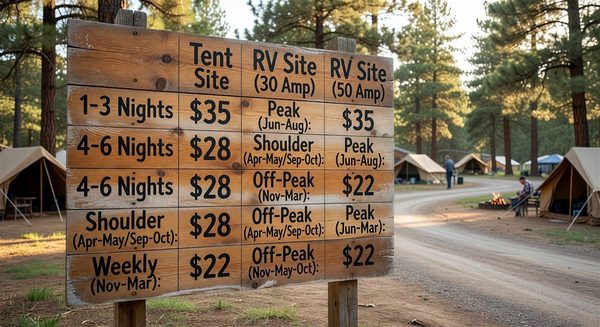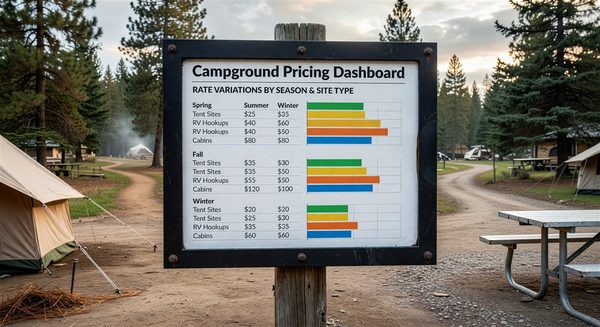
Revenue management — the practice of optimizing revenue from a fixed inventory over time — is well-established in hotels, airlines, and rental car companies. In outdoor hospitality, it’s arrived more recently, driven by the combination of modern reservation software and a post-pandemic market where demand volatility has made intuitive pricing less adequate.
Understanding the core concepts of revenue management gives campground operators a framework for making better decisions about pricing, inventory, and distribution.
The Three Key Metrics
Before discussing strategies, establish the metrics you’ll track:
Occupancy Rate: The percentage of your available site-nights that are sold. If you have 100 sites and operated 90 nights this quarter, your theoretical capacity is 9,000 site-nights. If you sold 7,200, your occupancy rate is 80%.
Average Daily Rate (ADR): Total site revenue divided by the number of site-nights sold. If you collected $216,000 on 7,200 sold site-nights, your ADR is $30.
Revenue Per Available Site (RevPAS): ADR multiplied by occupancy rate. Using the example above: $30 × 80% = $24 RevPAS. This is your most important metric because it captures both how much you’re charging and how often you’re filling. A park with 100% occupancy at $20 ADR has the same RevPAS as one with 50% occupancy at $40 ADR.
Track these metrics by site type, by period, and year-over-year. The trends matter as much as the absolute numbers.
The Revenue Management Decision Framework
Every pricing and inventory decision in a campground can be evaluated through the lens of its likely RevPAS impact:
Should I lower rates to fill low-occupancy periods? Only if the demand is genuinely elastic — if guests would actually book at a lower rate who wouldn’t book at your current rate. If low occupancy reflects simply low demand (not price resistance), lowering rates may hurt RevPAS by reducing revenue on the guests who would have booked anyway.
Should I raise rates during high-demand periods? If occupancy is consistently hitting 95%+ at current rates, you’re almost certainly leaving money on the table. Test rate increases in increments and measure whether occupancy holds.
Should I impose minimum stays? Minimum stays protect your ability to sell weekend blocks rather than having one-night gaps that are hard to fill. They improve RevPAS by increasing average stay length and reducing rebooking overhead. The trade-off is losing some short-stay bookings. The math usually favors minimum stays when occupancy on adjacent dates is strong.
Segmenting Your Inventory
Not all sites are equal, and managing them as if they are undervalues your premium inventory. Segment your inventory at least by:
Site type: Tent-only, partial hookup, full hookup, pull-through, premium, cabin, glamping. Each segment has its own supply and demand dynamics.
Site quality: Within each type, some sites are clearly better — shadier, more private, closer to facilities, better views. These premium sites command higher rates and often sell first. Make sure your pricing reflects this.
Time dimension: The same site on July 4th weekend versus a Tuesday in September is different inventory. Your pricing calendar should reflect the value difference.
Managing each segment separately — setting rates, minimum stays, and cancellation policies at the segment level — allows you to maximize RevPAS across your property rather than applying one-size-fits-all rules.
Distribution Strategy as Revenue Management
Where you sell your sites matters for RevPAS:
Direct bookings are more profitable — no OTA commission. Every percentage point you shift from OTA to direct improves your margin without requiring any change in occupancy or rate.
OTA inventory allocation should be strategic. Allocate to OTAs the inventory that’s hardest to sell through direct channels: last-minute availability, shoulder season dates, non-premium site types. Reserve peak holiday weekends for direct bookings when possible — you’ll fill them anyway, so there’s no need to pay OTA commissions.
Last-minute discount channels can fill cancellation inventory without announcing a public rate reduction. Flash deal promotions, targeted email to a waitlist, and OTA last-minute promotions all serve this purpose.
Building a Revenue Management Calendar
Rather than evaluating pricing reactively, build a proactive calendar:
- Pre-season (60–90 days out): Review year-over-year pace. If bookings are running ahead of last year, consider holding or raising rates. If behind, diagnose — is it a demand issue or a visibility issue?
- Mid-season: Weekly occupancy review. Identify dates tracking to below 70% and take proactive action.
- Post-season: Full season review. Calculate RevPAS by site type and period. Identify where you outperformed and underperformed your targets.
Frequently Asked Questions
Is revenue management only for large parks? The principles apply at any size. A 30-site park can meaningfully benefit from occupancy-aware pricing and better minimum stay rules. Sophisticated software tools are more necessary at larger scale.
How do I know if low occupancy is a pricing problem or a marketing problem? Price-test it. Lower your rate for a specific slow period and see if bookings increase. If they do, it was a pricing problem. If bookings don’t increase at a lower rate, the issue is awareness or demand, not price — and discounting just reduces revenue without increasing occupancy.
What software tools support campground revenue management? Several campground-specific tools have emerged for yield management. Some are built into PMS platforms; others are standalone products that connect via API. Evaluate on the quality of their pricing logic, the transparency of their recommendations, and how much manual control you retain.
Can I apply revenue management to non-site revenue (camp store, activities)? Absolutely, though the mechanics differ. Camp store revenue management involves inventory control and margin management rather than rate optimization. Activity scheduling and pricing can follow similar demand-based logic — premium pricing for peak Saturday morning kayak tours, lower pricing for weekday afternoon slots.
Further Reading from Authoritative Sources
- ARVC campground yield management and revenue optimization resources — ARVC is the primary campground industry trade association that tracks revenue management adoption and provides education on yield management concepts adapted specifically for the outdoor hospitality sector.
- Revenue management principles and yield optimization fundamentals — Wikipedia’s revenue management article provides authoritative background on the yield management discipline that campground operators are adapting, supporting readers who need foundational context on how the hotel and airline revenue management principles described in the article were originally developed.