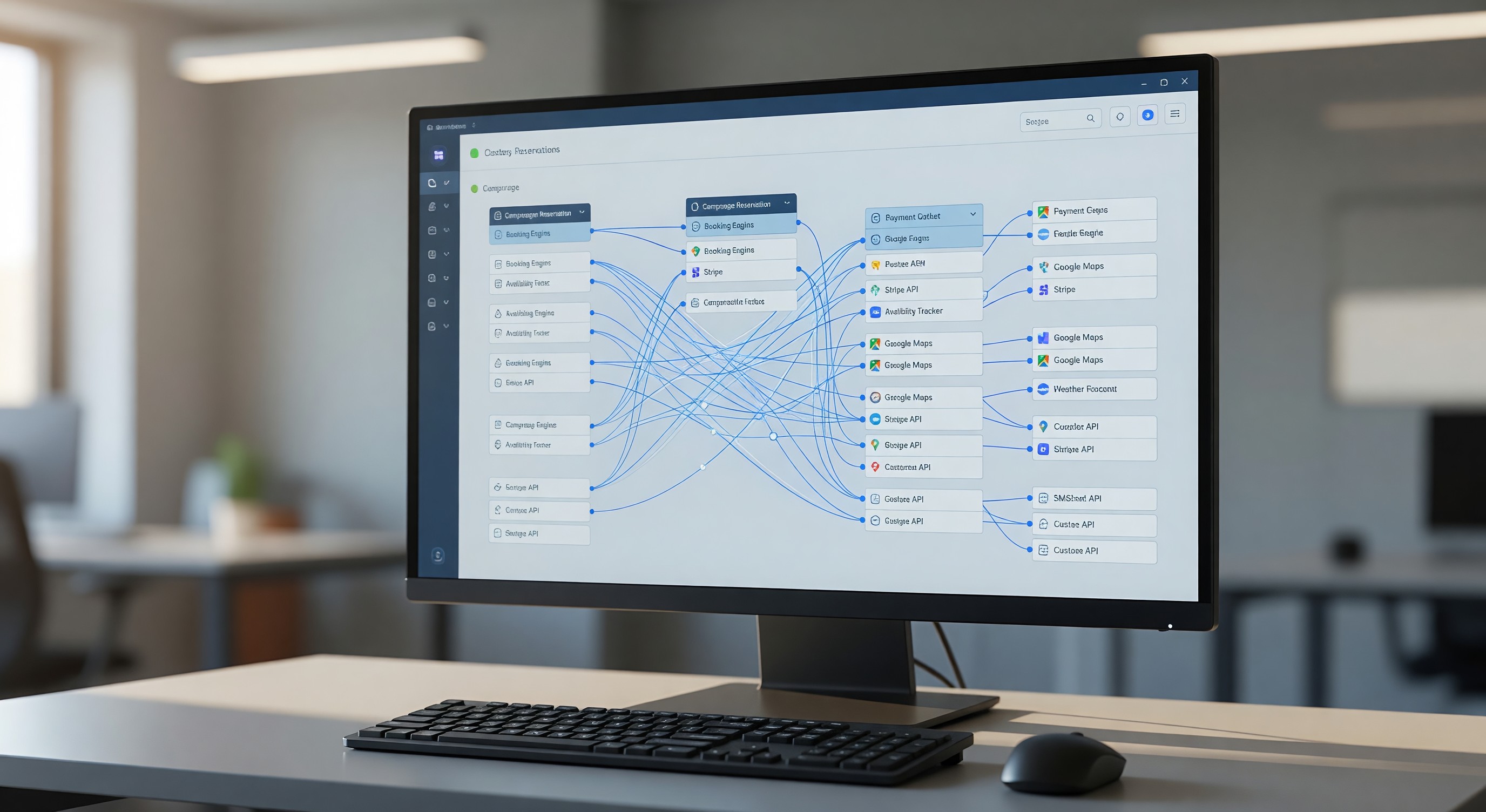
For most campground operators, the reservation platform is a point-and-click tool — a web interface where you manage bookings, update rates, and run reports. What’s less visible is the API layer beneath many modern platforms: a set of programmatic interfaces that allow other software systems to communicate with your reservation data in real time.
API integrations are what enable two-way channel management, CRM data syncing, custom reporting dashboards, and automated workflows that would otherwise require manual data entry. As the campground tech stack matures, API capability is becoming an important factor in platform evaluation.
What an API Actually Is
An API (Application Programming Interface) is a defined set of rules for how software systems communicate. When your reservation platform has an open API, it means other software can:
- Read data from your reservation system (availability, booking details, guest records)
- Write data to your reservation system (create bookings, update rates, cancel reservations)
- Trigger actions in real time when events occur (send a notification when a booking is made)
In practical terms, this enables building custom connections between your reservation system and other tools you use — without waiting for your PMS vendor to build a native integration.
Common API Use Cases in Campground Operations
OTA channel management: Channel managers use your PMS API to read availability and write incoming bookings from OTAs. This is the most common and mature API use case in the campground space.
CRM integration: Syncing guest reservation data to a CRM system (HubSpot, Salesforce, or a simpler tool) allows marketing teams to segment and communicate based on reservation history without manual data exports.
Custom reporting and business intelligence: Pulling reservation data into a BI tool (Google Looker Studio, Tableau, Microsoft Power BI) enables custom dashboards that go beyond what your PMS reports natively support.
Accounting integration: Syncing booking revenue to accounting software (QuickBooks, Xero) in real time eliminates manual reconciliation between reservation and accounting systems.
Custom guest apps: A park with a branded mobile app can use the PMS API to provide guests with reservation information, site maps, and park information through a custom interface.
Loyalty program management: A loyalty platform can use the API to track stay counts and trigger benefits based on actual reservation data, rather than requiring manual tracking.
What to Look for in API Documentation
When evaluating a PMS platform’s API capability, quality indicators include:
Comprehensive documentation: A well-documented API has clear descriptions of every endpoint, what data it returns, and example requests and responses. Poor documentation signals an immature or poorly maintained API.
RESTful architecture: REST APIs are the modern standard — they’re stateless, use standard HTTP methods, and are broadly compatible with common development tools.
Real-time webhooks: The ability to push data to your systems the moment an event occurs (rather than requiring periodic polling) is important for time-sensitive use cases like channel management.
Rate limits and stability: A usable API has reasonable rate limits (how many requests you can make per minute) and a documented version history with backward compatibility commitments.
Developer support: A responsive vendor support channel for API developers is worth asking about during evaluation.
Working With Developers
Unless you or your team have development capability, API integrations require working with a developer. Options:
Freelance developers familiar with REST APIs and the specific platforms you’re connecting can build custom integrations for one-time project costs. Platforms like Upwork make it straightforward to find developers with relevant experience.
Campground-adjacent software vendors often have pre-built integrations with common PMS platforms. Before commissioning custom development, check whether a vendor you want to connect to already has a connector to your PMS.
No-code integration platforms like Zapier and Make (formerly Integromat) can connect some campground platforms to other tools without custom code. The capability is more limited than direct API integration but requires no development resources.
Frequently Asked Questions
Do all campground reservation platforms have APIs? No. Many legacy platforms and some smaller vendors don’t expose public APIs. This is an increasing differentiator as the industry matures — open API access is a meaningful advantage for platforms that offer it.
Can I use the API to build a custom booking interface for guests? Technically yes, if the API supports all the needed operations (availability checking, reservation creation, payment). However, building a fully functional guest booking interface from scratch requires significant development investment. This makes sense for large chains building custom branded experiences; for most parks, the platform’s native booking widget is the right tool.
Will API access cost extra? Often yes. Some platforms gate API access to premium tiers. Others include it at standard pricing but charge for higher rate limits or advanced features. Clarify API pricing before committing to a platform you plan to build integrations around.
How do I know if the integrations I want are worth the investment? Calculate the time saved on manual processes that the integration would replace. If a channel management integration prevents one double-booking per month (which might cost $500+ in guest compensation and staff time), it pays for itself quickly. If a CRM sync saves two hours per week of manual data entry at $25/hour, it’s $2,600/year in recovered staff time.
Further Reading from Authoritative Sources
- ARVC campground technology integration standards — ARVC provides technology integration guidance for campground operators and maintains a vendor marketplace where PMS platforms and their integration capabilities are documented, making it the most relevant trade authority for campground API integration decisions.
- Application programming interface overview and hospitality technology integration — Wikipedia’s API article provides the authoritative technical definition and background on API architecture that campground operators need to understand before evaluating PMS integration capabilities with confidence.