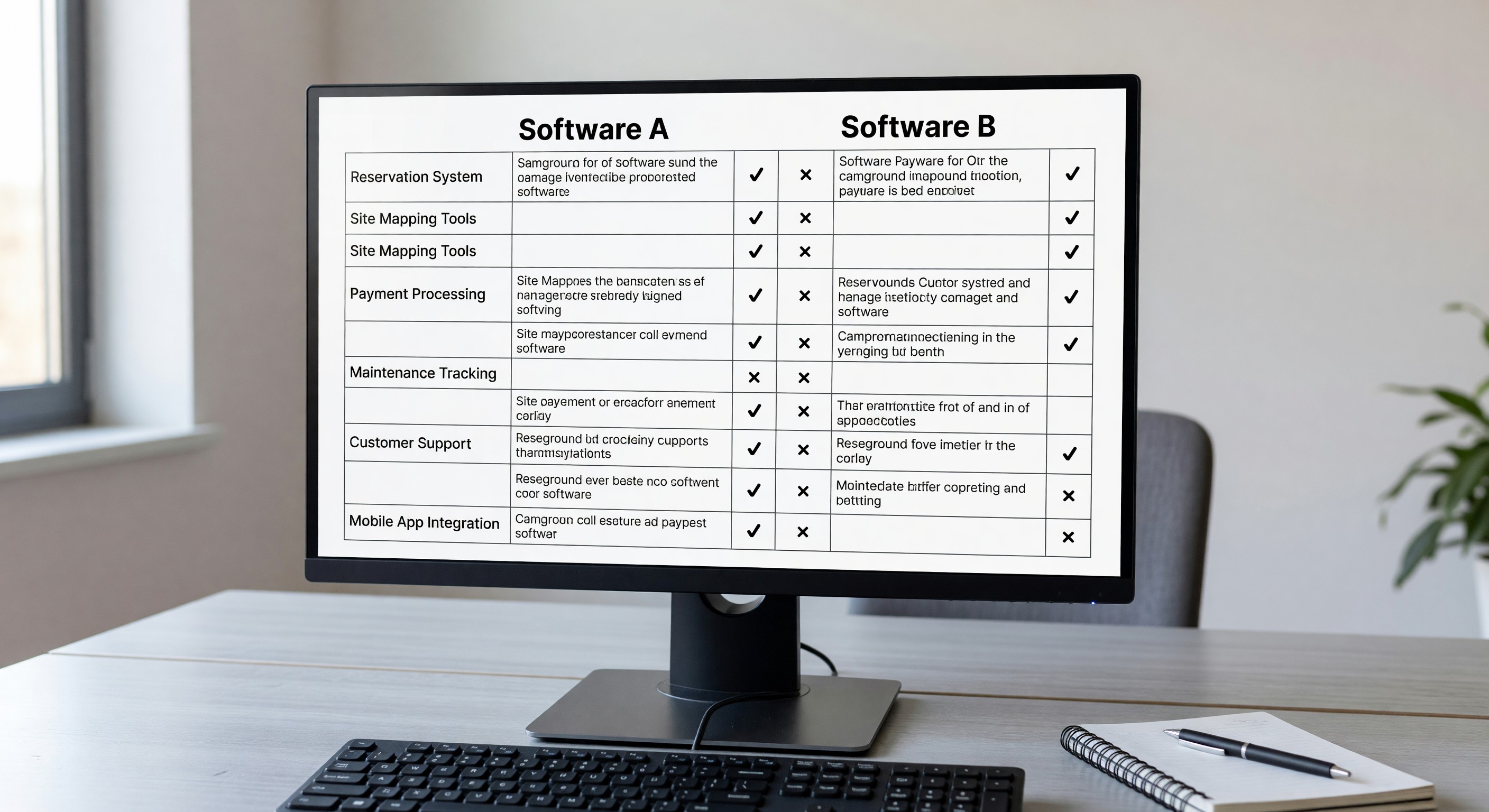
The campground property management system (PMS) market looks very different in 2022 than it did five years ago. Several new entrants have matured into full-featured platforms, legacy systems have modernized their interfaces, and the post-pandemic boom has pushed operators to demand more from their software.
This guide doesn’t name platforms specifically — the landscape changes too quickly for any specific ranking to stay current. Instead, it provides a framework for evaluating what actually matters when you’re comparing PMS options for your park.
The Six Dimensions of PMS Evaluation
1. Reservation and Inventory Management
This is the core function. Evaluate:
- Does the system support all your site types (tent, hookup, pull-through, cabin, glamping)?
- Can you configure pricing rules by site type, season, day of week, length of stay, and number of guests?
- Does the availability calendar update in real time across all channels?
- Can you block sites for maintenance with a click?
- Does the system handle multi-site reservations (a large group booking several adjacent sites)?
2. Guest-Facing Experience
The guest’s experience with your system affects conversion and satisfaction:
- Is the booking widget mobile-responsive and genuinely easy to use on a phone?
- Does it support photos and descriptions at the site level?
- Can guests select specific sites or only site types?
- Does the system send professional, customizable confirmation and pre-arrival emails?
- Is there a guest portal for managing reservations, adding nights, or requesting changes?
3. Reporting and Analytics
You can’t manage what you can’t measure:
- What built-in reports are included? Look for occupancy by site type, revenue by period, arrival/departure manifests, and cancellation rate tracking.
- Can you export reports to CSV or Excel?
- Does the platform offer year-over-year comparisons?
- Is there a mobile-accessible dashboard for checking key metrics when you’re not at a desk?
4. Integrations
Modern parks run on interconnected systems:
- Which OTAs and booking channels does the platform connect to natively?
- Is there an API for building custom integrations?
- Does the platform integrate with point-of-sale systems for camp store sales?
- Can it connect to accounting software (QuickBooks, Xero)?
- Does it support payment processors beyond the platform’s default, or are you locked in?
5. Pricing and Total Cost
Total cost is almost always higher than the headline number:
- What is the platform fee (monthly or annual)?
- What is the transaction fee per booking?
- Are there setup fees?
- Is there a per-site fee that makes large parks expensive?
- Are premium features included or sold as add-ons?
- What does phone support cost?
Calculate your expected annual total cost based on your volume, not just the listed rates.
6. Support and Implementation
The best software is only useful if your team can use it:
- What onboarding support is provided?
- Is there live phone support or only ticket-based help?
- What are support hours relative to your operating hours?
- Is there a knowledge base or video library for self-service learning?
- What is the data portability policy if you want to leave?
The Post-Pandemic Feature List
Parks evaluating platforms in 2022 should specifically look for features that have become essential since 2020:
Contactless check-in support — automated pre-arrival communications with gate codes, site directions, and digital registration.
Flexible waitlist functionality — the ability to capture and automatically notify waitlisted guests when cancellations open availability.
Cancellation policy configurability — easy adjustment of refund rules without requiring vendor support.
Demand-based pricing tools — at minimum, date-based and occupancy-based rate adjustment rules.
Text/SMS communication — guests increasingly prefer texts to emails. Platforms that support automated SMS for confirmations and pre-arrival messages have a meaningful advantage.
Red Flags to Watch During Demos
- The system requires a phone call to tech support for common tasks (changing a rate, blocking a site, processing a refund)
- The mobile experience is clearly a compressed version of the desktop interface rather than a purpose-built mobile design
- Export tools are limited or require extra fees
- The vendor can’t clearly explain their data portability policy
- Contract terms include automatic renewal with significant notice periods required to cancel
Questions to Ask Your Current Guests
Before switching platforms, survey a sample of your guests who have used your current booking system:
- How easy was it to find available dates?
- How easy was it to select the right site?
- Did you encounter any problems completing your booking?
- Would you recommend our booking experience to a friend?
Guest feedback on your current system gives you a baseline and helps you evaluate whether a new platform actually represents an improvement.
Frequently Asked Questions
How often should I evaluate whether my PMS is still the right fit? Annually is reasonable. The market evolves quickly enough that a platform that was the best option two years ago may have been surpassed. Even if you don’t switch, the exercise of periodic evaluation keeps you informed.
What’s the typical contract length for campground PMS platforms? This varies widely. Some platforms are month-to-month; others offer 1–3 year contracts at a discount. Month-to-month is preferable while you’re evaluating fit. Longer commitments can be worth it once you’re confident in the platform.
Can I run two PMS platforms simultaneously during a migration? Yes, and it’s often the safest approach for busy parks. Maintain the existing system for reservations already on the books while building out the new system in parallel. Migration periods are typically 60–90 days.
Do all campground PMS platforms support timed-based rate rules, or is that a premium feature? Most modern platforms include at least basic seasonal and day-of-week pricing. True demand-based dynamic pricing (adjusting by remaining availability) is a premium feature on some platforms and not available at all on others. Confirm this specifically if it’s a priority for your operation.
Further Reading from Authoritative Sources
- ARVC campground PMS evaluation criteria and technology selection resources — ARVC’s technology resources and educational programming assist campground operators in evaluating PMS platforms, with member benchmarking on software adoption and operational impact.
- Go RVing consumer research on online booking expectations and campground digital experience — Go RVing’s consumer research documents what RV travelers expect from the campground booking experience, including online availability search, real-time booking confirmation, and pre-arrival communication.