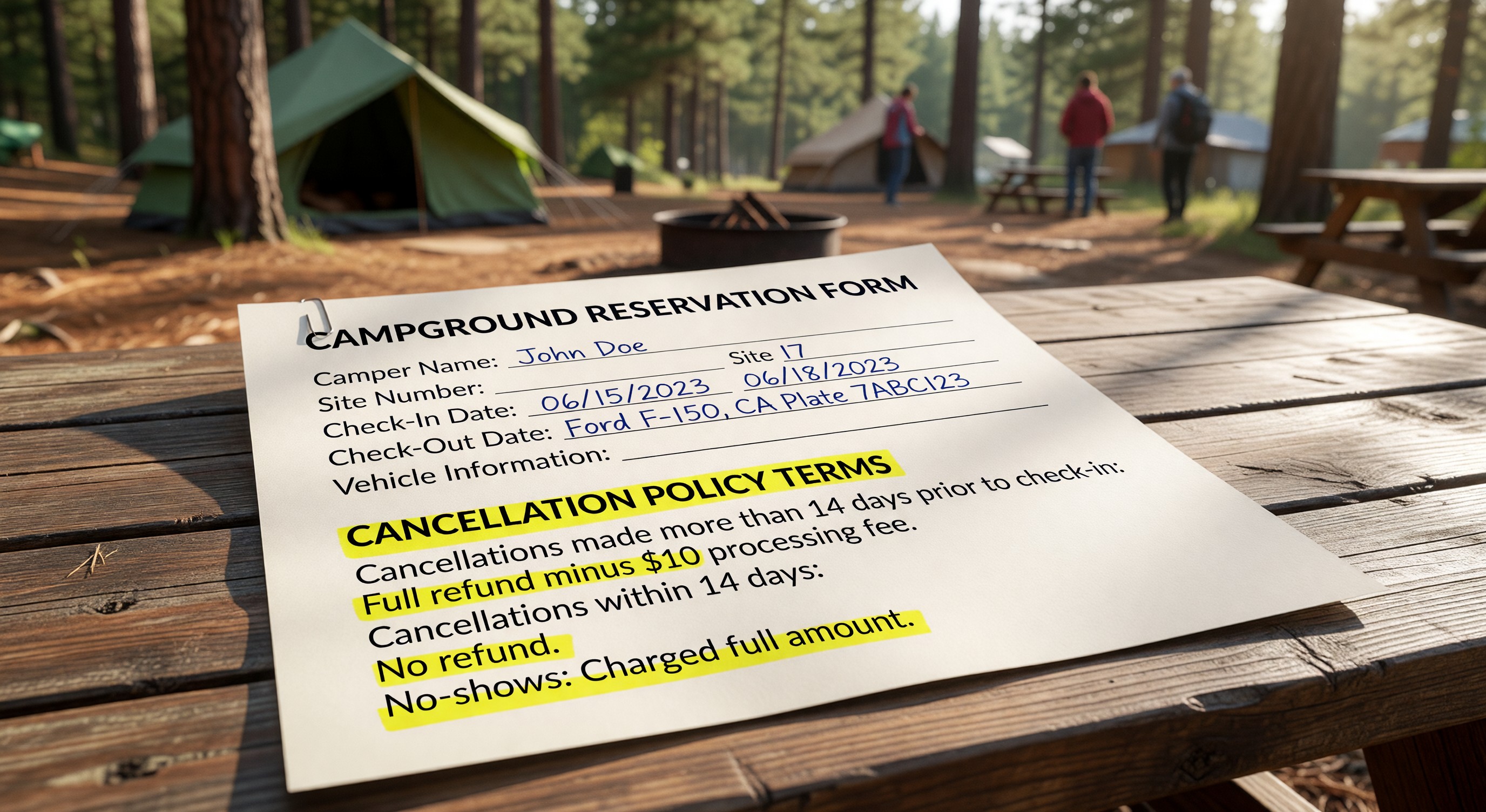
Your cancellation policy is one of the most consequential policies you operate. Too lenient and you’ll see chronic cancellations that leave sites empty and revenue unrealized. Too strict and you’ll lose bookings from guests who need some flexibility and drive negative reviews from guests who couldn’t cancel when genuine emergencies arose.
Getting the balance right requires understanding the trade-offs at each design decision point and calibrating to your market, your occupancy patterns, and your operating costs.
The Core Policy Variables
Every cancellation policy has four key variables to configure:
Refund amount. Full refund, partial refund, no refund, or credit for future stay. Each option has different implications for guest behavior and your revenue security.
Timeline triggers. The refund amount typically varies based on how far before the arrival date the cancellation is made. A cancellation 30 days out should be treated differently than one 24 hours before arrival.
Processing fee. Many parks retain a flat fee (typically $10–$25) on all cancellations regardless of timing. This covers payment processing costs and reduces casual cancellations.
Non-refundable options. Some parks offer a rate discount for non-refundable bookings — guests trade flexibility for savings, and you gain revenue certainty.
A Typical Three-Tier Structure
The most common campground cancellation policy structure:
| Cancellation Timing | Refund |
|---|---|
| 14+ days before arrival | Full refund minus processing fee |
| 7–13 days before arrival | 50% refund |
| Less than 7 days before arrival | No refund |
This structure is reasonable for parks with moderate peak demand. Parks with extremely high demand (where cancellations are reliably filled by waitlisted guests) can tighten the policy significantly. Parks in markets with more competitive pressure may need to offer more flexibility.
Peak vs. Off-Peak Policy Differences
Operating a single cancellation policy year-round doesn’t serve parks with strong seasonal variation. Consider differential policies:
Peak season (May–September, holiday weekends): Tighter policy — 14–21 day refund window, smaller refund percentage, larger processing fee. The revenue loss from a cancellation at peak is higher, and your ability to resell the site decreases with shorter notice.
Shoulder and off-season: More flexible policy — 7-day refund window, higher refund percentage. The revenue impact of a cancellation is lower when demand is softer, and flexibility may be what differentiates you from competitors for shoulder-season travelers.
Most modern PMS platforms allow you to configure different cancellation rules by date range.
Booking Credit vs. Cash Refunds
An underused policy option is the “credit for future stay” in lieu of a cash refund. This approach:
- Keeps revenue in your ecosystem regardless of when the cancellation occurs
- Provides genuine value to guests who intend to rebook
- Reduces payment processor refund fees
- Is most appropriate for loyal guests who will definitely return
The downside is that some guests don’t want credit — they want money back — and a credit-only policy on short-notice cancellations will generate complaints. Using credit as an option (rather than a requirement) is typically better received.
Communicating Your Policy Effectively
The most common source of guest frustration with cancellation policies is surprise — discovering terms they didn’t read or didn’t understand when they booked. Reduce this problem:
Show the policy prominently at checkout — not buried in terms and conditions that guests click through.
Summarize it in your confirmation email — “If your plans change, you can cancel with a full refund minus our $15 processing fee if you contact us by [date].”
Reiterate in your pre-arrival communication — a brief reminder of the cancellation deadline a week before arrival prompts guests who are reconsidering to act while they still qualify for a refund.
Train your staff to explain it clearly when guests call with cancellation questions — the explanation should be consistent, empathetic, and in terms that align exactly with what the guest received in writing.
Handling Exceptional Circumstances
No policy should be applied rigidly in every situation. Weather events, medical emergencies, and family crises are real, and how you handle them affects your long-term reputation.
Building in discretionary authority — typically at the manager or owner level — allows you to waive policy in genuine exceptional circumstances without creating a general expectation of flexibility. Document exceptions and the reasoning behind them. If you’re waiving policy for a guest, a brief note in their reservation record protects you if the situation becomes a dispute later.
Frequently Asked Questions
Should I offer travel insurance as an option at checkout? Yes, and this is increasingly common in the campground industry. Third-party travel insurance products let guests purchase cancellation protection at their own cost, giving them flexibility without you bearing the financial exposure. Several campground PMS platforms have integrated travel insurance partnerships.
Can I enforce a no-refund policy if a guest paid by credit card? You can attempt to, but credit card chargebacks create a risk. If a guest disputes the charge with their bank, the bank will typically request evidence that the policy was clearly disclosed at booking. Maintain documentation showing the policy was presented and the guest agreed before payment. This documentation is your primary defense in a chargeback dispute.
How do I handle cancellations made by guests who say they’re sick? You can choose to honor the policy or make an exception — neither is required. Some parks request a note from a healthcare provider for medical cancellations; others make exceptions on the honor system. A credit for future stay is often a good compromise that treats the guest compassionately without a full cash refund.
What’s the most common policy mistake campground operators make? Making the policy too lenient out of discomfort with conflict. A policy that is too easily waived is the same as no policy. Staff need clear authority levels for when to uphold vs. escalate policy questions, and the policy needs to actually be applied for it to function as intended.
Further Reading from Authoritative Sources
- Credit card chargeback process and documentation requirements — Wikipedia’s chargeback article provides authoritative technical background on the credit card dispute process that determines how campground cancellation policy chargebacks are evaluated, supporting operators in understanding the documentation requirements.
- ARVC campground reservation policy and cancellation best practices — ARVC is the primary trade association for private campground operators and publishes industry guidance on reservation management practices including cancellation policy design and enforcement.