In 2023, “AI-powered” has become a marketing term attached to nearly every software product on the market. Campground reservation platforms are no exception — vendors are adding AI features at a rapid pace, and operators are understandably uncertain about what’s genuinely valuable and what’s just a rebrand of existing functionality.
This guide cuts through the hype to explain what AI tools are actually doing in campground reservation systems today, which ones are delivering real value, and how to evaluate them.
What “AI” Actually Means in Reservation Software
The term AI covers a wide range of capabilities. In the campground reservation context, it typically refers to one or more of:
Machine learning for pricing. Algorithms that analyze your historical booking data, competitor rates, and demand signals to recommend or automatically adjust nightly rates. This is one of the more mature applications.
Natural language chat. AI-powered chatbots on your booking page that can answer guest questions (“Do you allow pets?” “What hookup types are available?” “Is there cell service?”) without requiring human staff response.
Predictive occupancy. Tools that forecast your occupancy by date range based on historical patterns, helping you make staffing, supply, and pricing decisions in advance.
Automated guest communication. AI-drafted or AI-personalized emails and texts that adjust their content based on guest data — arriving with a dog, celebrating an anniversary, first-time visitor vs. returning guest.
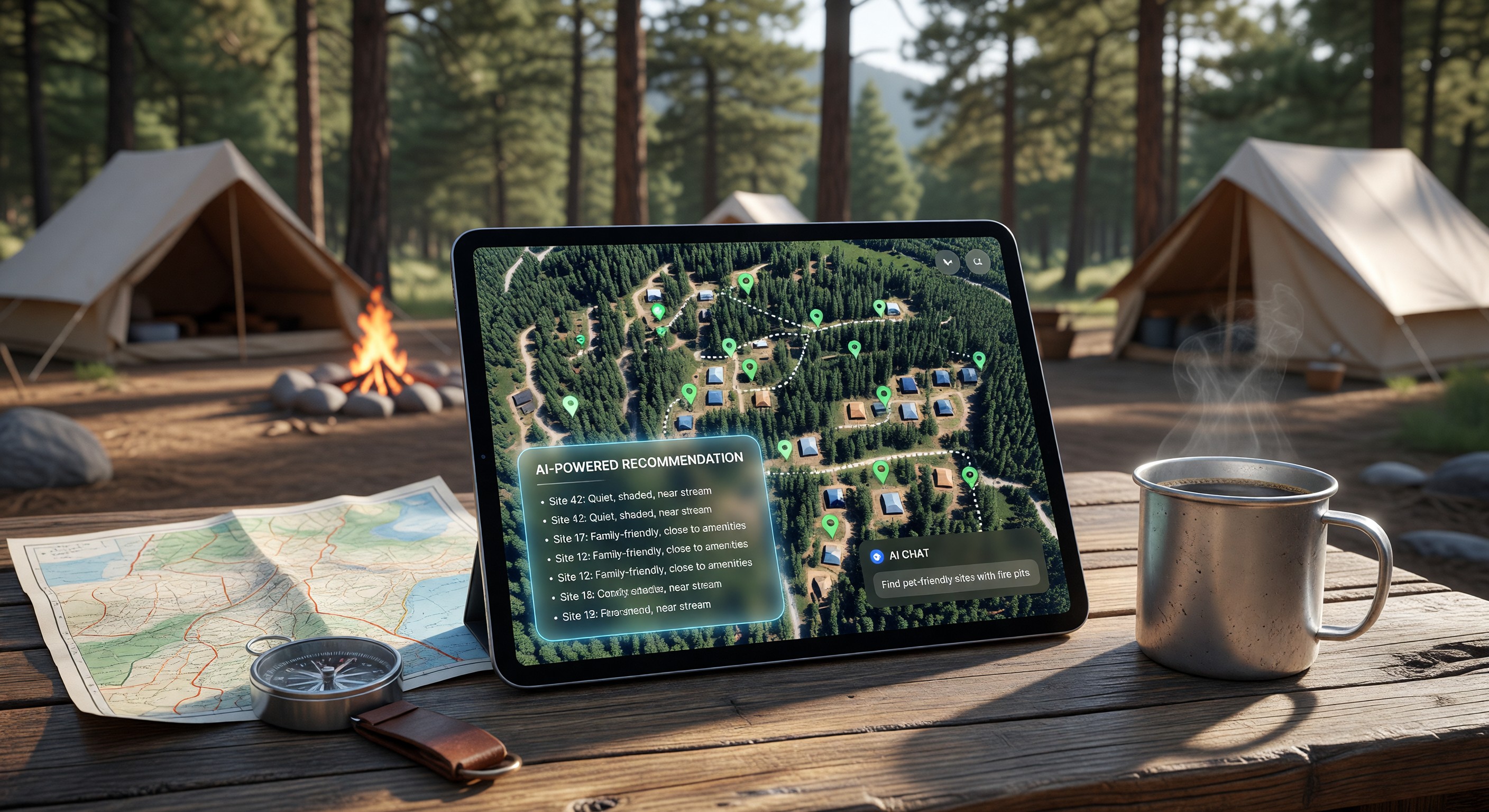
Site recommendation engines. Tools that analyze a guest’s stated preferences and suggest the sites most likely to satisfy them, reducing the “I don’t know which site to pick” friction in booking.
Where AI Is Actually Adding Value
Pricing Intelligence
The most proven AI application in campground reservations is demand-based pricing. Platforms with mature pricing algorithms can analyze occupancy trends, days until arrival, day-of-week patterns, and external demand signals (local events, holiday calendars) to optimize rates across a rolling booking window.
Parks that have adopted these tools consistently report revenue improvements in the 8–18% range. The mechanism is simple: the algorithm identifies pricing gaps — periods where you’re either underpriced relative to demand or overpriced relative to market — and closes them continuously rather than waiting for a quarterly manual review.
AI-Assisted Guest Communication
Pre-arrival and post-stay communication is time-consuming and often repetitive. AI tools that generate personalized versions of standard communication templates — adjusting tone, including relevant details, and adapting to guest history — reduce staff time on routine messaging while improving quality.
This is less “AI replacing staff” and more “AI drafting the first version that staff can review and send.” At parks with high volume, the time savings are meaningful.
Chatbot for FAQs
A well-trained chatbot on your booking page can answer the 80% of pre-booking questions that are always the same: site sizes, pet policies, noise quiet hours, check-in times, nearby attractions. Deflecting these from your phone and email queue reduces staff burden during peak inquiry periods.
The quality ceiling on campground chatbots is currently moderate — they work well for structured factual questions and fail on nuanced situations. Set accurate guest expectations about what the bot can and can’t do.
Where AI Is Less Mature
Dynamic availability prediction. Some platforms claim to predict last-minute availability gaps and proactively offer discounts to fill them. These tools are less reliable in smaller parks with limited historical data, and the rate management complexity can outweigh the benefit.
Guest sentiment analysis. AI review analysis tools that scan guest reviews for recurring themes are useful for identifying patterns but are still relatively crude at identifying nuanced operational issues.
Autonomous booking negotiation. AI that negotiates rates or terms with guests in real time is in early stages in this industry. Trust levels aren’t there yet for most operators.
How to Evaluate AI Claims From Vendors
When a vendor tells you their platform is “AI-powered,” press them on specifics:
- What data does the AI train on? Proprietary algorithms trained on industry-wide data are more reliable than models built only on your park’s limited history.
- How long before results improve? Machine learning tools typically need at least one full season of data to produce reliable outputs.
- What control do you retain? You should be able to set rate floors and ceilings that the AI can’t cross without human approval.
- Can you see the logic? A system that makes opaque decisions you can’t interrogate is harder to trust than one that shows you why a price changed.
Frequently Asked Questions
Will AI pricing tools set rates lower than I want? Reputable tools allow you to set minimum and maximum rate constraints. The AI optimizes within the bounds you define. If a tool doesn’t offer this control, treat that as a significant red flag.
Do I need a large park to benefit from AI pricing? Larger parks with more historical data benefit more from AI pricing tools in the early stages. Small parks (under 50 sites) may not have enough booking history for algorithm-driven pricing to significantly outperform well-configured manual rules. Consider the tool’s minimum data requirements.
Is there a risk that AI chatbots give guests wrong information about my park? Yes, and this is a real concern. AI chatbots trained on your park’s data can still hallucinate or misinterpret questions. Any chatbot deployment should have a clear escalation path to a human for complex questions, and responses should be reviewed during initial deployment.
How much extra does AI functionality typically cost? AI pricing tools and chatbots are usually add-ons priced as a percentage of revenue or a flat monthly fee. Expect to pay an additional $50–$200/month for meaningful AI functionality on most campground platforms, though pricing varies widely.
Further Reading from Authoritative Sources
- ARVC campground technology adoption standards and AI reservation tool guidance — ARVC’s technology resources and educational programming cover emerging reservation technology including AI tools, providing campground operators with industry-standard evaluation frameworks and adoption guidance.
- Go RVing consumer research on digital booking preferences and chatbot acceptance — Go RVing’s consumer research on booking behavior tracks how RV travelers interact with campground digital tools, including comfort levels with AI-assisted booking and communication.