Kampgrounds of America’s 2026 North American Camping & Outdoor Hospitality Report, released in April, is the twelfth edition of the series and the first to frame the whole industry around a single idea: campers are coming for restoration. KOA’s own summary ties the findings to how travelers prioritize wellness, connection and meaningful experiences. For an operator setting an amenity budget, the useful part of the report is not the headline. It is the handful of numbers that say what campers do not need.
The numbers that matter for a capital plan
The report counts more than 52 million North American households that camped in 2025, above pre-pandemic levels, and puts the sector’s local community spending at roughly $66 billion, about $5 billion more than in 2024. It is built on 4,088 completed surveys (2,834 U.S. and 1,254 Canadian households), produced with Cairn Consulting Group, and this edition includes material from Leave No Trace, a KOA Foundation partner.
Within that, four figures bear directly on what a park should build:
- 77% of campers say just being in nature is enough, without structured programming or additional amenities.
- 49% book trips specifically to improve their mental wellbeing, and 50% prioritize experiences that help them recharge.
- Walking near water, wildlife viewing and night-sky viewing lead the activities campers associate with wellness.
- Three-quarters of campers describe campgrounds as a modern “third place,” a setting for community outside home and work.
Read together, those numbers argue against the amenity arms race. The camper the report describes wants the setting protected and made accessible, not replaced with programming.
Where technology spending supports the wellness finding
Protecting quiet and darkness
If night-sky viewing ranks among the top wellness activities, light trespass is a guest-experience defect, not just a neighbor complaint. Shielded, downward-facing fixtures on loop roads, warm color temperatures, and motion or timer controls on bathhouse exteriors are inexpensive changes that directly serve what campers said they value. Dimming schedules tied to quiet hours can be set on most networked lighting controllers without new fixtures.
Noise works the same way. Decibel monitoring that alerts staff to sustained noise on a specific loop, rather than relying on guest complaints the next morning, enforces quiet hours without adding patrols. The investment case is retention: a guest whose restorative stay was ruined by a generator next door does not rebook.
Making the natural assets easy to reach
The report’s emphasis on water, wildlife and walking points to wayfinding rather than new facilities. A digital map that shows trail access points, shoreline paths and stargazing spots, delivered in the pre-arrival message or through the park’s booking confirmation, puts existing assets in front of guests who would otherwise never find them. This costs little if the park already has a mobile-friendly site map and a messaging tool; it is mostly content work.
Supporting connection without forcing it
The third-place finding cuts both ways. KOA’s data shows generational differences: 51% of Boomers report at least one meaningful interaction per trip, 40% of Millennials say interactions with neighbors make trips more memorable, and 43% of Gen Z campers stay in touch with other guests long-term while interacting less often during the stay. A single communal program will not suit all three.
The technology implication is optionality. Event calendars published through the guest messaging channel, opt-in group texts for a weekend’s activities, and bookable fire-ring or pavilion slots let guests choose their level of contact. Mandatory or heavily promoted programming runs into the 77% who said nature alone is enough.
Where the report argues for restraint
Some common amenity investments look weaker against this data:
- Large entertainment installations such as inflatable play structures, outdoor screens and amplified event spaces work against the quiet and darkness campers say they came for. They may still suit family-destination parks, but they are not a response to the wellness trend.
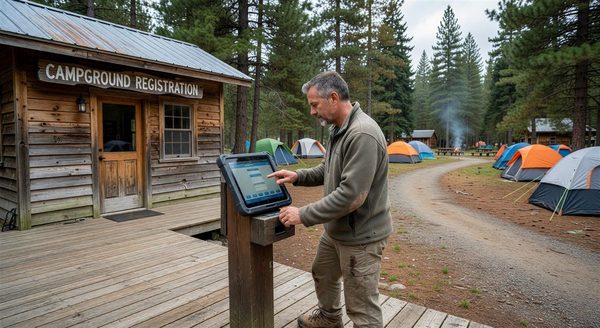
- Guest apps built for engagement metrics. An app whose value proposition is pushing activity notifications conflicts with a guest who came to disconnect. A guest app earns its place by removing friction (check-in, gate access, store orders), not by adding prompts.
- Programming software for parks with little programming. If a park’s real draw is a lake and a trail system, an activity-booking module is overhead.
None of this argues against Wi-Fi. A park can serve wellness-seeking guests and remote workers at the same time, and the report does not address connectivity directly. What it does suggest is that connectivity should be dependable rather than promoted as a feature of the stay.
The glamping and new-camper overlay
Two further figures complicate the picture. Glamping accounted for 29% of camping experiences in 2025, and 31% of new campers choose glamping accommodations, making it a primary entry point for first-timers. The report also notes that Gen Z and Millennial campers are price-sensitive yet spend the highest daily rates when they do camp.
For a park weighing a glamping expansion, that means the accommodation itself carries more of the wellness promise than shared amenities do. Climate control, quality bedding, reliable power and a quiet site placement matter more than a shared activity center. The technology spend that follows is operational: smart locks or keypad entry for self check-in, in-unit environmental controls that can be set before arrival, and housekeeping scheduling that turns units without disturbing neighboring guests.
Leave No Trace as an operational input
The inclusion of Leave No Trace material in this edition does not come with statistics, but it signals where messaging is heading. Parks that already send pre-arrival and in-stay messages can fold low-impact guidance (fire safety, wildlife food storage, staying on trails) into those messages at no additional cost. That serves the same guest the rest of the report describes, and it protects the natural setting that is, by the campers’ own account, the main product.
Turning the report into a budget line
The practical test for any 2026 amenity proposal is whether it protects, reveals or adds to the natural setting. Lighting controls, noise monitoring, wayfinding content and optional community scheduling pass that test cheaply. Large, loud or engagement-driven installations need a separate justification, because the largest single number in KOA’s report says most campers did not ask for them. Before signing a contract for anything new, survey your own guests on the same question KOA asked; if your answers track the national 77%, the better investment is probably making what you already have quieter, darker and easier to find.