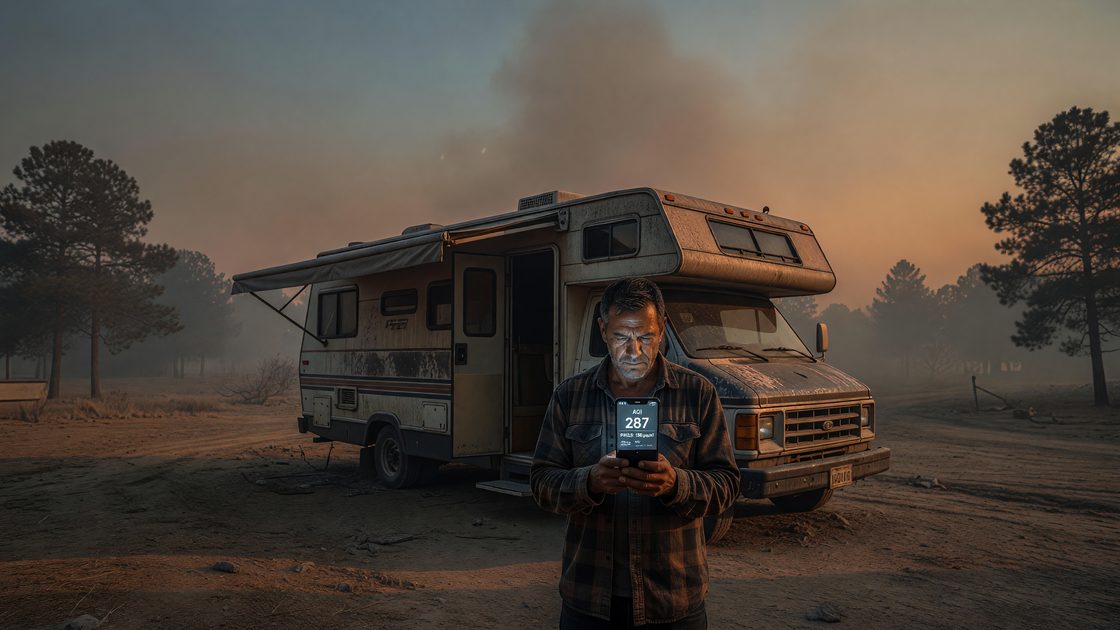
Wildfire smoke used to be a regional problem — something Western campgrounds near active fire zones dealt with for a few weeks in late summer. That’s no longer an accurate picture. In July 2026, for example, smoke from Canadian wildfires reportedly reached Jackson County, Michigan campgrounds, and West Virginia’s environmental agency issued air quality monitoring advisories the same month as smoke drifted in from fires burning hundreds of miles away. Air quality has become a season-long, cross-regional operational concern rather than a niche coastal-or-mountain-park issue.
For campground operators, this shift creates a genuine technology and policy gap. Reservation systems handle bookings; access control handles gates; weather monitoring tools handle storms and lightning. Almost none of it was built with sustained, multi-day smoke events and fluctuating air quality index (AQI) readings in mind. This article covers the monitoring tools, guest communication systems, and policy frameworks operators need to manage a wildfire smoke season that’s arriving earlier, lasting longer, and reaching parks that never used to think about it.
Why Wildfire Smoke Is Now an Operations Problem, Not Just a Weather Footnote
Smoke is different from the hazards campground emergency plans are usually built around. A thunderstorm passes in hours. A smoke event can settle over a region for days, with AQI readings swinging from moderate to hazardous and back within a single afternoon as wind direction shifts. That volatility is the operational challenge: a park that was fine at 8 a.m. can have unsafe outdoor air by early afternoon, and guests mid-stay have no way to know that without being told.
The stakes are also different from routine weather disruption. Multi-day outdoor exposure to elevated particulate matter (PM2.5) affects guests continuously, including overnight in tents that provide no filtration. Guests with respiratory conditions, older adults, and young children are at meaningfully higher risk during sustained smoke exposure than during a single smoky afternoon — which is why campground guidance increasingly distinguishes tolerance thresholds for a single outdoor activity versus tolerance thresholds for a multi-night stay.
Operators who treat smoke as “just haze” until a guest complains are managing the risk reactively. The parks handling this well have built monitoring, alerting, and policy responses that operate continuously through smoke season, the same way lightning protocols operate continuously through storm season.
Monitoring Tools: From EPA AirNow to Hyperlocal Sensors
The starting point for any smoke management program is knowing your property’s real-time AQI, not a regional estimate.
EPA AirNow and the Fire and Smoke Map: AirNow.gov is the federal government’s official air quality reporting system, aggregating monitoring station data into current AQI readings and forecasts by location. Its companion Fire and Smoke Map overlays satellite smoke plume imagery on top of ground-level monitor readings, which is useful for campgrounds trying to understand not just current AQI but where smoke is moving from and whether conditions are likely to improve or worsen.
Hyperlocal sensor networks: EPA and state monitoring stations are sparse in rural areas — exactly where many campgrounds are located. Low-cost sensor networks like PurpleAir supplement official monitors with dense, crowd-sourced PM2.5 readings, often including a station close enough to a rural property to be meaningfully more representative than the nearest official monitor 40 miles away. Some operators install their own on-site sensor and make the reading visible on the property website or check-in board.
NOAA weather service integration: Smoke behavior is driven by wind and atmospheric conditions, which is why pairing AQI monitoring with NOAA forecast data — wind direction, inversion risk, expected front passage — gives operators a forward-looking view rather than only a current-conditions snapshot. A property that knows a wind shift is forecast for the next morning can plan communication accordingly instead of reacting after air quality has already degraded.
Dashboard consolidation: The operational goal isn’t monitoring one more feed in isolation — it’s getting AQI data in front of the staff member checking the weather board each morning, alongside the same lightning and storm tools already part of a campground’s severe weather routine.
Setting AQI Action Thresholds for Your Property
Vague guidance like “monitor conditions closely” doesn’t give staff a decision they can act on at 6 a.m. Operators handling this well set specific, documented thresholds in advance, similar to how lightning protocols specify distance-based action triggers.
A workable threshold framework, adapted from air-quality guidance used by camps and outdoor recreation operators:
- AQI 0–50 (Good): No restrictions; standard operations.
- AQI 51–100 (Moderate): No guest-facing action needed for most visitors; monitor trend, note in staff log.
- AQI 101–150 (Unhealthy for Sensitive Groups): Post advisory signage; proactively flag conditions to guests known to have respiratory conditions or traveling with young children; consider modifying strenuous outdoor programming.
- AQI 151–200 (Unhealthy): Move or cancel strenuous outdoor activities; communicate conditions to all currently checked-in guests; open indoor common spaces as refuge.
- AQI 200+ (Very Unhealthy / Hazardous): Evaluate whether continued outdoor camping is appropriate for the property; this is the threshold at which cancellation and rebooking policy typically activates.
The exact numbers should be calibrated to your property, region, and the demographics of your guest base, but the structure matters more than the specific cutoffs: predetermined thresholds tied to predetermined actions remove ambiguity from a fast-moving situation, and they give front-desk staff a documented basis for decisions instead of an on-the-spot judgment call.
Guest Alert and Communication Systems
Once a threshold is crossed, guests need to hear about it quickly — and the same multi-channel logic that applies to severe weather notification applies here.
Automated text/email alerts: Reservation and PMS platforms that support mass guest messaging can push an AQI advisory to every currently checked-in guest the moment a threshold is crossed, without staff manually compiling a contact list mid-event.
Signage at high-traffic points: A physical AQI reading posted at the office, bathhouse, and camp store gives guests a passive way to check conditions without needing to look up a phone app, which matters for guests who may not be monitoring air quality apps proactively.
Pre-arrival advisories: For parks in active fire-prone regions during smoke season, a pre-arrival email noting current regional conditions and a link to the property’s own monitoring page sets expectations before guests commit to travel, reducing the volume of same-day cancellation calls.
Staff escalation protocol: Someone needs explicit ownership of checking AQI at set intervals (morning, midday, evening) during smoke season and triggering the communication plan when a threshold is crossed — this shouldn’t be an informal, whoever-happens-to-notice responsibility.
Refund, Rescheduling, and Cancellation Policy Design
Smoke-related cancellation policy has become one of the more visible guest-facing decisions a campground makes during an active wildfire season, and public agencies have set some instructive precedents.
In July 2026, Michigan’s Department of Natural Resources reportedly waived camping cancellation fees at state parks during a hazardous air quality alert, treating the smoke event similarly to a severe-weather closure rather than requiring guests to eat the standard cancellation fee. British Columbia Parks takes a more threshold-based approach, and as of its current published policy generally offers refunds for wildfire smoke only when the regional Air Quality Health Index reaches a defined severity level — giving guests and staff an objective, publicly stated trigger point rather than a case-by-case negotiation. (Operators should confirm the details of any such program directly with the agency, as these policies can change season to season.)
For private operators, three policy design questions come up consistently:
Will you offer a full refund, or push toward rebooking? Many private campgrounds default to offering a date change or credit rather than a cash refund for smoke-related cancellations, reserving full refunds for the most severe, sustained events — a distinction worth stating explicitly in your written policy rather than leaving to discretion.
What’s the objective trigger? A policy that says “refunds available for wildfire smoke conditions” is vaguer and harder to administer consistently than one that ties the decision to a specific, checkable AQI reading from a named source (e.g., AirNow) at a specific severity level.
How do you handle guests already on-site when conditions deteriorate mid-stay? A policy written only for pre-arrival cancellations misses the guest three nights into a week-long stay when air quality suddenly worsens. Mid-stay early-departure credit or partial-stay policy should be addressed as its own case, not assumed to be covered by the arrival-cancellation policy.
Whatever the specifics, publishing the policy — not just applying it reactively — reduces the volume of individual negotiation calls during an already-stressful operational period, and it gives front-desk staff something concrete to point to.
Indoor Refuge and Ventilation Planning
Not every guest can simply reschedule, and not every operator wants cancellation to be the default response to moderate smoke. Indoor refuge space is the complementary tool.
Common areas with functioning HVAC, closable windows, and — ideally — supplemental filtration give guests and staff a place to reduce exposure without leaving the property entirely. This doesn’t need to be elaborate: a bathhouse or clubhouse with a well-sealed HVAC system and a portable HEPA unit can meaningfully improve indoor air relative to ambient outdoor conditions during a smoke event. Camp and outdoor-recreation guidance recommends identifying these spaces in advance, confirming their ventilation systems can actually maintain air quality (rather than simply recirculating outdoor air through an open-window design), and communicating their availability as part of the same alert system used for AQI advisories.
Properties in fire-prone regions increasingly treat “which buildings function as smoke refuge” as a standing item in their emergency and seasonal planning documentation, the same way flood or high-wind refuge points are documented for other weather hazards.
Frequently Asked Questions
What AQI level should trigger canceling outdoor activities at a campground?
Camp and outdoor-recreation guidance generally treats AQI above 100 (Unhealthy for Sensitive Groups) as the point to modify strenuous programming, and above 150 (Unhealthy) as the point to move or cancel most outdoor activities generally. Multi-night camping warrants more caution than a single afternoon activity, since guests are exposed continuously, including overnight.
Should campgrounds rely on official EPA monitors or lower-cost sensors like PurpleAir?
Both, ideally. EPA AirNow monitors are the authoritative reference but are sparse in rural areas where many campgrounds operate. Hyperlocal sensor networks fill that geographic gap with denser, real-time PM2.5 readings, though they should be treated as directionally useful rather than a regulatory-grade substitute for official monitoring data.
Do campgrounds have to offer refunds for wildfire smoke conditions?
No — refund policy for smoke is a business decision, not a legal requirement in most jurisdictions, and practices vary. Some public park systems waive fees during hazardous air alerts or tie refunds to an AQI threshold; many private operators offer rebooking credit instead of cash refunds except for severe, sustained events. A clear, published threshold-based policy reduces disputes.
How should a campground communicate a worsening AQI to guests already on-site?
Use the same multi-channel approach as severe weather alerts: mass text or email through the reservation system, physical signage at high-traffic points, and a clear staff protocol for checking AQI at set intervals and triggering the alert when a threshold is crossed. Guests mid-stay need to be told proactively, not left to discover deteriorating air quality on their own.
Further Reading from Authoritative Sources
- AirNow.gov Fire and Smoke Map — EPA’s official real-time air quality and wildfire smoke tracking tool, combining satellite smoke imagery with ground-level monitoring station data.
- NOAA National Weather Service — Federal forecasting data on wind and atmospheric conditions that drive smoke movement and help operators anticipate air quality changes before they arrive.