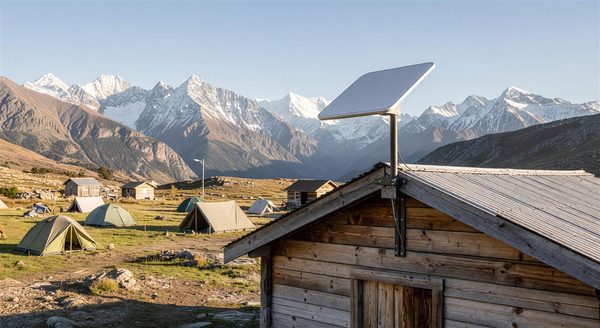
The most common response to evening Wi-Fi complaints at a campground is to buy another outdoor access point. Sometimes that is the right fix. Often it is not, because the access points were never the constraint. If the internet connection feeding the park is saturated between dinner and bedtime, every additional radio simply shares the same exhausted pipe among more devices.
This is a diagnostic guide for separating the two problems before spending money. It assumes the park already has a working mesh or wired AP network and is trying to work out why it fails at peak.
Two different bottlenecks with similar symptoms
A campground network has two layers that can fail independently:
- Backhaul is the path between the park and the internet, plus the internal links that carry traffic from each loop back to the main switch. It is the ISP circuit, satellite terminal or point-to-point radio, and the fiber, copper or wireless links between buildings and loops.
- Access is the radio layer: the access points guests connect to, their placement, channels and power settings.
When access is the problem, guests in one area see weak signal or cannot connect. When backhaul is the problem, guests see a strong signal and still cannot load anything. Installer guidance on RV park networks makes the same point: parks focus on access points because they are visible, while the real bottleneck is often backhaul.
The warning signs that point to backhaul
Several patterns are characteristic of a saturated uplink rather than poor coverage:
- Performance tracks occupancy. Speeds are fine midweek and collapse on full weekends and holidays.
- Failure has a clock. It degrades in the evening, commonly cited as roughly 7 to 11 p.m., and recovers overnight.
- Signal looks strong but throughput is poor. Guests show full bars and still cannot stream.
- Reboots help briefly. Restarting equipment clears queues for a few minutes before the problem returns.
- One loop is consistently worse. This usually means an internal backhaul link (a long copper run, a weak wireless bridge) rather than the ISP circuit.
How to measure it without special tools
You do not need a network engineer to establish where the bottleneck sits. You need the same tests run in the right places at the right times.
Test at the handoff during the busiest hour
Connect a laptop by cable directly to the ISP’s modem or terminal, or to the first port after it, and run a speed test during the worst hour of a busy weekend evening. Then repeat midweek at the same hour. If throughput at the handoff during the busy hour is far below the plan’s rated speed, or close to fully used by guest traffic, the ISP link is saturated or underperforming. Midday tests are misleading; they measure an idle network.
Test at the far end of each loop
Run the same test from a device connected to the access point at the end of each loop. If the handoff is healthy but one loop is slow, the problem is the internal link serving that loop, not the ISP.
Read your own equipment
Most managed Wi-Fi controllers show total WAN throughput over time and client counts per access point. A graph that flattens at the same ceiling every evening is a saturated uplink. Many clients on one AP with modest total throughput points to an access problem instead.
Keep a log for a few weekends
Record occupancy, peak-hour throughput at the handoff, client counts and complaint times by location. A few weekends of data turn the argument with a vendor from opinion into evidence.
When a backhaul upgrade beats another access point
If the tests show the uplink is the ceiling, adding radios will not help. The options, roughly in order of preference where available:
Fiber or a cable business circuit. Where it reaches the property, a wired circuit is usually the most consistent backhaul at peak. Rural availability is the obstacle, and construction charges to extend service can be significant; ask providers for a written quote rather than an estimate.
Point-to-point wireless. A licensed or unlicensed radio link from a nearby tower or building with fiber can bring wired-class capacity to a park that cannot get a direct circuit. A published Cambium Networks case study describes a KOA park fed by a point-to-point link providing up to 450 Mbps.
Satellite (Starlink and similar). Low-earth-orbit service is now a realistic backhaul for remote parks, with important limits. Business plans are sold with priority-data allowances, and once that allowance is used, speeds drop sharply on the base tiers. Pricing and allowances vary by country and change often; confirm the current U.S. business plan terms directly with the provider rather than relying on third-party price lists, which disagree with each other. A single terminal serving a full park at peak almost always requires per-device or per-site rate limits to remain usable.
Bonding or load balancing. Combining two circuits (for example, a cable line and a satellite terminal) behind a load-balancing router adds capacity and resilience. It does not fix a bad internal link.
If the tests instead point to one loop, the fix is the internal link: replace long copper runs with fiber where practical, upgrade a weak wireless bridge, and confirm switch ports and power-over-Ethernet budgets support the equipment attached.
Manage demand while capacity catches up
Even with a good uplink, a few guests streaming in 4K can consume a disproportionate share at peak. Per-device rate limits, fair-use caps, and a separate network for park operations (point of sale, gate systems, cameras) keep the park running when guest demand spikes. The operations network should never share a saturated queue with guest streaming.
Describe your Wi-Fi honestly on booking listings
Peak-hour failure becomes a reviews problem when a listing promises something the network cannot deliver on a Saturday night. Once you have measured, describe the service in terms you can support:
- Say where coverage is reliable (for example, near the office and specific loops) and where it is limited.
- State that the service is suited to email, browsing and messaging if it does not reliably support video calls or streaming at peak.
- If you rate-limit devices, say so. Remote workers would rather plan around a known limit than discover it.
- If a premium tier exists, describe what it actually guarantees.
An accurate description costs a few bookings from guests who need more than the park can provide. An inaccurate one costs reviews from every one of them who books anyway.
The sequence that saves money
Measure at the handoff during the busiest hour. Measure at the end of each loop. Compare. Only then decide between a backhaul upgrade, an internal link repair, or more access points. Parks that run that sequence before the next peak season tend to spend once; parks that skip it often buy radios, then buy them again, and still have the same Saturday night.