The campground technology landscape has matured substantially over the past six years. What began as a reservation-software-and-basic-website category has evolved into a rich ecosystem of purpose-built platforms covering every aspect of campground operations — from gate access control and utility metering to revenue management and AI-assisted guest communication.
This guide provides a practical overview of the technology stack a well-run modern campground should have in place in 2026, organized by function, with realistic guidance on what’s essential vs. what’s aspirational for operations of different sizes.
The Core Layer: Reservation Management System
The reservation management system (RMS or PMS) remains the operational backbone of any campground. Everything else connects to it.
What to expect from a modern campground PMS in 2026:
- Online booking with site-selection map and mobile-optimized guest interface
- Dynamic pricing with rule-based automation
- OTA channel management integration
- Automated guest communication (pre-arrival, during stay, post-departure)
- Housekeeping and maintenance task generation from reservations
- Access control integration for gate credential issuance
- Reporting and analytics with YoY comparison
The market leaders have invested heavily in feature completeness; the gap between the best and average platforms is larger than it was five years ago. If your current RMS feels limited, 2026 is a good time to re-evaluate the market.
Essential for all campgrounds. No effective modern campground operation manages reservations manually.
Guest-Facing Technology Layer
Online booking website: Your reservation system provides the booking engine; your website provides the marketing and context that drives guests to book. A professional, mobile-optimized website with high-quality photography, clear amenity information, and a seamless booking path is table stakes.
Guest communication automation: Pre-arrival email/text sequences, in-stay messaging capability, and post-departure review requests should all be automated. This is now a standard feature in most RMS platforms or available through integration with email marketing tools.
Digital campground guide: A QR code-accessible guide covering all guest-need information replaces the paper handbook. Updated digitally in minutes rather than reprinted for changes.
Chatbot/virtual assistant: AI-powered chatbot on your website handles pre-booking questions outside office hours. Optional for smaller operations; increasingly standard at mid-market and above.
Essential: online booking, guest communication automation, digital guide. Optional by size: chatbot.
Access Control and Security Layer
Gate access control: Barrier gate system with cloud management platform, integrated with RMS for automated credential issuance and expiration. This is now standard infrastructure for campgrounds above a certain size, not a luxury.
Security cameras: IP camera system with cloud video management for remote access. Coverage at entry points, common areas, and key facilities. Standard in most markets.
License plate recognition: LPR integrated with gate system for frictionless entry. Growing in adoption; most appropriate for higher-volume campgrounds.
Smart locks for cabins: Keyless entry for rental accommodations. Essential for any glamping or cabin operation.
Essential: gate access control, cameras. Increasingly standard: smart locks. Advanced: LPR.
Utility Management Layer
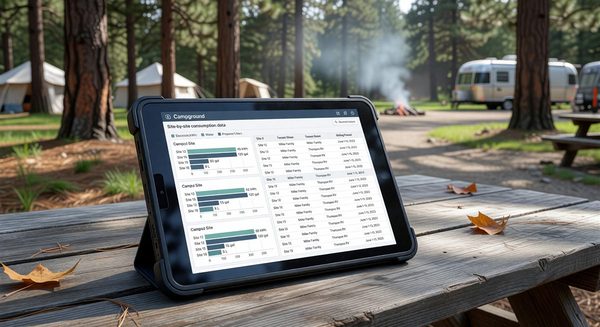
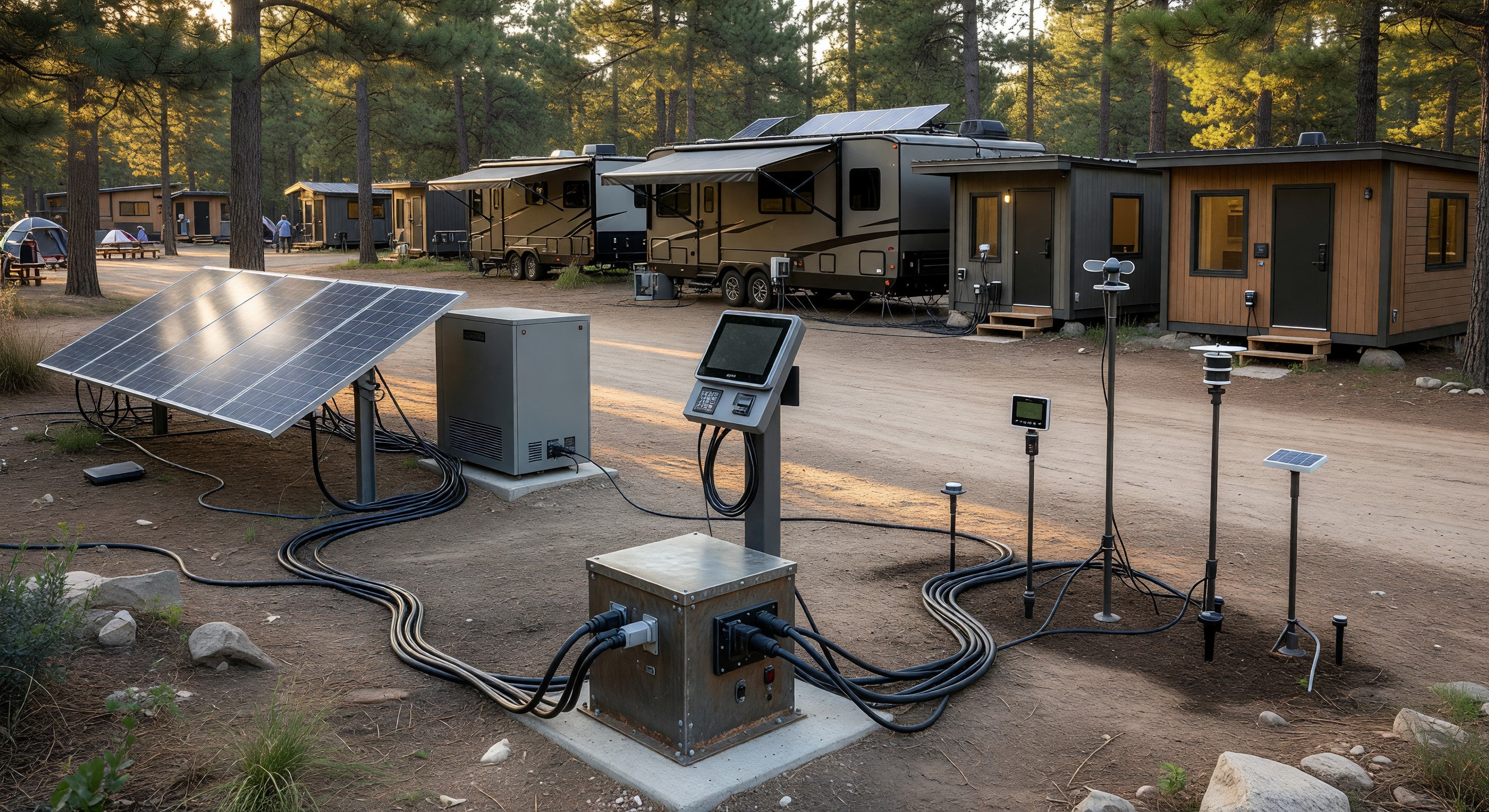
Smart electrical meters: Site-level metering for occupancy billing and consumption monitoring. Increasingly standard as electricity costs rise and EV adoption grows.
Energy management platform: Central monitoring of consumption across all facilities with demand management capability. Essential for campgrounds with significant electrical infrastructure and commercial rate demand charges.
Smart propane monitoring: Remote fill-level monitoring for campgrounds on propane supply. Standard for operations with significant propane consumption.
EV charging management: Managed charging software for any EV charging infrastructure. Essential for operations with EV charging — demand management without software is inadequate.
Essential at larger operations: smart metering. Standard for relevant systems: propane monitoring, EV management.
Financial and Operations Layer
Accounting software with integration: QuickBooks, Xero, or equivalent, connected to the RMS and POS for automated transaction posting. Essential for any operation beyond the smallest scale.
Camp store POS: Purpose-built point-of-sale system with inventory tracking and accounting integration. Essential for any campground with retail operations.
Maintenance management (CMMS): Digital work order management, preventive maintenance scheduling, and asset tracking. Increasingly standard; particularly important for multi-facility operations.
Payroll and HR platform: Digital payroll processing with tax compliance, onboarding workflows, and employee records. Essential.
Revenue management platform: Dynamic pricing software with demand forecasting. Standard at resort-level operations; increasingly adopted at well-run mid-market campgrounds.
Essential: accounting, POS, payroll/HR. Standard for relevant operations: CMMS, revenue management.
Analytics and Business Intelligence
Reservation system reporting: Most modern RMS platforms provide adequate reporting for single-property operations — occupancy, revenue, channel mix, booking patterns.
Web analytics (Google Analytics 4): Understanding website traffic sources, guest behavior, and booking conversion rates. Free, essential, and often under-utilized.
Review management platform: Aggregating and responding to reviews across platforms. Increasingly important as review volume grows.
Business intelligence (for portfolio operators): Tools that aggregate data across all properties into a portfolio-level dashboard. Essential at multi-park scale; unnecessary for single properties.
Essential: basic RMS reporting, Google Analytics. Standard for larger operations: dedicated review management, BI tools.
Building Your Stack Thoughtfully
The risk of reviewing a comprehensive technology stack is feeling pressure to implement everything immediately. That’s not the right approach.
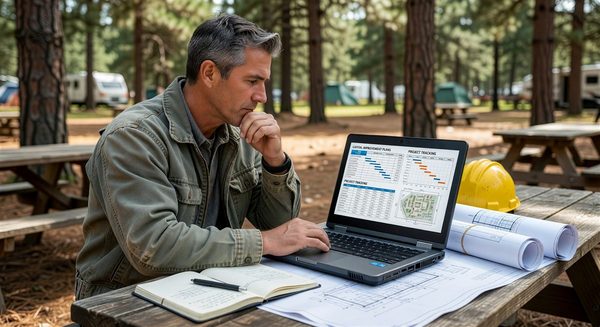
Sequencing matters: RMS, accounting, and payroll are foundational and come first. Gate access control and security cameras are infrastructure investments that come next. Utility management, revenue management, and advanced analytics come as the operation matures and the ROI from adding layers becomes clearer.
Integration is more important than features: A technology stack where all platforms communicate and share data is worth more than a collection of best-in-class individual tools that don’t connect. Prioritize integration capability over feature depth when making platform selections.
Total cost of ownership: Technology budget should include platform subscription costs, integration costs, training and implementation, and ongoing support. A platform that appears cheaper on subscription may cost more in total if integration is difficult or support is poor.
The human layer: Technology amplifies good operations; it doesn’t substitute for them. The most sophisticated technology stack in the world doesn’t compensate for inadequate staff, unclear procedures, or poor physical infrastructure. Build the human foundation alongside the technology foundation.
Frequently Asked Questions
What’s the biggest technology gap at most campgrounds in 2026? Utility management infrastructure — smart metering, energy management, and EV charging management — is the most significant capability gap at otherwise well-run campgrounds. Most have solved the reservation and communications stack; few have adequately addressed the utility infrastructure that’s becoming increasingly important as electricity costs rise and EV adoption grows.
How much should a campground budget for technology annually? Technology spend at well-run campgrounds typically runs 2–4% of gross revenue. For a campground with $500,000 annual revenue, that’s $10,000–$20,000 in annual technology costs including subscription fees, hardware maintenance, and periodic upgrades. Higher revenue operations with more complex technology needs may spend toward the upper end of this range.
Should I use a single integrated platform or best-of-breed point solutions? Single integrated platforms (where one vendor provides reservation management, guest communication, POS, and basic reporting in one system) reduce integration complexity and provide a simpler vendor relationship. Best-of-breed point solutions allow choosing the best tool for each function but require integration management. At smaller campground scale, integrated platforms are usually the right choice. At larger scale, the limitations of integrated platforms may justify point solutions for specific functions.
How do I evaluate whether a technology investment is generating ROI? Define the expected benefit before implementing (reduced staff time, recovered utility revenue, increased occupancy, reduced demand charges), baseline current performance, and measure against that baseline at 6 and 12 months post-implementation. Technology investments that don’t have measurable expected benefits attached to them are difficult to evaluate and easy to rationalize without accountability.
Further Reading from Authoritative Sources
- ARVC campground technology standards and operator resources — ARVC provides technology adoption guidance and industry benchmarks for campground operators, including the technology budget standards and adoption sequencing recommendations that inform the stack-building framework in this article.
- Technology stack architecture and integrated platform overview — Wikipedia’s technology stack article provides authoritative background on platform integration architecture and the build-versus-buy decisions that apply to campground technology stack planning, supporting operators who need foundational context before evaluating vendor options.