Sustainability in campground operations has moved from marketing language to operational practice. Third-party certification programs now verify specific practices and metrics. Guests — particularly younger demographics and those who travel extensively — are applying meaningful scrutiny to sustainability claims. And the operational practices that reduce environmental impact frequently reduce costs as well.
Technology tools support sustainability management in several ways: monitoring and measuring environmental metrics, documenting compliance with certification requirements, and communicating authentic sustainability performance to guests.
Why Certification Matters
Self-declared sustainability claims — “we’re eco-friendly” — have limited credibility with increasingly sophisticated travelers. Third-party certification programs provide independent verification that specific practices are in place and that performance meets defined standards.
Campground sustainability certification programs include:
Leave No Trace Outdoor Ethics certification: Partner certification that recognizes campgrounds actively promoting and practicing Leave No Trace principles with guests.
National Association of RV Parks and Campgrounds (ARVC) programs: Industry association recognition programs for environmental practices.
State camping association certification: Many state camping associations have developed their own green certification programs with criteria specific to their regulatory and environmental context.
International standards (for larger operations): ISO 14001 environmental management system certification applies to campgrounds pursuing formal environmental management at a higher standard.
The credibility and market recognition of different certification programs vary. Research which certification your target guest demographic recognizes and values before investing significantly in certification pursuit.
Sustainability Metrics Campgrounds Should Track
Whether pursuing formal certification or not, these metrics provide the foundation for meaningful sustainability management:
Energy:
- Total electricity consumption (kWh/month, compared to occupancy)
- Renewable energy generation (if applicable)
- Natural gas/propane consumption
- Energy intensity: kWh per occupied site-night (normalizes for occupancy variation)
Water:
- Total water consumption (gallons/month)
- Water intensity: gallons per occupied site-night
- Irrigation water use (if separately metered)
Waste:
- Total waste generated (pounds or cubic yards)
- Recycling diversion rate (percentage of total waste recycled)
- Composting diversion rate (if applicable)
Transportation:
- Guest transportation emissions (typically reported as awareness context, not operator responsibility)
- Operational vehicle fuel consumption
Materials:
- Use of recycled content in facility improvements
- Procurement of local, sustainable, or certified-sustainable products
Technology for Sustainability Tracking
Utility metering data: The foundation of energy and water sustainability tracking is accurate consumption data — which flows from smart meters and utility billing systems. If you’ve implemented these systems for billing purposes, the sustainability reporting data comes essentially for free.
Carbon footprint calculation tools: Various free and paid tools convert energy and fuel consumption data to CO2-equivalent emissions using EPA emissions factors. The EPA’s eGRID data provides regional electricity carbon intensity for accurate calculations.
Waste tracking: Tracking total waste volume and recycling diversion requires either weighing waste streams or using container volume and fill frequency as a proxy. Many waste haulers can provide weight data on request. Simple spreadsheet tracking updated monthly is adequate for most campgrounds.
Certification documentation platforms: Some certification programs have online portals where operators document their practices and upload supporting evidence. These platforms guide the documentation process and store certification records.
Communicating Sustainability Authentically
Sustainability communication that builds trust is specific and honest — both about what you’ve achieved and about what you’re still working on.
Specific metrics over vague claims: “Our solar array generated 87,000 kWh last year, offsetting 63% of our electricity consumption” is credible. “We use solar energy” is not.
Progress framing: Communicating sustainability as an ongoing improvement process — “we reduced our water consumption by 18% since 2022 through smart irrigation and low-flow fixtures” — is more authentic and engaging than implying completion.
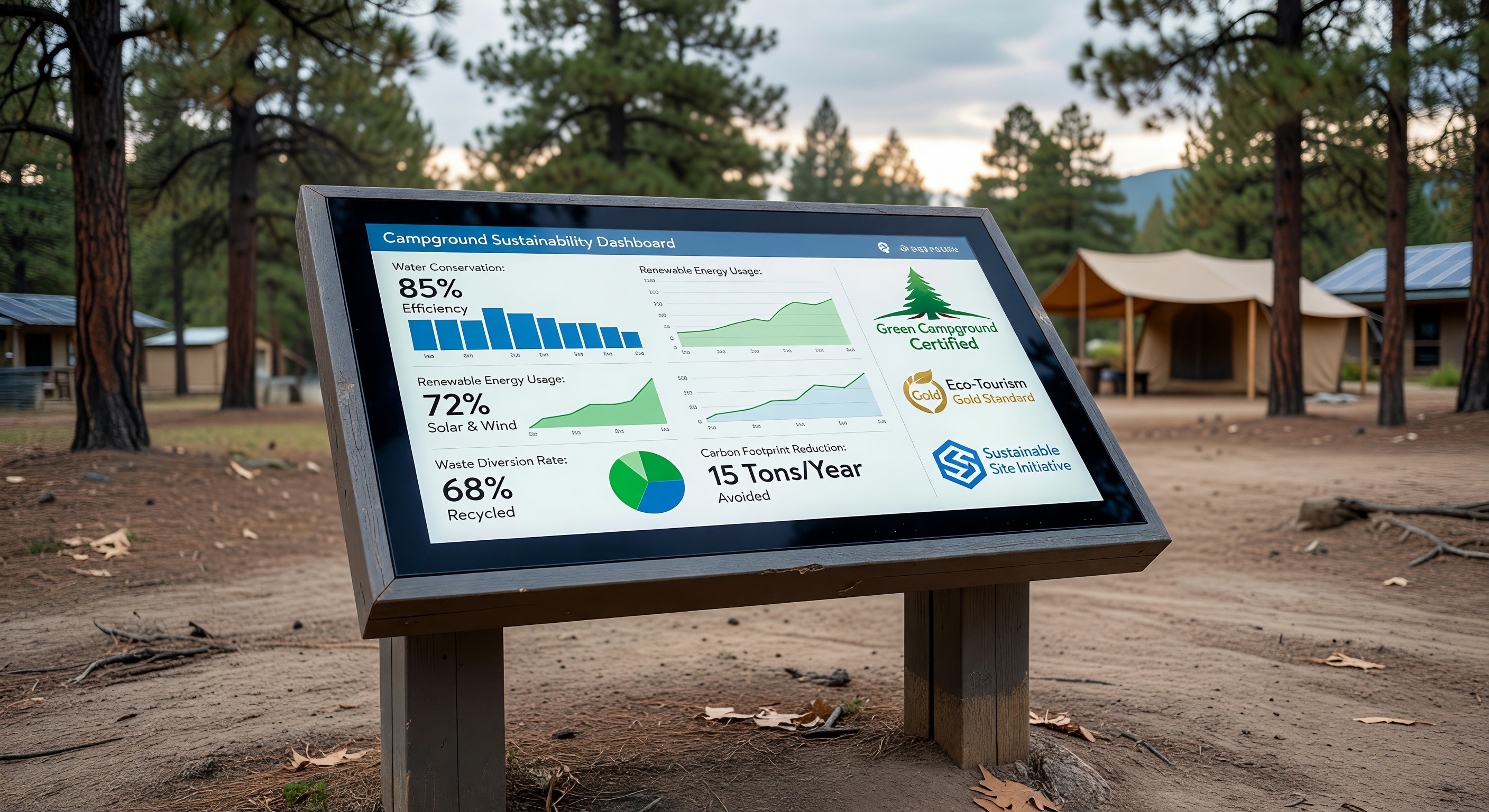
Visual communication: A sustainability dashboard visible in your check-in area — showing real-time solar generation, year-to-date recycling diversion, and other metrics — is a compelling and engaging way to communicate environmental commitment. Some campgrounds display this on a monitor in the camp store or office.
Guest participation: Sustainability programs that involve guests — Leave No Trace education, recycling station design, campfire wood conservation — create shared purpose rather than one-directional reporting.
Integrating Sustainability into Operations
Sustainability isn’t an add-on program; it’s embedded in operational decisions.
Procurement decisions: Choosing products with less packaging, recycled content, or certified-sustainable sourcing creates a sustainability record in your purchasing data. This doesn’t require significant price premium — many sustainable options are cost-competitive.
Construction and renovation standards: Specifying energy-efficient equipment, sustainable materials, and reduced site disturbance in capital improvement projects builds sustainability into the property’s physical infrastructure over time.
Staff as sustainability ambassadors: Employees who understand the campground’s sustainability goals and can explain them to guests are the most effective sustainability communicators. Brief sustainability orientation as part of employee onboarding creates this capability.
Supplier relationships: Engaging suppliers about their own sustainability practices — preferring local suppliers who reduce transportation, suppliers with environmental certifications, or vendors who take back packaging — extends sustainability influence beyond the campground boundary.
Frequently Asked Questions
What’s the most impactful sustainability investment a campground can make? The answer varies by operation, but LED lighting conversion (if not done), solar installation, and smart irrigation are consistently among the highest-impact investments for their cost. These also generate direct financial returns, making the sustainability case align with the financial case.
How do I start a campground sustainability program from scratch? Begin with measurement: collect 12 months of utility bills, estimate waste generation, and assess current practices against a sustainability checklist. Set 3–5 specific, measurable improvement goals for the next 12 months. Implement the highest-impact, lowest-cost improvements first. Document baseline and improvements. Share results with guests and staff. Improve goals for the following year. The cumulative effect of consistent improvement over 3–5 years is transformative.
Do sustainability certifications actually influence booking decisions? For a minority but growing segment of guests — particularly younger travelers, those who actively seek eco-lodging, and international visitors from markets where eco-certification is more established — certification does influence booking. The general sustainable positioning that certification supports also influences review tone and word-of-mouth. For most campgrounds, certification is better viewed as a long-term brand investment than as an immediate booking driver.
Can small campgrounds pursue the same sustainability practices as large resort operators? Absolutely. Many sustainability practices — energy conservation, recycling programs, water conservation, natural landscaping — scale down to small operations with proportionally lower investment. The practices are the same; the scale differs. Small campgrounds can achieve genuine sustainability performance that compares favorably with larger operators on a per-guest or per-site basis.
Further Reading from Authoritative Sources
- EPA green business resources and environmental management guidance — The EPA publishes environmental management guidance for small businesses and provides the regulatory framework for emissions reporting, water quality standards, and waste management regulations that campground sustainability programs must address.
- ARVC Green Business Network and campground sustainability certification — ARVC administers the Green Business Network, which is the most directly relevant sustainability certification program for US campground operators and the authoritative source for campground-specific sustainability standards cited in this article.