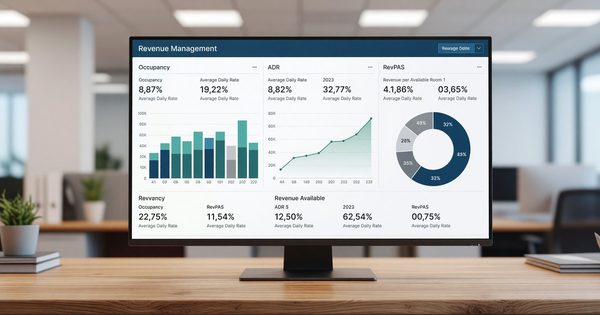
Revenue management — the practice of adjusting pricing based on demand, time, and competitive conditions — has been standard practice in hotels and airlines for decades. In campground operations, it’s been slower to arrive, but purpose-built revenue management tools are increasingly available for outdoor hospitality operators, and the operators using them are extracting significantly more revenue from the same inventory.
What Revenue Management Means for Campgrounds
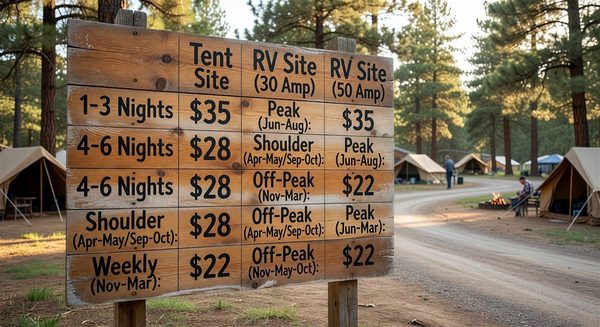
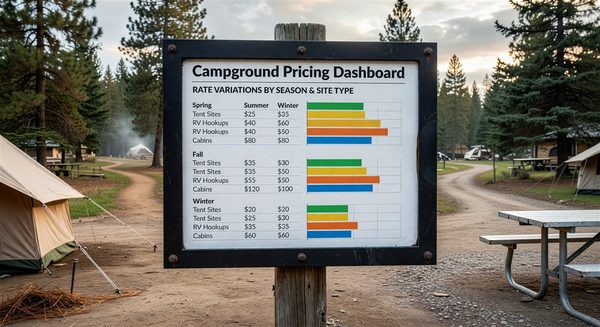
Revenue management for campgrounds isn’t about charging more for the sake of it. It’s about charging the right price at the right time for each unit of inventory. The core insight is that a site night has different value at different times:
- A Friday night in July at a popular lake campground has much higher demand than a Tuesday night in November
- A site that’s the last available on a holiday weekend has much higher marginal value than a site in a block of 50 available sites
- A guest booking 6 months in advance provides certainty and value; a last-minute booking of an otherwise-empty site provides incremental revenue above zero
Static pricing — the same rate for every night, every season — leaves money on the table when demand exceeds what that rate can clear the market, and potentially under-fills inventory when demand is weak.
Manual Dynamic Pricing vs. Software-Assisted Pricing
Some operators implement dynamic pricing manually: reviewing occupancy weekly, adjusting rates by hand for upcoming periods based on current booking pace. This is better than static pricing but has significant limitations:
- Manual review is labor-intensive and competes with operational demands
- Humans process data slowly; software can process occupancy, competitor rates, event calendars, and historical patterns simultaneously
- Manual adjustments are reactive; algorithmic pricing can be proactive based on forward-looking demand signals
Revenue management software automates the demand analysis and rate recommendation process. The operator sets parameters (minimum price, maximum price, pricing rules), and the software recommends or automatically adjusts rates based on algorithms optimizing for occupancy and revenue.
Key Features of Campground Revenue Management Tools
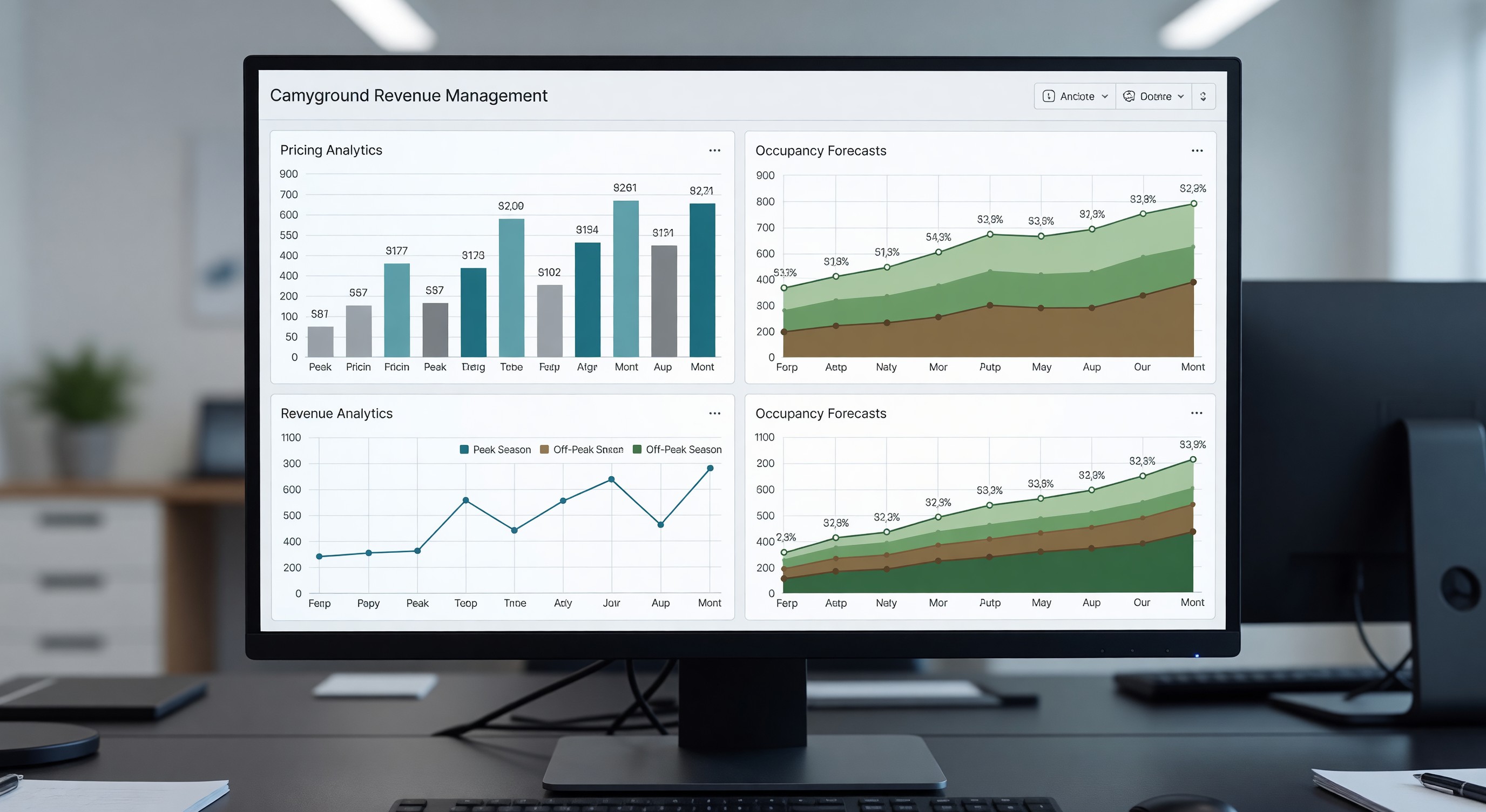
Demand forecasting: Using historical booking data, seasonal patterns, local events, and competitor rate data to forecast demand for upcoming periods. High-demand periods are identified weeks or months in advance, allowing rate optimization before the demand materializes.
Automated rate adjustment: Rule-based rate changes triggered by occupancy thresholds. “When Friday occupancy exceeds 70%, increase rates by 15%. When it exceeds 90%, increase by 30%.” This automation happens continuously without manual intervention.
Competitor monitoring: Tracking competitor rates (other campgrounds in your market) and adjusting rates to maintain appropriate positioning. If a nearby competitor raises rates for a holiday weekend, your system can automatically follow.
Minimum stay enforcement: During peak demand periods, requiring minimum stays (2 nights on holiday weekends, 3 nights on peak weekends) prevents single-night bookings from blocking access to multi-night guests who are often higher-value. Revenue management tools can apply minimum stay requirements dynamically based on demand level.
Length-of-stay optimization: Some revenue management tools analyze revenue generated per site per period rather than per night, optimizing for bookings that generate the most total revenue — which may favor 4-night stays over two separate 2-night stays depending on the rate differential.
Integration with Reservation Systems
Revenue management software functions as a layer above your reservation system. Integration is essential: the revenue management tool reads occupancy data from your reservation system and writes back rate adjustments.
Integration depth varies. Some tools have direct, automated two-way integration with specific campground PMS platforms. Others require manual rate exports and imports. When evaluating revenue management tools, confirm the specific integration with your reservation system and how much is automated vs. manual.
What to Expect from Revenue Management Adoption
Realistic expectations for campground operators implementing revenue management:
Revenue improvement: Operators implementing dynamic pricing consistently report 10–25% revenue improvement in the first year compared to static pricing, primarily from higher rates during peak periods that were previously underpriced.
Occupancy impact: Dynamic pricing doesn’t always improve occupancy — rates during slow periods may still be lower than what fills inventory, and aggressive rate increases during peak periods may slightly reduce occupancy while significantly increasing revenue. The goal is revenue optimization, not maximum occupancy.
Learning period: Algorithmic pricing takes time to learn your specific market’s demand patterns. Expect the first season to be a calibration period; performance typically improves in subsequent seasons as the algorithm develops more property-specific data.
Ongoing management: Revenue management isn’t set-it-and-forget-it. Regular review of algorithmic recommendations, manual overrides for specific situations (a local event you know about that the algorithm doesn’t), and ongoing parameter tuning require a few hours per week of management attention.
When Revenue Management Software Doesn’t Make Sense
Revenue management software is a meaningful investment — typically $200–$500/month for campground-appropriate tools. The return justifies this cost at campgrounds with significant peak demand variability and adequate size to generate meaningful revenue improvement. It typically doesn’t make sense for:
- Very small campgrounds (under 30 sites) where the absolute revenue impact is limited
- Campgrounds with flat year-round demand where pricing variability has limited impact
- Operations where dynamic pricing conflicts with the brand positioning (membership campgrounds where rate consistency is part of the value proposition)
For campgrounds in between — meaningful demand variation but uncertain whether software investment is justified — starting with manual dynamic pricing (reviewing and adjusting rates weekly) provides learning about your demand patterns before committing to software.
Frequently Asked Questions
Will guests push back on dynamic pricing? Guests are increasingly accustomed to dynamic pricing from airlines, hotels, and vacation rentals. Transparency helps: clearly communicating that rates vary by demand and showing the current rate prominently during booking avoids the worst surprise experiences. Guests who book early for peak periods often benefit from lower early-booking rates — framing the pricing system around that benefit, rather than emphasizing the high peak rates, frames dynamic pricing favorably.
How do I handle guests who see lower rates after booking at a higher rate? Your cancellation and rate change policy should be clear: rates are final at booking and not subject to price match for subsequent decreases. Most guests who book early understand and accept this; the early-booking discount they received justifies the rate, even if rates later decline.
Should I use the automated rate recommendations from revenue management software, or manually override them frequently? Start with conservative automation — narrower pricing ranges and manual review of significant rate changes — and expand automation as you develop confidence in the algorithm’s judgment. Frequent manual overrides that contradict algorithm recommendations may indicate that your pricing rules need adjustment, or may reflect local knowledge (an event or competitor change) that the algorithm hasn’t captured.
What data does campground revenue management software need to function? At minimum: current reservation data (occupancy by site type by date), historical reservation data for seasonal pattern learning, and current base rates. More sophisticated tools also ingest competitor rate data, event calendars for the local area, and weather forecast data for weather-sensitive outdoor destinations.
Further Reading from Authoritative Sources
- ARVC campground revenue management and pricing guidance — ARVC provides pricing strategy and revenue management guidance for campground operators and tracks adoption of yield management practices across the industry, making it the most relevant trade authority for this topic.
- Revenue management principles and demand forecasting overview — Wikipedia’s revenue management article provides authoritative background on yield management principles from hotel and airline applications that campground revenue management software adapts, supporting readers who need foundational context before evaluating campground-specific products.