Pricing strategy at a campground is more nuanced than posting a single nightly rate. A well-structured rate strategy differentiates by site type, season, day of week, length of stay, and advance booking window — capturing maximum revenue from guests willing to pay more while maintaining occupancy with competitive rates for more price-sensitive segments.
This article covers the framework for building a comprehensive campground rate strategy, not the software tools that automate it (covered in the revenue management software article).
Site Type Differentiation
The most fundamental pricing decision is how to price different site types relative to each other. Common campground site types and their typical pricing relationships:
Full hookup 50-amp (premium): Your highest-priced standard RV site. Modern RV travelers seek 50-amp service; sites with full hookups and 50-amp service command 20–40% premium over comparable 30-amp sites.
Full hookup 30-amp (standard): Your standard transient RV site pricing baseline. Set competitively with comparable campgrounds in your market.
Partial hookup (water/electric, no sewer): Typically priced 10–20% below full hookup. Guests accept the limitation in exchange for the lower rate.
Water and electric without sewer: Similar to partial hookup, depending on local terminology.
Electric only: Another tier lower, typically priced 20–30% below full hookup.
Dry camping/no hookups: Lowest standard site pricing. Often priced to attract tent campers and boondocking-style RV travelers who want a lower-cost option.
Premium sites (add-on to hookup type): Sites with specific premium attributes command additional premiums: pull-through site (add 10–15%), waterfront or water-view site (add 15–25%), extra-large site accommodating longer rigs (add 10–15%), patio or paved site (add 10–20%).
Seasonal Rate Structure
Campground demand is highly seasonal; pricing should reflect this. A basic seasonal structure:
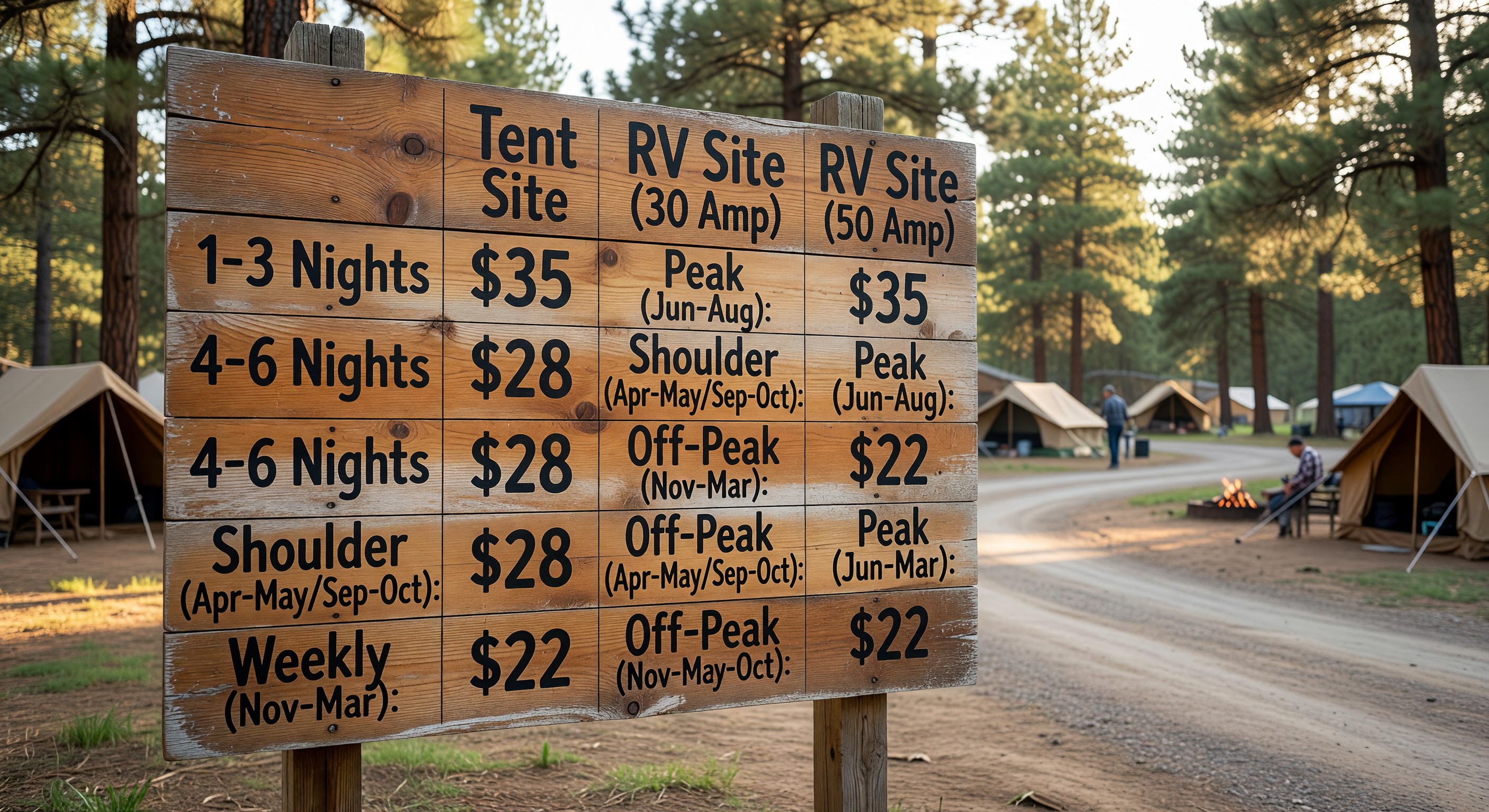
Peak season (Memorial Day through Labor Day in most US markets): Your highest rates. In competitive destination markets, peak season rates may be 50–100% higher than shoulder season.
Shoulder season (spring and fall, outside peak): Reduced rates to stimulate demand during periods with lower natural occupancy. Typically 20–35% below peak.
Off-season (winter, where applicable): Lowest rates, often 30–50% below peak. Some campgrounds close during off-season rather than operating at very low rates and occupancy.
Within-season variation (weekend vs. weekday): Within the peak season, weekend rates (Friday and Saturday nights) are typically 15–25% higher than midweek rates, reflecting significantly higher demand patterns.
Minimum Stay Requirements
Minimum stay requirements during peak periods serve multiple purposes: they reduce the operational burden of high-turnover, they prevent single-night bookings from blocking multi-night guests who are more valuable, and they increase average reservation value.
Holiday weekends: 3-night minimum (Friday through Sunday night, checking out Monday) is standard for major holidays. Some premium properties require 4+ nights on peak holidays.
Peak season weekends: 2-night minimum (Friday and Saturday) is increasingly common during peak season. This prevents guests from booking only Saturday night — the highest-demand night — and leaving Friday and Sunday nights as hard-to-fill residual inventory.
Midweek: Generally no minimum during midweek when stimulating any booking is the priority.
Minimum stay requirements should be clearly communicated during the booking process, not discovered as a surprise at checkout.
Length-of-Stay Incentives
Encouraging longer stays — beyond the minimum — through pricing incentives is a common strategy to improve average length of stay and reduce turnover cost.
Multi-night discounts: “Book 5+ nights, save 10%” or “Weekly rate = 6 nights for the price of 7” are common structures. The discount incentivizes longer stays; the lower cost of serving a guest for 7 nights vs. 7 separate 1-night guests justifies the discount economically.
Monthly rates: For long-term residents, monthly site rates are typically set at the equivalent of 20–25 nights of transient pricing — reflecting the stability value of a longer commitment.
Package Pricing
Packages that bundle site fees with add-ons can increase total reservation value while improving guest experience.
Welcome package: Site fee + bundle of firewood + ice + camp store credit. Convenient for guests who want to arrive and start enjoying themselves without stopping at the store.
Family fun package: Site fee + activities wristbands for the season or weekend + camp store credit.
Romance/couples escape package: Site fee + wine or beverages + s’mores kit + quiet amenity access.
Package pricing should be built around the cost-plus margin of the add-ons — the package should generate more revenue than the site alone, not represent a discount for add-ons guests would have purchased anyway.
Advance Booking Discounts and Last-Minute Pricing
Creating a price signal that rewards advance booking helps smooth reservation pace and reduces last-minute uncertainty.
Early bird discounts: “Book 60+ days in advance, save 10%” stimulates early booking and fills inventory before the booking window shortens. Best applied to shoulder season when demand isn’t strong enough to fill independently.
Last-minute pricing: Sites that remain unfilled 48–72 hours before the arrival date can be discounted to stimulate bookings that generate incremental revenue above zero occupancy. This should be managed carefully to avoid training guests to wait for discounts.
Non-refundable discounts: Offering a modest discount (5–10%) for non-refundable reservations trades flexibility for lower rates — a reasonable exchange that helps protect revenue from cancellations.
Competitor Research and Rate Positioning
Your rates should be calibrated against the market. Understanding your competitive positioning — whether you’re positioned as premium, mid-market, or value — requires knowing competitor rates.
Competitor rate research:
- Check competitor booking websites for current availability and rates
- Note which site types are comparable to yours
- Track competitor rates across different weekends and seasons
- Monitor OTA listings (Hipcamp, Pitchup) for competitive pricing visibility
Setting your rates relative to competitors requires a clear positioning decision. Premium properties command 20–40% above market rates when they deliver significantly better facilities, location, or experience. Mid-market properties price within 10% of comparable competitors. Value positions price 10–20% below market to drive occupancy.
Frequently Asked Questions
How often should I review and update my rate structure? Annually at minimum — setting rates for the coming season. Additionally, monthly review during the booking season to assess whether current rates are filling inventory at the desired pace or leaving money on the table.
Should I lower my rates during a slow period, or maintain rates and accept lower occupancy? It depends on your cost structure. If your marginal cost of serving an additional guest is low (you’re staffing the property regardless), then discounting to fill inventory may be economically rational. If discounting attracts price-sensitive guests who leave lower reviews or require more service, the impact on future bookings may not justify the short-term fill. Generally, moderate strategic discounting (shoulder season promotions, midweek specials) is appropriate; deep discounting that signals poor value is counterproductive.
How do I handle guests who complain that their neighbor got a cheaper rate? Transparent dynamic pricing communication is the best prevention. When guests book, the rate they’re quoted reflects availability, timing, and demand at that moment. Future rate changes (up or down) are normal. Having clear language in your booking confirmation that rates are variable and are not subject to price matching after booking sets appropriate expectations.
What’s the impact of OTA commission on my effective rate? OTAs (Hipcamp, Pitchup, RVillage) charge commissions of 15–25% of the booking value. A $50/night site that generates a $37.50 (25% commission) net rate when booked through an OTA costs significantly more than a direct booking at the same rate. You need to either price higher on OTA channels (to recover commission in the rate) or accept lower effective revenue on OTA-sourced bookings. Most campgrounds prefer maintaining consistent pricing across channels and viewing OTA commission as a marketing expense.
Further Reading from Authoritative Sources
- ARVC campground revenue management standards and pricing benchmarks — ARVC’s member benchmarking data on average daily rate, RevPAS, and occupancy by region and park type is the primary industry reference for campground operators calibrating their pricing against comparable operations.
- Go RVing consumer research on RV camper price sensitivity and booking behavior — Go RVing’s consumer research on price elasticity and booking behavior informs the market positioning framework in this article.