Every campground has a list of projects it should do someday: replace the aging bathhouse, add more 50-amp sites, install a new gate system, upgrade the pool equipment, resurface the roads. Managing this list systematically — prioritizing based on return and risk, timing investments appropriately, and tracking project execution — separates campgrounds that steadily improve from those that defer critical infrastructure indefinitely.
Capital improvement planning isn’t just about identifying projects. It’s about building the financial framework and decision-making process that turns a wish list into an executed improvement plan.
Building a Capital Improvement Inventory
The starting point is a comprehensive inventory of all capital improvement needs across your property. This typically requires a systematic walkthrough of every system and facility.
Categories to assess:
- Roads and site surfaces (condition, drainage, remaining useful life)
- Electrical infrastructure (service capacity, distribution panels, pedestals)
- Water system (supply, distribution, hookup risers, backflow prevention)
- Sewer/septic system (capacity, age, condition of drain field if applicable)
- Bathhouses (structure, plumbing, HVAC, fixtures)
- Pool and spa (structure, equipment, code compliance)
- Buildings (camp store, office, maintenance facility)
- Recreational amenities (playground, recreation hall)
- Landscaping and site aesthetics (trees, grounds, fencing)
- Technology infrastructure (Wi-Fi, gate systems, cameras)
For each item, assess: current condition, remaining useful life estimate, safety implications of continued deferral, and estimated replacement or improvement cost.
This assessment — best done with contractor input for systems outside your expertise — produces the raw data for a prioritized capital plan.
Prioritization Framework
Capital projects compete for limited budget. A consistent prioritization framework helps decision-making:
Safety and code compliance: Projects required to maintain safe conditions or comply with regulatory requirements are non-discretionary. They move to the front of the queue regardless of return calculations.
Failure risk: Systems approaching end of useful life with high failure consequence (main water service, electrical distribution, primary bathhouse) should be addressed before they fail rather than waiting for emergency replacement at premium cost and with operational disruption.
Revenue impact: Projects that directly support additional revenue — new sites, cabin additions, upgraded amenities that support premium pricing — should be evaluated against their projected revenue contribution.
Cost avoidance: Projects that reduce ongoing operating costs (energy efficiency upgrades, maintenance-heavy system replacements) are evaluated against their payback period.
Guest experience: Improvements that materially improve guest satisfaction — and thus return visits and reviews — have a revenue value that may not be directly measurable but is real.
Scoring projects across these dimensions — even with rough scoring rather than precise calculations — allows meaningful comparison across very different types of improvements.
Financial Planning for Capital Investment
Funding capital improvements requires advance financial planning. Options available to campground operators:
Self-funding from operations: Building cash reserves during high-occupancy seasons for deployment in capital improvements during off-season. Requires discipline and sufficient operating margin.
Financing: SBA loans, USDA rural business loans, conventional commercial loans, and equipment financing are all used by campground operators for capital improvements. Lenders typically want to see financial statements, a capital plan, and projected return on the improvement being financed.
Phased implementation: Breaking large improvement programs into phases reduces the capital requirement in any single period and allows cash flow from early phases to fund later phases.
Equipment-specific financing: Some equipment vendors offer financing programs for their products — solar systems, utility infrastructure, gate systems. These programs can provide more favorable terms than general financing for specific equipment types.
Capital improvement reserves: Establishing a dedicated capital reserve account — funded with a percentage of each season’s revenue — builds the financial foundation for a systematic improvement program rather than having to scramble for funds when systems need replacement.
Project Management Tools for Campground Operators
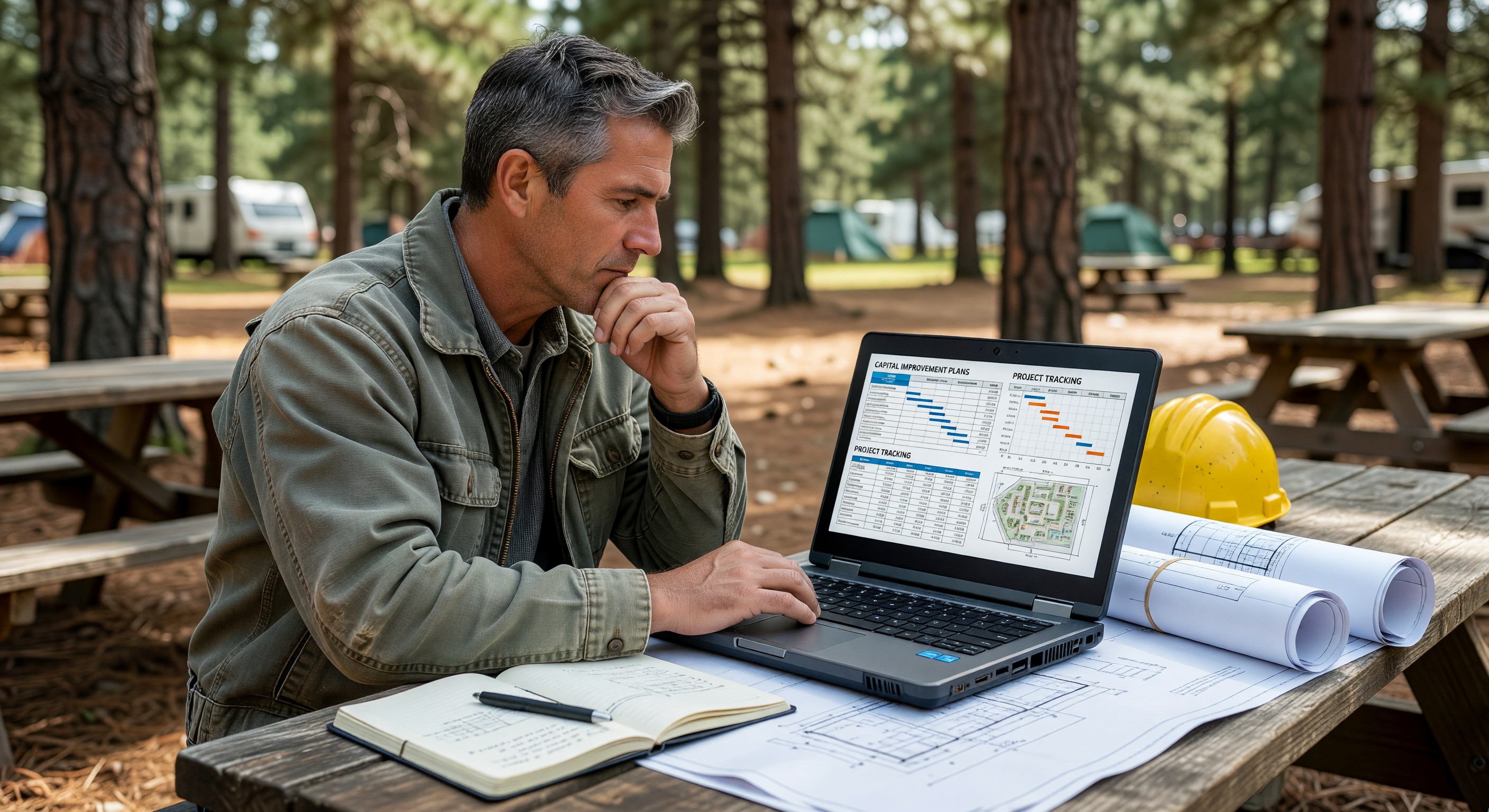
Managing a capital improvement project — coordinating contractors, tracking milestones, managing the budget, communicating with stakeholders — benefits from systematic tools even for relatively small projects.
Project management basics: A clear scope (exactly what will be done), defined schedule (what happens by when), and budget (what will it cost and where does each dollar go) are the foundation. For simple projects, a shared Google Doc covering these three elements may be adequate.
For more complex projects: Trello, Asana, or Monday.com provide project boards that track tasks, assign responsibility, and visualize progress. These tools are accessible to campground operators without project management expertise and significantly improve project coordination for multi-contractor or multi-phase projects.
Contractor management: Clear scope-of-work documentation before work begins, a change order process for work that expands beyond the original scope, and retention of final payment contingent on satisfactory completion are standard contract management practices that protect campground operators from the most common capital project problems.
Timing Capital Projects
The timing of capital improvements in a seasonal campground operation matters for both operational and financial reasons.
Off-season implementation preference: Completing construction and renovation during the off-season preserves revenue-generating capacity during the operating season. The tradeoff is that contractor availability and pricing may be less favorable during winter months in cold climates.
Multi-year phasing: Large improvement programs spread over 2–5 years are more financially manageable than attempting everything at once. Phasing also allows learning from early phases to inform later ones.
Coordination with reservations: For improvements that affect specific sites or facilities, coordinate timing against the reservation calendar. Completing a site loop renovation in October is much less disruptive than attempting it in July.
Permit and regulatory timeline: Building permits, utility interconnection approvals, and other regulatory processes take time — often 4–12 weeks. Factor these timelines into project scheduling to avoid delays that push construction into operating season.
Frequently Asked Questions
How do I prioritize when everything seems equally urgent? Apply the safety/compliance filter first — regulatory compliance is non-negotiable. Then apply the failure-risk filter: systems most likely to fail with the worst operational consequences go next. If you still have more than you can fund, rank the remainder by ROI (revenue impact and cost avoidance combined) divided by cost. This process produces a defensible priority order even when budget is tight.
Should I hire a project manager for large campground improvement projects? For projects over $200,000 with multiple contractors, a project manager — either from a general contractor or a dedicated owner’s representative — often earns their fee through better coordination, fewer change orders, and on-time delivery. For smaller projects, owner management with good documentation and clear contractor communication is usually adequate.
How do I evaluate contractor bids for campground projects? Get a minimum of three bids. Evaluate bids against a consistent scope document — if bidders are pricing different scopes, comparison is meaningless. Check references specifically from similar campground or outdoor recreation projects. Verify contractor licensing and insurance. Don’t automatically choose the lowest bid; evaluate the contractor’s demonstrated capability for the specific project type.
What’s the most commonly deferred campground capital improvement? Electrical infrastructure — specifically, campground-wide electrical pedestal replacement and service capacity upgrades — is among the most commonly deferred improvements, often because the need is invisible until a failure occurs and because the cost is significant. Operators who systematically track pedestal age and condition, and who plan replacement programs before failures force emergency action, avoid the premium costs and operational disruption of reactive electrical infrastructure work.
Further Reading from Authoritative Sources
- ARVC campground capital planning and improvement project resources — ARVC provides capital planning guidance for campground operators and publishes research on which improvement categories deliver the strongest guest satisfaction and revenue return, making it the most relevant trade authority for improvement prioritization decisions.
- ADA renovation trigger requirements for public accommodations — ADA.gov is the official government source for ADA renovation trigger rules and new construction requirements, which campground operators must understand before finalizing improvement project scope and budget to avoid mid-project compliance discoveries.