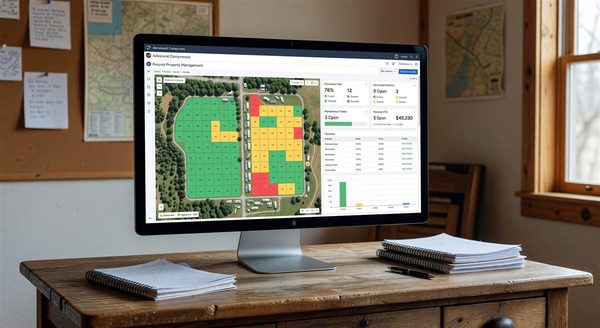
Data-driven campground management starts with a clear view of what’s actually happening in your operation. The reservation system knows your occupancy. The POS knows what’s selling. Guest reviews surface the recurring complaints. Maintenance logs reveal which equipment is failing most often. When these data streams are reviewed systematically, they support better decisions than gut feel and memory alone.
This article covers the key operational reports campground managers should track, how frequently to review them, and how to build a reporting routine that actually happens.
The Pyramid of Campground Metrics
Not all metrics deserve equal attention. Organizing reporting into a hierarchy helps managers focus on what matters most without getting lost in data.
Strategic metrics (monthly/annual review): These measure overall business health.
- Total revenue and year-over-year growth
- Average occupancy rate by site type
- RevPAS (Revenue Per Available Site) — total revenue divided by total available site-nights
- Net promoter score or average review rating
- Return guest percentage
Operational metrics (weekly review): These guide week-to-week decisions.
- Current and next-week occupancy with comparison to prior year
- Revenue pace (bookings received this week vs. target)
- Site availability by type
- Open maintenance work orders count and aging
- Guest issue report count
Tactical metrics (daily review): These drive same-day decisions.
- Today’s arrivals and departures
- Sites available for walk-in accommodation
- Maintenance requests submitted yesterday
- Occupancy for the current night
Reviewing the right metrics at the right frequency prevents both information overload (reviewing annual metrics daily) and strategic blindness (never looking beyond today’s operational needs).
Occupancy and Revenue Reports
Occupancy and revenue are the core financial metrics of campground operations. Understanding them in the right dimensions is what makes them useful.
Occupancy rate by site type: Total occupancy tells you how busy the campground is overall; occupancy by site type tells you whether you’re at capacity in your most profitable sites while budget sites sit empty, or vice versa. If 50-amp RV sites are at 95% occupancy while cabin sites are at 60%, that’s a different pricing and marketing problem than the reverse.
Advance booking pace: How far in advance are guests booking for an upcoming weekend? If peak weekend 8 weeks out is only 40% booked when it was 75% booked at this point last year, something needs attention — either pricing, marketing, or there’s a demand problem worth investigating.
Length of stay distribution: Average nights stays, and the distribution (what percentage of guests stay 1 night, 2 nights, 3–6 nights, 7+ nights). Long-stay guests typically generate better revenue per site (lower turnover cost) and may indicate an opportunity to develop more long-stay programming.
Revenue by booking channel: What percentage of revenue comes from direct bookings (your website), OTA channels, phone/walk-in? Channel mix affects both cost (OTAs charge commissions) and the quality of guest relationships (direct bookers are more likely to return).
Guest Satisfaction Metrics
Review scores and guest feedback are operational information, not just reputation management. Systematic review analysis reveals the specific operational issues driving poor experiences.
Review tagging: Creating a simple taxonomy of review topics — cleanliness, staff friendliness, facilities condition, Wi-Fi quality, noise, value — and tagging reviews by topic allows you to see whether a complaint is an isolated incident or a recurring theme. Multiple reviews mentioning bathhouse cleanliness is a signal that warrants operational investigation. A single review mentioning an unhelpful staff member may be an outlier.
Net Promoter Score proxy: Many campground review platforms allow you to calculate an approximate NPS by identifying promoters (5-star reviews), passives (3–4 star), and detractors (1–2 star). Tracking the promoter percentage over time gives a directional signal about overall guest sentiment.
Response rate and time to response: Responding to reviews — both positive and negative — is an increasingly important signal to prospective guests that management is engaged. Tracking your average response time and ensuring no review goes more than a week without response is a manageable operational target.
Maintenance Reporting
The maintenance operation has its own set of metrics that reveal operational health.
Work order aging: How long does the average work order stay open before completion? Segmented by priority (critical, standard, low priority). Long aging times on standard requests indicate either insufficient maintenance staffing or poor work order prioritization.
Preventive vs. reactive work order ratio: What percentage of your maintenance work orders are scheduled preventive maintenance vs. unplanned reactive repairs? A higher reactive percentage indicates that preventive programs aren’t preventing failures effectively.
Repeat failures: Assets or locations that generate repeat work orders within 30–60 days of a repair are signaling that the underlying problem wasn’t resolved, or that the asset is at end of useful life.
Maintenance cost by asset: As covered in the maintenance scheduling article, tracking repair costs per asset over time identifies equipment where cumulative repair investment is approaching replacement cost.
Building a Reporting Routine
Reports are only useful if they’re actually reviewed. Building a regular reporting routine is the behavioral discipline that converts data into decisions.
Weekly management review (30–45 minutes): Current week occupancy, upcoming weekend filling status, open work orders count and critical items, revenue pace comparison to prior year, and any flagged guest issues from the past week.
Monthly leadership review (60–90 minutes): Monthly revenue and occupancy vs. budget and prior year, year-to-date financial summary, guest satisfaction trend, maintenance cost summary, channel mix analysis.
Annual strategic review: Full year performance analysis, market comparison (if benchmark data available), capital investment planning based on maintenance history, pricing strategy review for next season.
Scheduling these reviews as recurring calendar events — not “we’ll do it when we have time” — is the difference between reporting routines that actually happen and those that exist only in intention.
Frequently Asked Questions
What reporting does campground PMS software typically provide? Most modern campground PMS platforms provide occupancy reports, revenue summaries, booking channel analysis, and length-of-stay data. The quality of reporting varies significantly between platforms — it’s worth evaluating reporting capabilities specifically when selecting or evaluating PMS software. Some platforms provide robust built-in reporting; others offer limited reporting that requires data export to Excel for analysis.
How do I benchmark my performance against other campgrounds? Industry associations (ARVC, your state campground association) periodically publish operational benchmark surveys. These provide aggregate data on average occupancy rates, RevPAS, ADR (average daily rate), and other metrics by campground type and region. Campground management consultants also have industry benchmark databases. Comparing your metrics against relevant benchmarks reveals whether performance gaps are operational or market-driven.
What’s the difference between occupancy rate and utilization rate? Occupancy rate is the percentage of available site-nights that were booked. Utilization rate typically refers to the percentage of total capacity that was used, accounting for site types that may not be available for all or part of the season. Both metrics are useful; understanding the distinction prevents confusion when different sources use the terms differently.
Should I share operational metrics with my staff? Yes, selectively. Sharing occupancy data with front-desk staff gives them context for what they should expect each day. Sharing maintenance work order completion rates with the maintenance team creates healthy performance visibility. Financial data (total revenue, profitability) requires judgment about what’s appropriate to share based on your management culture and the trust level with your team.
Further Reading from Authoritative Sources
- ARVC campground performance metrics and operational reporting guidance — ARVC provides operational reporting guidance and industry benchmarks for campground key performance metrics, making it the most relevant trade authority for the reporting frameworks and metric definitions that campground operators should use.
- Revenue management metrics and booking pace analysis — Wikipedia’s revenue management article provides authoritative background on booking pace analysis and revenue management metrics including RevPAS and ADR, which are adapted from hotel yield management for campground operational reporting.