Human resources management at campgrounds involves specific challenges that general HR advice often misses: seasonal hiring cycles, a mix of full-time and part-time workers, workamper employment relationships, and the compliance complexity of hiring workers across potentially multiple states. Digital HR systems are increasingly accessible to small and mid-sized operations and address these challenges more efficiently than manual processes.
The Seasonal HR Cycle
The annual campground HR cycle follows a predictable rhythm:
November–February (off-season): Review performance of prior-season staff, extend re-hire offers, post for positions that won’t be returning. Plan staffing levels for upcoming season based on capacity and programming changes.
March–May (pre-season): Screen and select new hires. Complete onboarding. Conduct pre-season training. Build the schedule for opening weekend.
May–Labor Day (peak season): Active workforce management — scheduling, payroll, performance issues, any mid-season turnover.
September–November (closedown): Season-end performance reviews. Off-boarding of seasonal employees. COBRA/benefits notices. Final payroll. Record retention.
Each phase has distinct HR tasks that benefit from system support.
Digital Recruiting for Seasonal Positions
Campground seasonal positions — front desk, maintenance, activities, housekeeping — are filled from a different candidate pool than professional roles. Effective recruiting channels:
Workamper communities: Platforms like Workamper News, Harvest Hosts, and Camp Host Jobs reach RV travelers specifically looking for seasonal campground work in exchange for site plus wage. These candidates are motivated by the camping lifestyle, often experienced, and available for an entire season.
Indeed and ZipRecruiter: General job boards reach a broader audience, including local candidates who might commute rather than stay on-site. Effective for front desk and maintenance positions in campgrounds near residential areas.
Local colleges and universities: Parks and Recreation, Hospitality Management, and Environmental Science programs at nearby institutions produce qualified candidates interested in outdoor industry employment. Campus career services and faculty contacts are useful recruiting channels.
Prior-season rehires: Maintaining a database of prior-season employees who performed well — and reaching out proactively in late winter — is the most cost-effective recruiting source. People who’ve done the job, know the property, and choose to return are significantly lower training risk than new hires.
Applicant Tracking Systems (ATS): For campgrounds processing more than 20–30 applications per year, an ATS — even a basic one like Workable or JazzHR — organizes applications, facilitates team review, and maintains a searchable candidate database. Smaller operations can manage adequately with a shared email inbox and spreadsheet.
Digital Onboarding Platforms
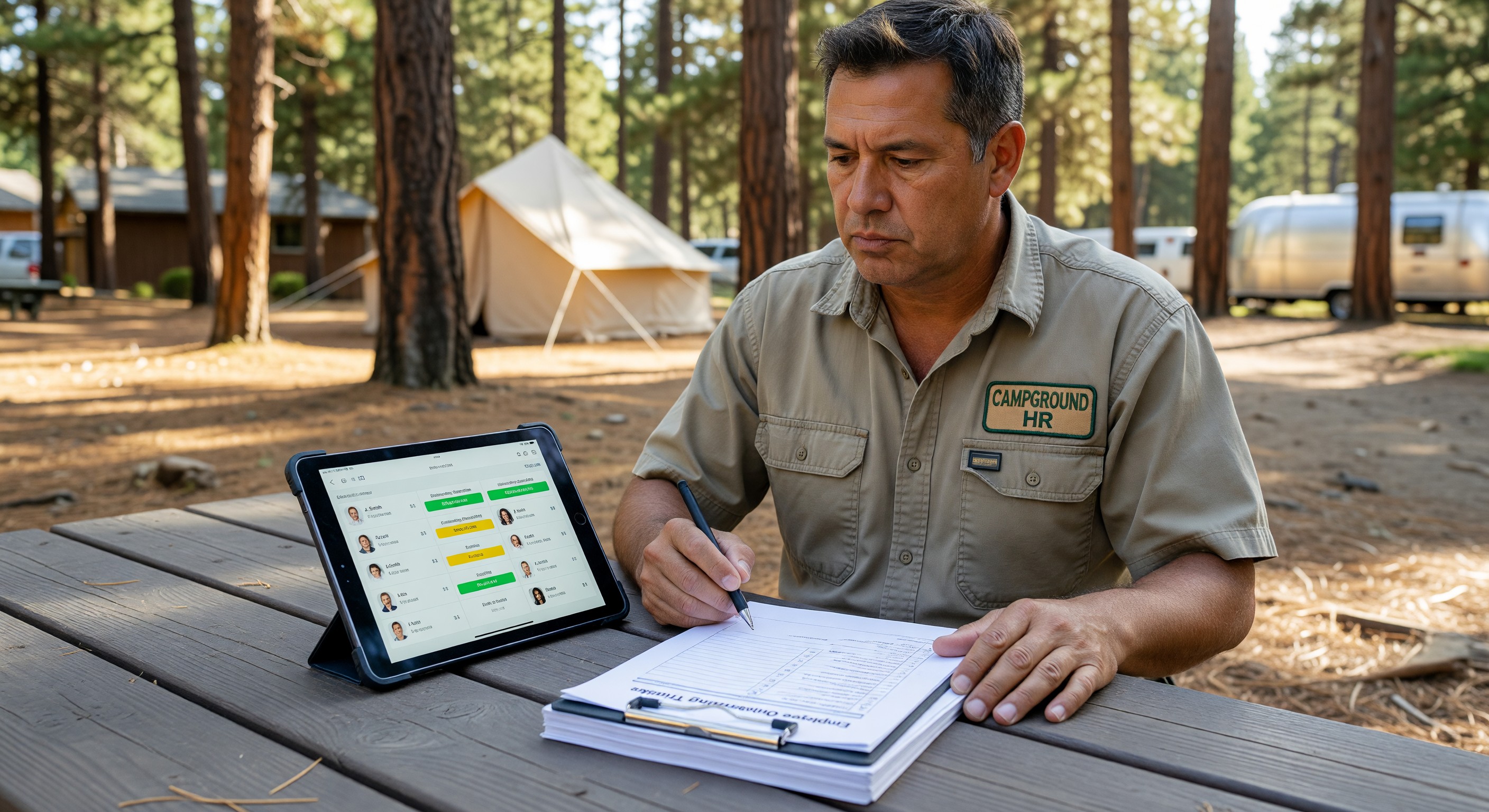
Digital onboarding platforms (Gusto, BambooHR, Rippling, OnPay) automate the administrative tasks of new employee setup:
- I-9 employment eligibility verification (with electronic I-9 capability in some platforms)
- W-4 federal withholding elections
- State tax withholding forms
- Direct deposit setup
- Handbook acknowledgments and policy sign-offs
- Benefits enrollment (where applicable)
Completing these tasks digitally before the employee’s first day means their first day can focus on operations training rather than paperwork. For seasonal employees who may start just days before the opening rush, eliminating day-one paperwork overhead is meaningful.
E-Verify: If your campground hires workers who may not be US citizens or permanent residents, E-Verify integration in your HR platform streamlines the eligibility verification process that is required by law in some states and recommended in all.
Payroll Systems
Payroll for campground operations has several complexity factors:
Overtime management: Campground employees often work irregular hours during peak periods, including weekends and holidays. Accurate overtime tracking — which varies by state (some states require daily overtime, most follow federal weekly overtime) — requires payroll systems that handle these nuances correctly.
Tip handling: If camp store or activities staff receive tips, payroll must handle tip reporting and tax withholding correctly.
Multiple pay rates: Some employees may work multiple roles at different pay rates — a maintenance technician who sometimes covers front desk at a different rate. Payroll systems must support multiple pay rates for the same employee.
Workamper site value: If workamper compensation includes a site, the fair market value of that site may be taxable compensation that must be included in payroll calculations and W-2 reporting.
Payroll services — Gusto, ADP, Paychex, Square Payroll — handle federal and state tax calculations, tax deposits, and reporting automatically. For campground operators who’ve been doing payroll manually or with spreadsheets, the time savings and compliance improvement from a payroll service typically justify the cost ($40–$150/month depending on provider and employee count) immediately.
Performance Management for Seasonal Employees
Formal performance management for seasonal employees — annual reviews, development plans, career paths — isn’t typically relevant. But informal, ongoing performance feedback matters for maintaining service quality and making re-hire decisions.
Mid-season check-ins: A brief conversation with each employee at the season midpoint (or monthly for longer seasons) to acknowledge what’s going well, address any concerns, and provide specific feedback is valuable even for seasonal roles.
End-of-season performance notes: Before the employee’s last day, document specific performance observations in the employee’s file. These notes — positive and negative — inform next year’s re-hire decision far better than memory alone.
Re-hire coding: Coding employees as “rehire eligible” or “do not rehire” in your HR system prevents the embarrassment and cost of accidentally extending an offer to a former employee who had serious performance issues.
Multi-State Compliance
Campgrounds that recruit from out of state — particularly workampers who may be residents of different states — face multi-state payroll tax compliance requirements. If an employee is a resident of one state but works in another, there may be withholding obligations in both states. These nexus rules are complex and vary by state.
When hiring out-of-state workers, your payroll service can often handle the withholding calculations, but you may need to register as an employer in additional states, which has its own administrative requirements. A payroll service with multi-state capabilities is essential if your workforce regularly includes out-of-state workers.
Frequently Asked Questions
What’s the minimum HR technology a campground with 10–15 seasonal employees needs? At minimum: a payroll service (not manual payroll), digital onboarding for I-9 and W-4 completion, and digital storage of employee records. These three elements address the most significant compliance risks and the most time-consuming administrative tasks. Total monthly cost for these basics is typically $100–$200.
How do I handle a seasonal employee who has performance problems mid-season? Document specific performance issues in writing as they occur. Follow up verbal performance conversations with brief written summaries sent via email (creating a timestamp and record). If the issues rise to the level of termination, consulting with an employment attorney familiar with your state’s laws before acting prevents mistakes that create liability. Document everything — what happened, what was communicated to the employee, and what resulted.
Are workampers employees or independent contractors? This is an important legal distinction. Most workampers who work regular hours under the direction of campground management are employees — not independent contractors. Misclassifying employees as independent contractors creates significant legal and tax liability. If in doubt, consult with an employment attorney or HR professional before entering into workamper arrangements.
How long must campground employee records be retained? Federal law requires retaining I-9 forms for the later of: 3 years after hire date, or 1 year after employment ends. Tax records must be retained for at least 4 years. State requirements may be longer. Employment application, performance records, and related documents should generally be retained for the duration of employment plus 3–7 years. Digital HR platforms typically manage retention automatically; paper records require active management to ensure compliance.
Further Reading from Authoritative Sources
- OSHA hazard communication and employee safety training requirements for campground employers — OSHA’s general industry standards apply directly to campground employers and cover the safety training, PPE, and hazard communication requirements referenced in the article.
- ARVC campground workforce management and workamper employment resources — ARVC is the primary industry association for campground operators and provides workforce management resources including guidance on the workamper employment model that is unique to the outdoor hospitality sector.