Grounds management — mowing, trimming, landscaping, trash collection, road maintenance, and general property appearance — is the most visible operational function at a campground. Well-maintained grounds signal quality and care that guests notice immediately on arrival. Poorly maintained grounds — overgrown sites, scattered debris, damaged road surfaces — signal the opposite, regardless of how well other aspects of the operation function.
Managing grounds efficiently at a property that may span dozens or hundreds of acres requires systematic planning, route optimization, and equipment management that benefits from digital tools.
Grounds Maintenance Planning
The scope of campground grounds maintenance varies significantly by property size, vegetation density, and seasonality. Planning this work starts with a comprehensive inventory of what needs to be maintained.
Grounds maintenance inventory:
- Mowing: Total acreage by type (intensively maintained vs. naturalized areas vs. sites vs. roads)
- Trimming: Linear footage of edges, fence lines, building foundations
- Landscaping beds: Square footage requiring mulching, weeding, deadheading
- Trees: Inventory of significant trees requiring monitoring, pruning, or hazard assessment
- Roads: Linear footage of road surface requiring regular inspection and seasonal maintenance
- Drainage features: Swales, culverts, detention areas requiring regular inspection and maintenance
From this inventory, calculate the labor hours required per cycle for each maintenance type. This calculation is the foundation for understanding whether your grounds maintenance staffing is adequate for your property — not just for how long the work feels, but in actual hours per week required to maintain the property to your standards.
Route Planning and Efficiency
On a large campground, the sequence and routing of grounds maintenance tasks significantly affects how much ground can be covered in a day. Inefficient routing — backtracking, repeated passes through the same area for different tasks, inefficient mowing patterns — wastes 20–30% of available time at many operations.
Mowing route optimization: Mowing routes that minimize turns and backtracking cover more area per hour. On large open areas, a systematic pattern (back-and-forth rows, or concentric circles) minimizes wasted passes. On complex campground layouts with many obstacles (trees, pedestals, buildings), more planning is required to identify efficient patterns.
Combined task routing: Planning routes that address multiple maintenance tasks in the same zone — mowing, trimming, trash collection, pedestal inspection — in a single pass through an area is more efficient than separate passes for each task. Some campgrounds organize maintenance crews by geographic zone rather than by task, enabling this combined approach.
Digital mapping tools: Simple tools — even a printed aerial map marked with routes — improve consistency compared to leaving routing decisions entirely to individual crew members. Mobile apps that display maintenance zones and track which areas have been completed in the current cycle support teams covering large properties.
Equipment Management and Tracking
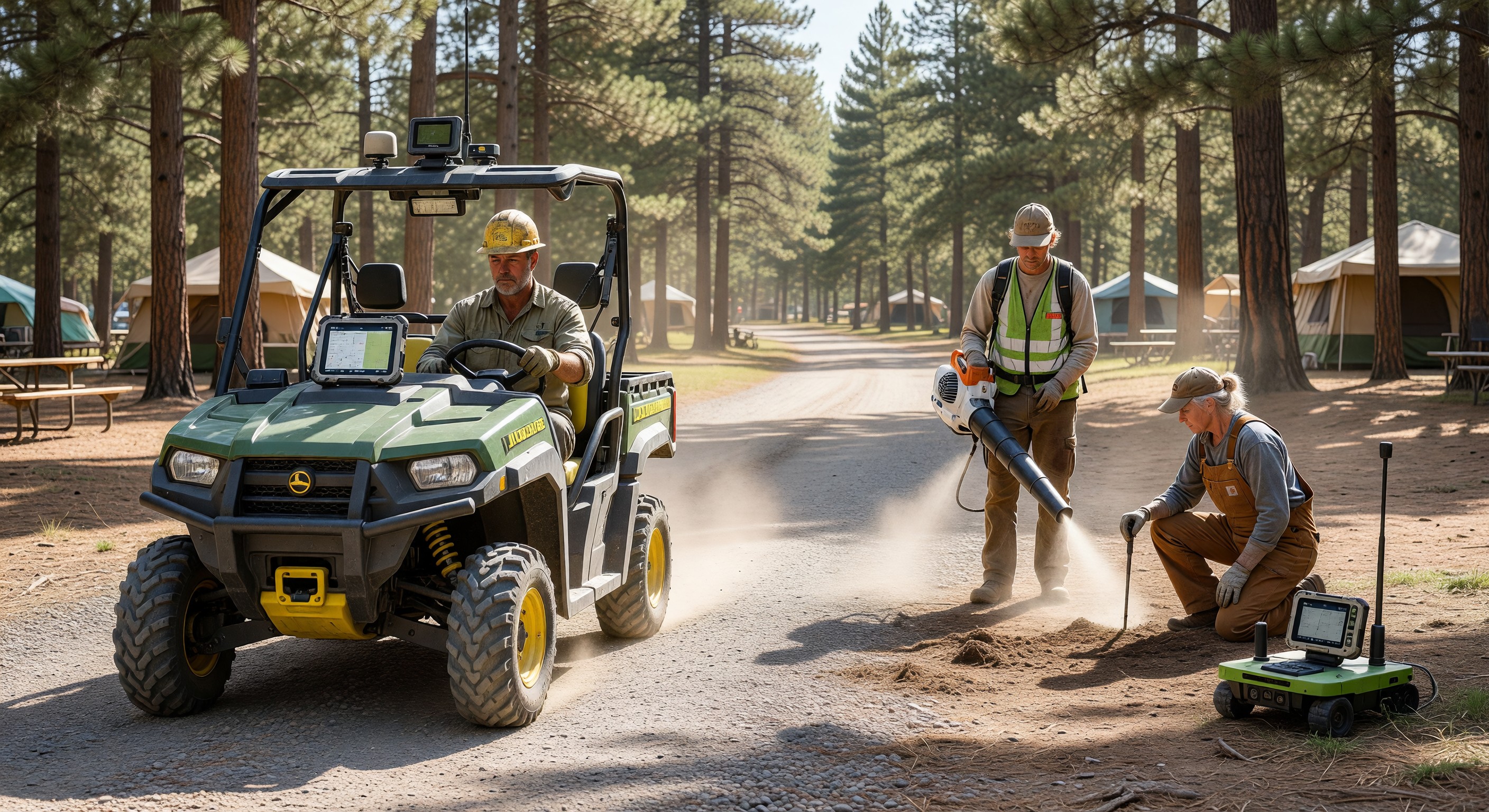
Grounds maintenance equipment — riding mowers, zero-turn mowers, string trimmers, leaf blowers, utility vehicles — represents significant capital investment and has high maintenance requirements from intensive seasonal use.
Equipment inventory and service scheduling: Maintaining a record of each piece of equipment with model, serial number, purchase date, and service history supports preventive maintenance scheduling. Commercial mowers typically require oil changes every 25–50 hours of operation; this interval is much shorter than most operators realize and is often missed in informal maintenance approaches.
Hour meter tracking: Equipment with hour meters (most commercial mowers have them) allows service to be scheduled by operating hours rather than calendar interval — appropriate since equipment that’s used more frequently needs service more frequently.
GPS tracking for equipment: GPS trackers installed on major equipment items — riding mowers, utility vehicles — track where equipment is on the property and how many hours it’s been operated. This data supports both route analysis (where is equipment spending time vs. where management expects it) and theft prevention for equipment left outdoors.
Fuel management: Commercial grounds maintenance equipment consumes significant fuel. Tracking fuel consumption by equipment item reveals unexpected usage patterns that might indicate operational inefficiency or equipment problems consuming excess fuel.
Invasive Species and Pest Management
Campground grounds maintenance includes managing invasive plant species and pest insects that can degrade the property environment for guests.
Invasive plant monitoring and treatment: Regular inspections for invasive plant species (specific species vary by region) identify infestations early when they’re more manageable. Digital mapping of known invasive populations, with photos and treatment history, creates a management record that informs annual treatment planning.
Tick and mosquito management: Pest insects significantly affect guest experience at campgrounds in affected regions. Integrated pest management approaches — habitat modification, targeted treatment of high-tick areas (woodland edges, tall grass), and potentially pesticide application — require planning and documentation.
Tree hazard assessment: Regular inspection of trees on the property identifies hazard trees — those with structural defects that create risk of failure and injury. A documented tree hazard assessment, updated annually and after major storms, is both good safety practice and evidence of due diligence if a tree failure injures a guest.
Seasonal Grounds Planning
Grounds maintenance requirements change significantly through the year.
Spring: Pre-season cleanup and preparation; mulching; bed planting; tree inspection for winter damage; road surface inspection and repair.
Summer (peak season): Highest frequency mowing and trimming; regular trash collection; irrigation management; pest management.
Fall: Leaf collection; overseeding; preparation of naturalized areas for winter; winterization of irrigation systems.
Winter/off-season: Major tree work (removal of hazard trees, pruning); equipment maintenance and servicing; drainage improvements; preparation for next season.
Planning the annual grounds calendar — with seasonal tasks mapped against the operational calendar — ensures that major tasks happen at the right time rather than being perpetually deferred.
Frequently Asked Questions
How often should campground sites be mowed during peak season? Frequency depends on grass growth rate (which varies with rain and temperature) and your appearance standards. A general guide is mowing when grass height reaches twice your desired maintained height — typically weekly to every two weeks during peak growing season. High-visibility areas (entrance, common areas) merit more frequent attention than back loops with lower guest traffic.
Should campground grounds management be in-house staff or contracted out? This is primarily an economics question. In-house staff provide more control over scheduling and quality but require equipment investment and year-round management. Contracted grounds maintenance provides flexibility (seasonal engagement, no equipment ownership) but at potentially higher per-visit cost and less control over scheduling. For most campgrounds with significant grounds, in-house staff for core maintenance tasks and contracted specialists (tree work, pesticide application, major landscaping projects) is a practical hybrid.
What’s the best approach to controlling grass around electrical pedestals and trees? String trimming around obstacles is labor-intensive and, if done aggressively, can damage pedestal bases and tree trunks. Ground cover plants (mulch, low ornamental grass, creeping thyme) installed around obstacles reduce trimming requirements significantly. Rubber pedestal surrounds that protect the base while allowing trimmer access are available and reduce damage risk during routine trimming.
How do I handle storm damage to the grounds efficiently? Have a storm recovery plan before you need it: define who assesses damage first, what safety checks are required before guests can access damaged areas (downed lines, unstable trees), what equipment is used for debris removal, and when contractors are called vs. handled in-house. Post-storm response is one of the more visible operational tests a campground faces, and an organized plan makes the difference between a 4-hour recovery and a 2-day ordeal.
Further Reading from Authoritative Sources
- EPA integrated pest management guidance for recreational properties — The EPA’s Integrated Pest Management resources provide the regulatory and best-practice framework for pesticide application and invasive species management at campgrounds.
- ARVC campground grounds maintenance standards and property management resources — ARVC’s operational standards and member benchmarking data cover grounds maintenance as a core campground quality indicator.