Glamping — glamorous camping — has shifted from a trend to a mainstream segment of the outdoor hospitality market. Safari tents, yurts, treehouses, luxury cabins, and Airstream trailer accommodations now appear at campgrounds across North America, commanding premium nightly rates and attracting guests who wouldn’t consider traditional camping.
Operating glamping accommodations successfully requires a more hotel-like operational approach than standard RV site management. The gap between what guests expect at $250+/night and the operational reality of a campground environment requires specific systems, processes, and technology.
Understanding the Glamping Guest
Glamping guests have fundamentally different expectations than traditional campers. Traditional campers bring their own gear, are self-sufficient, and tolerate variability as part of the outdoor experience. Glamping guests are paying for curated comfort in an outdoor setting — they expect the accommodation to be ready when they arrive, stocked with what they need, and maintained to a standard they associate with quality hotel accommodations.
This creates operational implications:
- Bed linens must be hotel-quality and impeccably clean
- Amenities (robes, toiletries, coffee service, welcome provisions) must be fully stocked
- Any maintenance issue — a broken lamp, a sticking door, a wifi connection problem — is a guest service failure that will appear in a review
- Check-in should feel like a hospitality experience, not a campground registration
Understanding this expectation gap is the prerequisite for designing systems adequate to meet it.
Reservation System Configuration for Glamping
Glamping accommodations need to be configured in your reservation system as distinct inventory units with specific attributes:
Unit-specific descriptions and photos: Each glamping accommodation should have its own photos and description in the booking system — not a generic “glamping tent” entry. Guests booking glamping accommodations at $200+ per night are making a decision based significantly on the specific aesthetic and amenities of the accommodation.
Maximum occupancy and age requirements: Glamping units typically have specific occupancy limits (often 2–4 guests) and may have age restrictions (adults only, no children under a certain age) that must be enforced at booking.
Amenity inclusions: The booking description must be unambiguous about what’s included (towels, toiletries, bed linens, firewood, welcome provisions) and what’s available for purchase (activities, meals if offered, additional firewood).
Long-stay pricing: Glamping operators who offer multi-night stays need pricing structures that reward longer stays — typically 3, 5, or 7-night minimums during peak season, with discounted per-night rates for longer stays.
Housekeeping and Turnover Operations
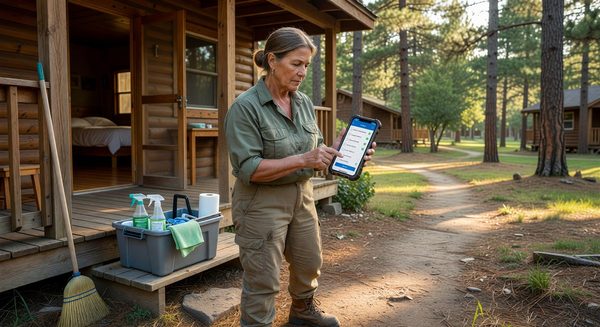
Glamping housekeeping is significantly more intensive than standard campground site maintenance. A full turnover of a glamping tent or cabin that meets guest expectations requires systematic execution:
Turnover checklist: A unit-specific checklist that covers every element — stripping and remaking the bed with freshly laundered linens, cleaning all surfaces, restocking all consumables (toiletries, coffee, welcome provisions), inspecting all amenities for function, photographing the completed unit before marking it ready.
Turnover time: A realistic glamping unit turnover requires 60–120 minutes for standard units, more for larger or more amenity-rich accommodations. Scheduling turnovers with adequate time built in prevents rushed cleaning that results in missed elements.
Quality inspection: For glamping accommodations at premium price points, a management-level inspection before every check-in — not just spot checks — is appropriate. The cost of one negative review from a guest who found the accommodation not meeting expectations exceeds the cost of many hours of management inspection time.
Photography for accountability: Requiring housekeeping staff to photograph completed units (before and after photos) creates accountability for cleaning standards and documentation for damage assessment.
Maintenance Priorities for Glamping Accommodations
Guest intolerance for maintenance failures in glamping accommodations is high. Issues that a traditional camper might shrug off — a slow drain, a squeaky door, a porch light that doesn’t work — are review-generating events in glamping accommodations.
Proactive unit inspection schedule: Between turnovers, glamping accommodations should be inspected on a weekly cycle during peak season: all mechanical systems, all electrical components, all structural elements, all amenity items. Catching problems before a guest encounters them prevents the review damage from problems during stay.
Seasonal maintenance: Glamping tents specifically require seasonal attention to canvas condition, sealing and weatherproofing, structural support maintenance, and platform/base condition. Annual inspection before opening season and after closing season, with any necessary repairs completed before the next operating period.
Pest management: Glamping accommodations in outdoor settings are particularly vulnerable to insect and wildlife intrusion. Regular pest inspection — especially for wasps, spiders, mice, and seasonal insects — is essential before guest arrivals.
Smart Technology for Glamping Accommodations
Technology amenities that meet glamping guest expectations:
Smart locks: Keyless entry with guest-specific codes issued through the reservation system is the professional standard for glamping accommodations. Guests arriving outside office hours (or on properties without continuous front desk staffing) can self-check-in with their code without requiring staff intervention.
Connectivity: Reliable Wi-Fi is expected in glamping accommodations by most guests, even at the most “off-grid” feeling properties. Extending Wi-Fi coverage to glamping units — which may be at the property perimeter — requires proper access point placement and signal strength testing. A guest who can’t get a reliable Wi-Fi connection in their $250/night glamping tent will mention it in their review.
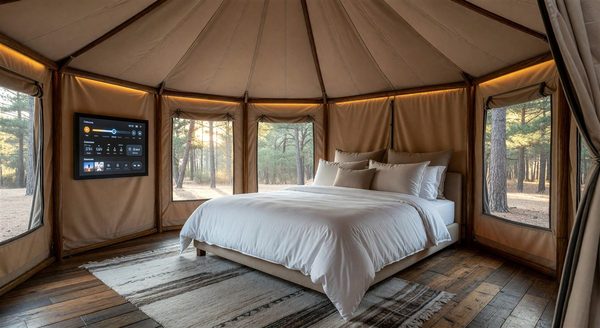
Climate control: Heating and cooling appropriate to your climate is expected in enclosed glamping accommodations. Smart thermostats with remote access allow operators to pre-heat or pre-cool units before guest arrival and manage energy costs between stays.
USB charging stations: Multiple USB-A and USB-C charging outlets in glamping accommodations are a baseline expectation for modern guests — as important as adequate lighting.
Pricing Strategy for Glamping
Glamping pricing requires more sophisticated strategy than standard site pricing because the guest segment, competitive landscape, and cost structure are all different.
Cost-based floor: Calculate your fully-loaded cost per glamping unit night (housekeeping labor, linen costs, amenity provisions, utilities, maintenance, capital depreciation). This is your absolute floor — your minimum rate to avoid losing money on each booking.
Market comparison: Research comparable glamping properties in your region — not just your campground neighbors, but Hipcamp, Glamping Hub, and Airbnb listings for similar accommodations within your driving radius. Understand where your accommodations sit in that competitive landscape.
Dynamic pricing: Apply revenue management principles to glamping accommodations as aggressively as you would to standard sites. Peak weekend premiums, early-booking incentives for shoulder season, last-minute availability discounts — glamping accommodations warrant active pricing management given their higher unit value.
Frequently Asked Questions
What’s the minimum number of glamping units to make the operation financially viable? Glamping operations with fewer than 6–8 units typically struggle to generate enough revenue to justify the dedicated housekeeping and operational investment required. Below that threshold, operators often find that glamping units are high-maintenance for their revenue contribution relative to RV sites. If starting with glamping, 8–12 units is a threshold that provides enough revenue volume to support dedicated operational investment.
Should glamping accommodations be marketed differently than standard sites? Yes. Glamping guests discover accommodations through different channels (Hipcamp, Glamping Hub, Airbnb, Instagram) and make decisions based on different factors (aesthetic, experience, amenity level) than traditional campers. A marketing approach specific to glamping — quality photography, platform-specific listings, lifestyle-oriented social media content — is necessary to reach and convert the glamping guest segment.
How do I handle a glamping unit that has a serious maintenance issue mid-stay? Have a clear relocation protocol: if the issue materially affects the guest’s use of the accommodation (heating failure in cold weather, plumbing problem, major structural issue), offer relocation to a comparable or upgraded accommodation. Have backup accommodations available, or establish relationships with nearby properties that can accommodate guests in a genuine emergency. Clear communication, a sincere apology, and an appropriate rate adjustment for any disruption experienced address most situations.
What’s the biggest mistake new glamping operators make? Underestimating the housekeeping and maintenance intensity of the operation and trying to run glamping accommodations with the same light-touch approach used for RV sites. Glamping accommodations require hotel-level operational systems — housekeeping protocols, inspection procedures, maintenance programs, quality standards — scaled to an outdoor hospitality context.
Further Reading from Authoritative Sources
- ARVC glamping operations standards and outdoor hospitality guidance — ARVC provides glamping operations guidance and tracks the segment’s growth within the outdoor hospitality industry, making it the most relevant trade authority for the operational technology requirements that distinguish glamping from standard campsite management.
- Glamping overview and hospitality category development — Wikipedia’s glamping article provides authoritative background on the glamping category’s development and the hospitality standard expectations it has established, providing context for why the operational technology requirements differ so significantly from standard camping.