Many campgrounds have evolved their camp store beyond basic convenience items into full food service operations — prepared breakfast items, pizza, sandwiches, ice cream, and full-service restaurant concepts at larger resorts. This evolution into food service introduces regulatory, operational, and technology requirements significantly more complex than retail merchandise management.
Understanding the technology stack appropriate for campground food service — and the regulatory environment that governs it — helps operators run compliant, efficient food operations.
Types of Campground Food Service
Campground food service spans a wide range:
Convenience retail: Pre-packaged items only — chips, candy, frozen meals, beverages. Lowest regulatory complexity; standard retail POS is adequate.
Grab-and-go prepared food: Pre-made sandwiches, baked goods, coffee. Typically requires a food handler permit and safe food handling practices; may require refrigeration temperature logging.
Limited hot food preparation: Pizza, hamburgers, hot dogs — simple hot food prepared to order. Full food service permit required in most jurisdictions; food handler certification, equipment inspection, commercial kitchen standards apply.
Full restaurant service: Breakfast menus, expanded food service at larger resorts. All of the above plus potentially a full commercial kitchen, hood systems, grease management, and higher-capacity equipment.
Each step up the food service complexity scale adds regulatory requirements and operational investment. Understanding where you want to be on this spectrum — and planning your investment accordingly — prevents building a food service operation that’s out of compliance or over-invested relative to the market you serve.
Point-of-Sale Systems for Camp Store Food Service
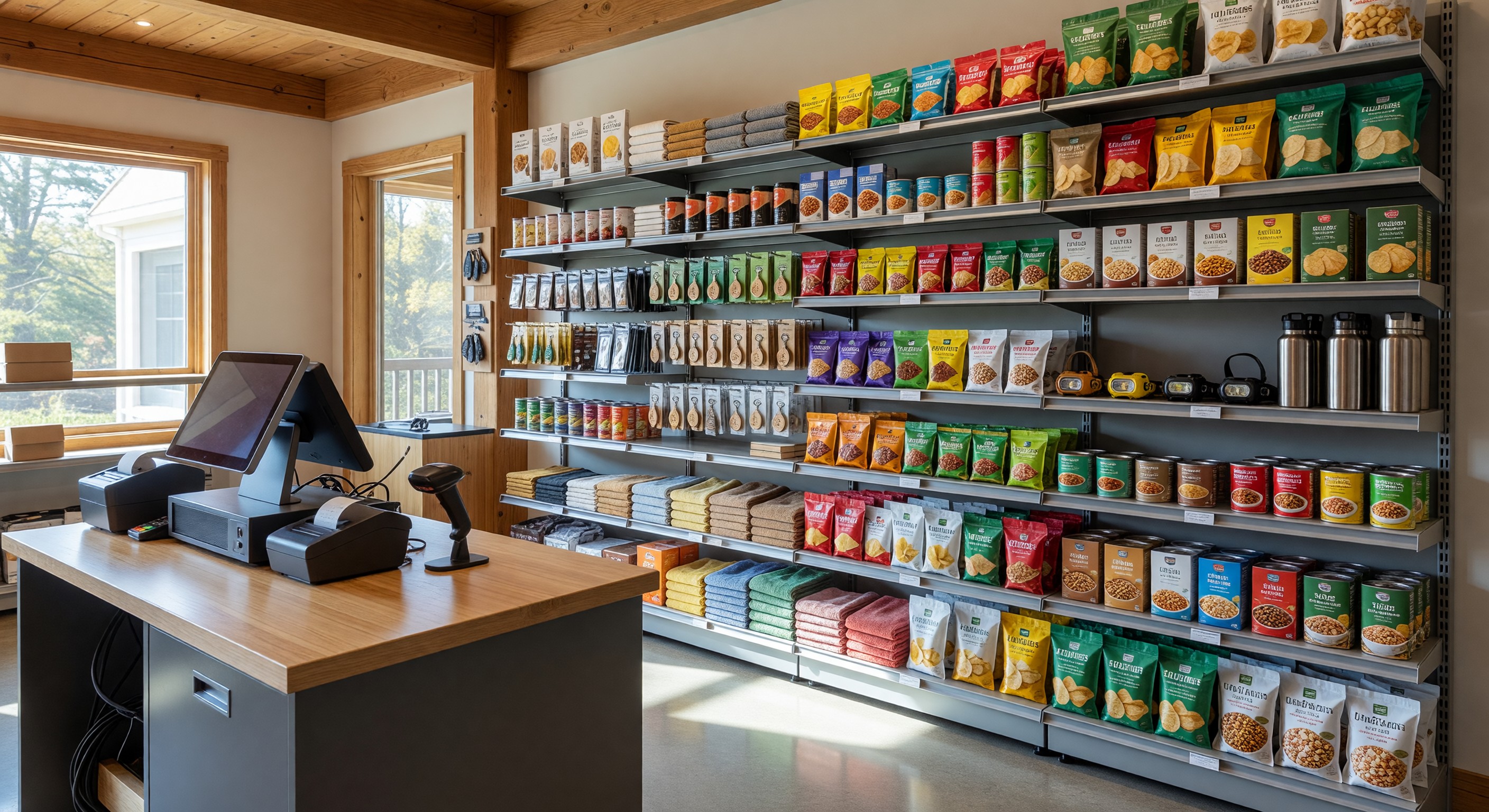
The POS system for a camp store with food service must handle both retail and food service transaction types.
Retail POS requirements:
- Barcode scanning for packaged merchandise
- Inventory tracking with automated reorder alerts
- Cash, credit/debit, and campground account payment methods
Food service POS requirements:
- Menu item ordering with modifier capability (e.g., “no onions,” “extra cheese”)
- Kitchen display system or printed kitchen ticket routing
- Tab management for table service if applicable
- Integration with food inventory for ingredient-level tracking
Platforms that handle both retail and food service transactions include Toast (restaurant-focused), Square for Restaurants, and Lightspeed Restaurant. Camp store-specific needs — blending retail and food service in one transaction, integrating with campground management for account charging — may require integration testing with your specific PMS.
Account charging: Many campground guests prefer to charge camp store purchases to their site account for checkout billing. This “charge to site” capability, available in some PMS-integrated POS systems, reduces cash handling, improves guest convenience, and may increase camp store spend.
Food Safety Technology
Food safety compliance requires temperature monitoring, logging, and documentation that technology can automate.
Temperature monitoring: Refrigeration units and hot holding equipment must maintain food at safe temperatures (below 41°F for cold food, above 135°F for hot food). Manual temperature logs are the traditional approach; digital temperature sensors with cloud logging provide continuous monitoring and automatic alerts when temperatures fall out of range — catching failures before they become food safety events.
HACCP documentation: For food service operations above a certain scale, Hazard Analysis Critical Control Points (HACCP) plans may be required by local health departments. Digital HACCP tools help food service operators document critical control points, monitoring procedures, and corrective actions.
Food handler certification tracking: Food handler certifications (ServSafe and state-equivalent programs) expire and must be renewed. Tracking certification status for all food handling staff — and ensuring new hires complete certification before handling food — is a compliance obligation that benefits from a simple tracking system.
Health inspection preparation: Health departments conduct periodic unannounced inspections of food service operations. A digital compliance calendar that tracks when required cleaning tasks, equipment checks, and documentation reviews are due — and provides confirmation that they happened — demonstrates the systematic compliance approach that inspectors reward.
Supply Chain and Inventory for Food Operations
Food inventory management is more complex than retail merchandise for several reasons: perishability requires tighter control, food costs are a larger percentage of food revenue than merchandise margins, and recipe-based inventory (where multiple ingredients go into one menu item) is harder to track than unit-based retail.
Food cost management: Tracking food cost as a percentage of food revenue — and investigating when that percentage is higher than expected — reveals where cost is leaking (waste, theft, over-portioning, supplier price increases).
Perishable ordering cadence: Order frequency for perishables should match the time window within which items will be used, not maximizing purchase size. Ordering fresh produce twice a week in small quantities results in less waste than weekly large orders. Building this cadence discipline is more important than the specific tools used to track it.
Supplier relationships: Local food suppliers — bakeries, produce suppliers, specialty food vendors — who understand seasonal campground demand patterns can be valuable partners. Building these relationships before you need emergency supply flexibility is worthwhile.
Frequently Asked Questions
What permits do I need to add prepared food service to my camp store? Requirements vary by jurisdiction. Most jurisdictions require: a food service establishment permit from the county or city health department, a food handler permit for each staff member handling food, and compliance with the physical facility requirements for your food service category (commercial kitchen equipment, ventilation, handwashing stations). Contact your local health department before building out food service — permit requirements vary significantly and inspections are required before opening.
Is a food service liability claim likely if a guest gets sick from camp store food? Foodborne illness claims can be serious and expensive. Restaurants and food service operators face significant liability exposure for foodborne illness outbreaks. Proper food safety practices — temperature control, proper storage, sanitation, staff training — are both regulatory requirements and liability risk mitigation. Food service liability coverage should be confirmed with your insurance carrier before starting food operations.
Should I use a commissary arrangement rather than on-site food preparation? A commissary arrangement — purchasing prepared food from a licensed commercial kitchen and reselling it — significantly reduces the regulatory and operational burden compared to on-site food preparation. The campground acts as a food retailer rather than a food manufacturer. This model works well for grab-and-go items (pre-made sandwiches from a local bakery, baked goods from a local cafe) and may be appropriate as a starting point before investing in on-site preparation capability.
How do I manage seasonal staffing for food service? Food service requires certified and trained staff, which creates challenges with seasonal turnover. Strategies that help: running a simplified menu during shoulder season when staffing is limited; identifying and retaining 2–3 core food service staff who return each season; using a commissary model during lower-occupancy periods when full food service staffing isn’t justified; and scheduling ServSafe training for new seasonal hires as part of onboarding so certification is completed before they’re needed on the line.
Further Reading from Authoritative Sources
- FDA food safety regulations and HACCP guidance for retail food operations — The FDA regulates retail food safety through the Food Code and publishes HACCP guidance that applies to the temperature monitoring and documentation practices campground camp stores must follow for perishable food management.
- ARVC campground food service operations guidance — ARVC provides operational guidance for campground food service programs and tracks adoption of food service models across the industry, making it the appropriate trade authority for campground-specific food service operations.