Campgrounds are outdoor environments where guests are more exposed to natural hazards than in most other hospitality settings. Severe weather, lightning, wildfires, flooding, medical emergencies, and security incidents can occur, and campground operators bear responsibility for having plans and systems in place to protect guests when they do.
Emergency management technology doesn’t eliminate risk — but it enables faster response, better coordination, and more effective communication when emergencies occur. This article covers the technology tools and frameworks that support effective campground emergency preparedness.
Building the Digital Emergency Plan
Every campground should have a written emergency action plan (EAP) that documents procedures for likely emergency scenarios. The EAP should be:
- Accessible to all staff: Not locked in a manager’s filing cabinet, but available digitally to all team members through a shared drive or internal knowledge base
- Specific to your property: Generic templates are starting points; the actual plan must reflect your specific sites, facilities, emergency access points, and nearest emergency services
- Regularly tested: Annual tabletop exercises — walking through emergency scenarios with staff — identifies gaps before a real emergency reveals them
Core EAP components:
- Chain of command: Who is in charge during an emergency when management may not be immediately available
- Scenario-specific procedures: Severe weather, fire, medical emergency, violent incident, search for missing person
- Emergency contact list: Local law enforcement, fire department, ambulance, utility emergency lines, insurance carrier, ownership
- Property maps showing: Emergency vehicle access routes, utility shutoff locations, assembly points, site that requires special evacuation attention (accessibility-limited guests)
- Guest notification procedures: How guests are informed of emergencies and what they’re asked to do
Severe Weather Monitoring and Response
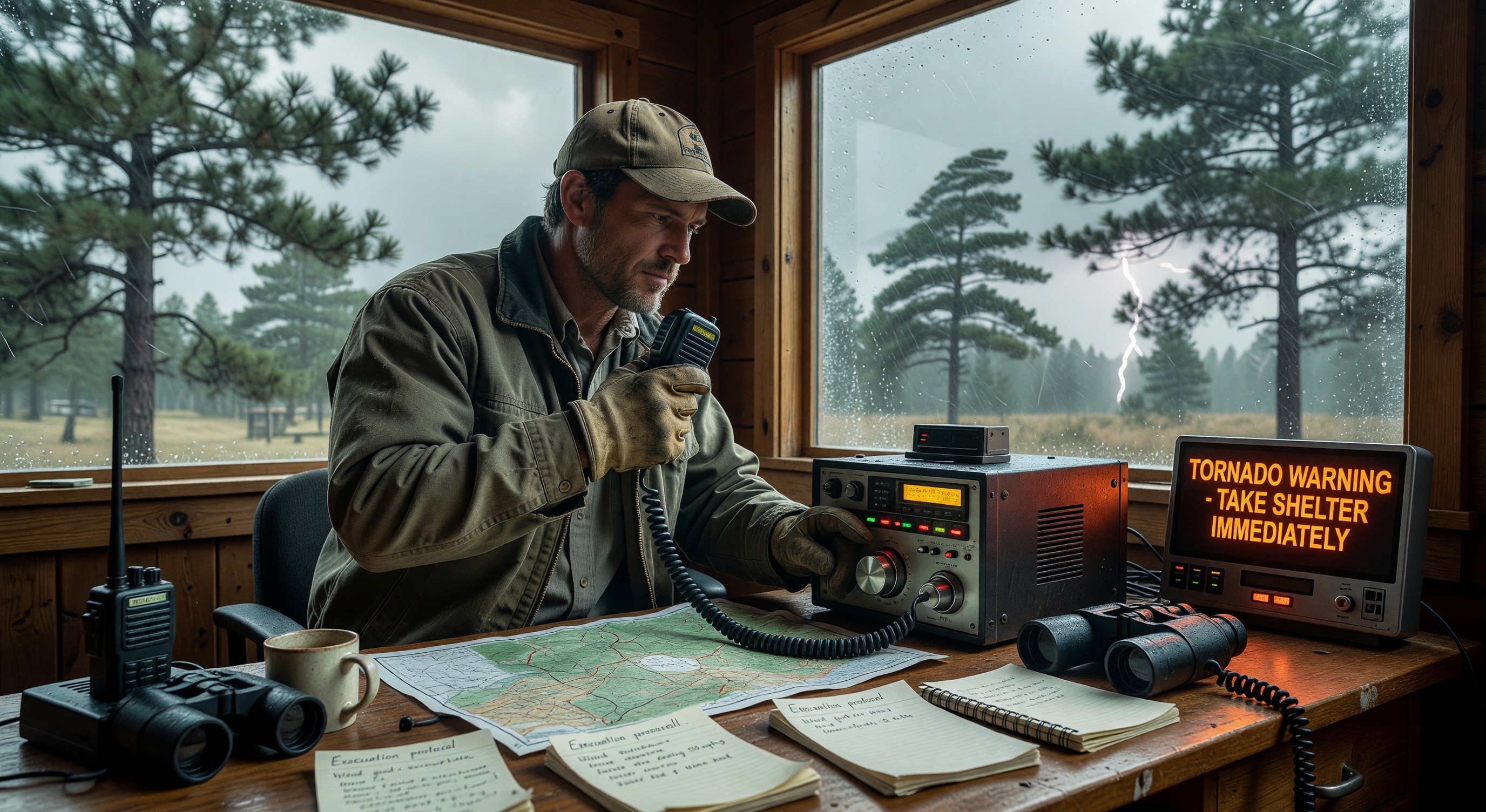
Weather is the most frequent emergency management trigger for most campgrounds. The geographic risk varies — tornado risk in the Midwest, hurricane risk on coastal properties, flash flood risk in mountain terrain, wildfire risk in western arid regions — but some form of severe weather risk exists everywhere campgrounds operate.
Real-time weather monitoring: Campground operators should have reliable access to real-time severe weather alerts for their specific location. Options:
- Weather alert radio with NOAA broadcasts — low cost, reliable, battery-powered backup
- Smartphone weather apps with push notifications for severe weather alerts
- Purpose-built weather monitoring platforms that provide more granular lightning and storm tracking
- On-site weather stations (discussed in the guest experience section) that provide local condition monitoring
Lightning response protocol: Lightning is a significant risk at campgrounds where guests are outdoors. A defined lightning response — including distance-from-storm thresholds for action, what guests are told to do (shelter in hard-sided RVs or permanent structures, avoid trees and bodies of water), and how the message is communicated — should be documented and practiced.
Campground-wide notification systems: How do you quickly reach all guests with an emergency notification? Options in order of reach and reliability:
- PA/loudspeaker systems covering the campground (most reliable for on-property guests)
- Emergency mass text/email to registered guests (fastest for guests not in common areas)
- Air horn or siren signals (backup option requiring guests to know the signal meaning)
- Security patrol driving through and shouting (labor-intensive but reaches everyone)
Ideally, multiple notification methods are available and used simultaneously. Emergency mass communication through the reservation system — automatic text alerts to all guests currently checked in — is a capability worth specifically evaluating when selecting reservation software.
Medical Emergency Response Infrastructure
Campgrounds face a specific medical emergency challenge: they’re often located far from emergency medical services, with response times potentially measured in 15–30 minutes rather than 5 minutes in urban areas.
AED deployment: Automated External Defibrillators (AEDs) deployed in accessible locations (main office, bathhouse, pool area) and staff trained in CPR/AED use significantly improve outcomes for cardiac arrest — where survival rates drop approximately 10% for every minute without defibrillation.
First aid supply stations: Comprehensive first aid supplies accessible to staff (not locked in a manager’s office) enable immediate basic response while emergency services are en route.
Emergency vehicle access: Ensuring that emergency vehicles — ambulances, fire trucks — can reach all areas of the campground. This means maintaining minimum lane widths, marking dead-end roads that could trap emergency vehicles, keeping roadways clear of obstacles, and having current maps ready to provide to dispatchers when calling for emergency services.
911 location information: When calling 911 from a campground, providing the specific site number and location is critical for responders to reach the patient quickly. This means staff having immediate access to current arrival information showing which guest is at which site, and being trained to provide this information to dispatchers.
Wildfire Response Planning
Campgrounds in or adjacent to forested land face wildfire risk that requires specific planning beyond general emergency preparedness.
Evacuation route planning: Identify primary and secondary evacuation routes from all areas of the campground. Ensure all staff know these routes and that they’re documented on the emergency map. Consider that during an evacuation, many RVs will be moving simultaneously — traffic flow planning for the exit lanes matters.
Early warning systems: Monitoring local fire information channels (official fire information websites, local emergency management alerts, Wireless Emergency Alerts via cell phone) provides advance notice of nearby fire activity.
Guest registration and tracking: During an evacuation, knowing how many guests are on property and being able to account for them is critical. The current reservation roster in your PMS is your primary tool for this — which is one more reason why an accurate, up-to-date reservation system is a genuine safety asset, not just a business tool.
Fire mitigation: Defensible space around structures and facilities, firewood storage away from buildings, campfire ring design and enforcement, and restrictions on generator spark-producing equipment reduce fire ignition risk on property.
Beyond evacuation-level events, sustained wildfire smoke without an active fire nearby has become its own operational challenge — see Campground Smoke and Air Quality Management: Technology for Wildfire Season Operations for AQI monitoring, guest alerting, and cancellation policy frameworks.
Technology Limitations in Emergencies
A realistic assessment includes understanding what technology may fail when you need it most:
- Cellular networks often become congested or fail during major disasters
- Internet connectivity may be unavailable during power outages
- Electronic access control systems require power and connectivity to function
Backup systems and procedures:
- Battery-powered weather radio not dependent on internet
- Paper-based emergency contact lists (not just in digital format)
- Gate access override procedures that allow manual operation if electronic systems fail
- Portable radios for staff communication if cellular fails
Frequently Asked Questions
How should campgrounds communicate with guests who don’t check their phones regularly? This is a real challenge. A multi-channel approach — PA announcement, security patrol, text message — maximizes reach. Some campgrounds post emergency procedures in the campground guide and at check-in, including instructions for accessing the campground app or text alerts. For severe weather, an audible alarm (air horn, siren) that’s explained to guests at check-in is the most reliable backup for guests who aren’t monitoring their phones.
What insurance considerations relate to campground emergency preparedness? Liability insurers may ask about emergency preparedness as part of coverage underwriting. A documented emergency action plan, AED deployment, staff CPR training, and regular emergency drills are all factors that support favorable coverage terms. Consult with your insurance broker about what documentation they want to see and what risk management practices affect your coverage.
How do we handle guests who refuse to comply with emergency instructions? This is primarily a communication and de-escalation challenge. In a genuine emergency, law enforcement presence (if available) provides authority. Clear explanation of the risk and the specific action requested, from a calm and authoritative voice, resolves most situations. Pre-stay communication about emergency procedures — included in the check-in information — establishes expectations before emergencies occur.
Should campground staff be trained in first aid? Yes. At minimum, managers and supervisors should hold current CPR/AED certification. For campgrounds with pools, lifeguard certification for pool staff may be legally required. More broadly, having multiple staff trained in first aid across different shifts ensures that trained response capability is available throughout operating hours, not only when a specific person is on shift.
Further Reading from Authoritative Sources
- NFPA fire safety standards and emergency action plan requirements — NFPA 1 (Fire Code) and NFPA 101 (Life Safety Code) govern emergency action plan requirements for facilities open to the public, including campgrounds.
- CDC emergency preparedness and community health guidance — The CDC’s emergency preparedness resources include guidelines on community response to weather emergencies, medical emergencies, and communicable disease outbreaks — all of which are relevant to campground emergency planning.