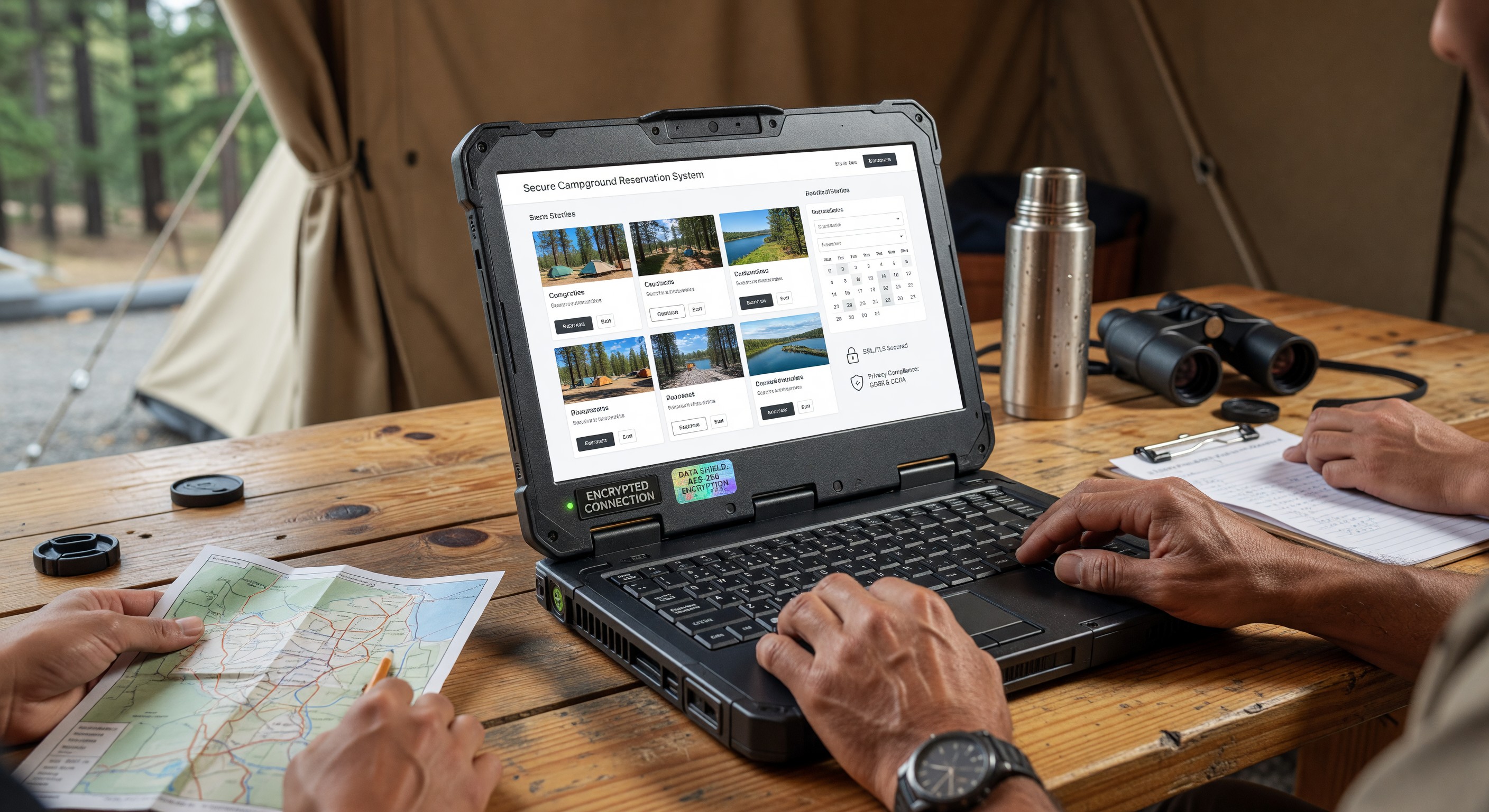
Campground operations collect and store significant amounts of guest personal data: names, contact information, credit card data, vehicle information, and in some cases ID copies and loyalty program records. Operators who haven’t thought carefully about how this data is protected and managed face both legal risk (privacy regulations) and operational risk (breach incidents).
This doesn’t require enterprise-level security programs — but it does require thoughtful practices appropriate to the nature and volume of data campground operations handle.
What Data Campgrounds Collect and Why It Matters
Reservation data: Name, email, phone number, address, vehicle information, payment card details, arrival date, site assignment, special requests. This data is necessary for booking management and constitutes personally identifiable information (PII) subject to privacy regulations.
Payment data: Credit and debit card numbers, expiration dates, CVV codes during transaction processing. This data is subject to Payment Card Industry Data Security Standard (PCI DSS) requirements regardless of jurisdiction.
Access control data: Gate entry and exit logs, license plate records (if using LPR), access credential issuance records. This data could reveal guest movement patterns.
Security camera footage: Video recordings from cameras covering entry points, common areas, and potentially site areas. Retention and access policies are important privacy considerations.
Guest communication data: Email and text message histories, guest-reported issues, and service notes that may contain personal information.
The accumulation of this data across all these systems — often without a conscious inventory or management approach — is the data privacy starting point for most campground operators.
PCI DSS Compliance for Payment Processing
Payment Card Industry Data Security Standards (PCI DSS) are the baseline security requirements that apply to any business accepting credit card payments. Non-compliance creates both regulatory risk and increased liability if cardholder data is breached.
The most important PCI principle for small operators: Don’t store payment card data. Let your payment processor handle card data storage and processing — they have the security infrastructure and compliance certifications to do this properly. Configure your systems so that card data never touches your local systems.
Practical implications:
- Use a payment processor (Stripe, Square, PayPal, or a campground-specific processor) rather than processing cards yourself
- Ensure your campground PMS is configured to tokenize card data — storing a token reference rather than actual card numbers
- Never write down card numbers or store them in spreadsheets
- Use chip-card readers that support EMV transactions rather than magnetic stripe only
Annual PCI self-assessment: Most small businesses qualify for the simplified PCI SAQ (Self-Assessment Questionnaire) rather than a full PCI audit. Your payment processor can provide guidance on which questionnaire applies to your processing setup.
State Privacy Law Compliance
The privacy regulatory landscape has become more complex as state-level privacy laws multiply. As of 2025, numerous states have enacted comprehensive privacy legislation with varying requirements.
California CCPA/CPRA: If you accept bookings from California residents (which any campground with a web-booking presence does), California’s privacy laws may apply. Key requirements include privacy policy disclosure, the right to know what data you collect, the right to request deletion of personal data, and the right to opt out of sale of personal information.
Other state laws: Virginia, Colorado, Connecticut, Texas, and other states have enacted comprehensive privacy legislation with similar (though varying) requirements. The trend is toward more states enacting privacy laws with increasingly similar frameworks.
Practical minimum compliance:
- Publish a privacy policy on your website that describes what data you collect, how it’s used, and how guests can contact you about their data
- Honor deletion requests from guests who request them (subject to legitimate retention requirements for financial records)
- Review your third-party data sharing — if you share guest data with OTAs, marketing services, or other vendors, your privacy policy should disclose this
Operational Data Security Practices
Beyond regulatory compliance, basic data security practices protect both guests and the campground from breach incidents:
Access control: Employees should have access only to the data necessary for their role. Front desk staff need access to current reservations; they don’t need access to multi-year financial records or administrative system credentials.
Password management: Unique, strong passwords for all business accounts. No password reuse across systems. A business password manager (1Password Teams, Bitwarden Business) enables this without requiring staff to memorize dozens of complex passwords.
Software updates: Keep your operating systems, reservation software, and other business software updated. Many breaches exploit known vulnerabilities in outdated software.
Endpoint security: Campground computers that access reservation systems and payment processing should have up-to-date antivirus/anti-malware software. This is basic hygiene that most small businesses implement inconsistently.
Wi-Fi separation: Guest Wi-Fi and operational Wi-Fi (the network connected to your reservation system and POS) should be separate networks. Guest devices on the same network as your business systems create unnecessary exposure.
Backup and recovery: Business data — reservation history, financial records, customer contacts — should be backed up regularly to a location separate from your primary system. Cloud-based reservation systems handle this automatically; local systems require explicit backup configuration.
Incident Response Planning
Despite best practices, data incidents happen. Having a basic incident response plan prevents a bad situation from becoming catastrophically bad.
Breach response basics:
- Who is responsible for managing the response?
- How do you assess the scope of what was exposed?
- What breach notification requirements apply in your state (most states require notifying affected individuals within defined timeframes)?
- How do you communicate with affected guests?
- When do you involve law enforcement?
State breach notification laws vary, but most require notification to affected individuals within 30–90 days of discovering a breach involving their personal information. Some states also require notification to the state attorney general or a designated regulatory body.
Frequently Asked Questions
Do campgrounds need to hire cybersecurity consultants? For most campground operations, foundational data security (using cloud-based reservation systems from reputable vendors, PCI-compliant payment processing, strong password practices, software updates) provides adequate protection without specialized cybersecurity consulting. Operators processing high volumes of transactions or holding sensitive data beyond the standard reservation data set may benefit from a periodic security assessment.
What should the campground privacy policy include? At minimum: what personal data you collect, how you use it (reservation management, communication, marketing if applicable), who you share it with (payment processors, OTA partners, if any), how long you retain it, and how guests can contact you to exercise their privacy rights. A privacy policy template from a privacy-focused law firm or a GDPR/CCPA compliance tool provides a starting framework that can be customized to your specific data practices.
Can I use guest email addresses for marketing? You can market to guests who have provided their email for reservation purposes, subject to applicable opt-out requirements (CAN-SPAM in the US requires a functioning opt-out mechanism in all commercial emails). More permissive marketing to guests who haven’t explicitly opted in may raise issues under stricter state privacy laws. For Canadian guests, CASL requires explicit opt-in consent before sending commercial electronic messages. When in doubt, send only transactional messages (reservation confirmations, pre-arrival information) to all guests, and marketing only to those who have explicitly opted in.
How long should I retain guest reservation data? Retain financial records (including reservation records with payment information) for the period required by tax law — generally 7 years. Guest contact information for marketing purposes can be retained indefinitely unless the guest requests deletion. Balance this against privacy law minimization principles: don’t retain data longer than necessary for the purpose for which it was collected.
Further Reading from Authoritative Sources
- FTC data security and privacy requirements for small businesses — The FTC is the primary federal regulatory body for data security and privacy practices for businesses including campground operators, and publishes specific guidance for small businesses on data protection obligations and breach response requirements.
- PCI DSS requirements overview and campground compliance — Wikipedia’s PCI DSS article provides authoritative technical background on the Payment Card Industry Data Security Standard requirements that apply to every campground accepting credit card payments, helping operators understand their specific compliance obligations.