The check-in experience is a guest’s first direct interaction with campground operations. A smooth check-in — quick, informative, and friendly — sets a positive tone for the entire stay. A frustrating check-in — long lines, missing information, the wrong site, a gate code that doesn’t work — sets the opposite tone, one that guests need to overcome before they can enjoy their visit.
Check-in technology helps campground operators deliver consistently good arrival experiences, even during the peak Saturday afternoon rush when a dozen RVs are all trying to check in simultaneously.
The Check-In Bottleneck Problem
The check-in bottleneck is real at busy campgrounds. At 3pm on a summer Friday, a popular campground might have 20–30 arriving parties in a 90-minute window. Each check-in involves: finding the reservation, verifying identity and vehicle information, collecting any outstanding balance, assigning a site, issuing a gate code or key, reviewing campground rules, and answering questions. At 5–7 minutes per party, that’s 100–210 minutes of front desk capacity — rarely what’s staffed.
The result is lines, frustrated guests, and front desk staff who are rushed, stressed, and unable to provide the welcoming first impression they’d like to deliver.
Technology addresses this bottleneck by either speeding individual check-ins or shifting them out of the peak window entirely.
Online Pre-Check-In
Online pre-check-in allows guests to complete check-in tasks before they arrive. The most common implementation:
- Guest receives a pre-arrival email with a check-in link (typically sent 24–48 hours before arrival)
- Guest confirms their details (party size, vehicle information, any changes)
- Guest signs campground rules acknowledgment and any required waivers electronically
- Guest receives site assignment (if you pre-assign) and gate access information
- On arrival, they proceed directly to their site without stopping at the office
When guests complete pre-check-in, their arrival process reduces from 5–7 minutes to essentially nothing — they drive in, their gate credential works, and they proceed to their site. Front desk arrival processing needs only a brief visual confirmation that the right vehicle is arriving.
Pre-check-in completion rates vary. Guests who are motivated (first-time visitors who want to arrive smoothly, tech-comfortable demographics) complete it readily. Guests who are less engaged or who procrastinate need a reminder text the morning of arrival. Most campgrounds see 40–70% pre-check-in completion with a good reminder workflow.
Self-Service Check-In Kiosks
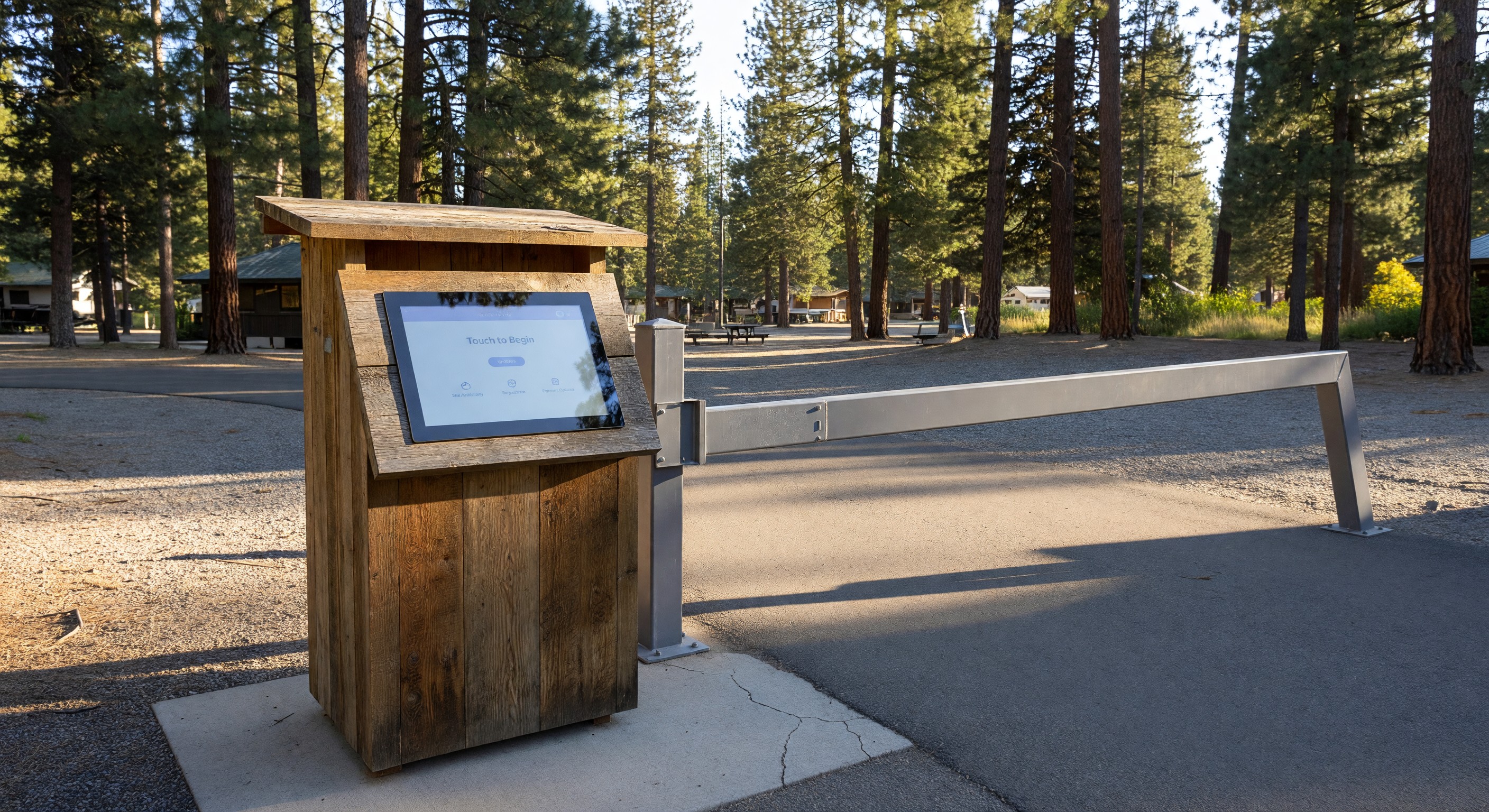
For guests who arrive without completing pre-check-in, self-service kiosks provide an alternative to waiting for front desk staff.
Kiosk capabilities typically include:
- Reservation lookup by confirmation number, last name, or phone number
- Identity verification (driver’s license scan)
- Electronic waiver signature
- Payment collection for outstanding balance
- Site assignment display or selection (if choice is offered)
- Gate code delivery or wristband printing
- Campground guide and map printing or QR code
Well-implemented kiosks handle 70–80% of check-ins without staff involvement, freeing front desk staff for guests who have questions, need exception handling, or simply prefer human interaction.
Hardware considerations: Kiosks for outdoor or semi-outdoor installation need weatherproof housings, high-brightness screens readable in daylight, and robust touchscreen interfaces. Indoor kiosks have more flexibility but may create lines in a small lobby.
Software integration: Kiosks must integrate with your reservation management system in real-time — reading reservation data and writing back completion status. Standalone kiosks that don’t connect to your main system create reconciliation problems.
Mobile Check-In
Some campground mobile apps support mobile check-in workflows — the guest’s smartphone serves as both the check-in interface and the gate access credential.
Mobile check-in is convenient for guests who are comfortable with apps and actively use the campground’s digital tools. Its limitations are the same as any app-based solution: not all guests want to download an app, and guests without cellular data may have connectivity problems at the moment of arrival.
The best mobile check-in implementations require no app download — a mobile-optimized web page accessed through a link in the pre-arrival email handles the check-in workflow in the mobile browser, delivering a QR code or gate code at completion.
Contactless Check-In Post-COVID
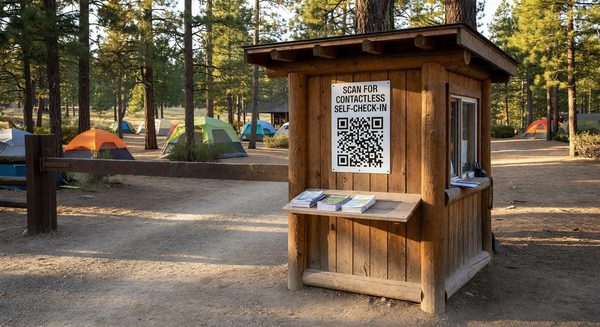
The COVID-19 pandemic accelerated campground adoption of contactless check-in dramatically. Campgrounds that had considered self-service check-in for years implemented it quickly in 2020 and 2021 as a safety requirement rather than a convenience feature.
The pandemic-era implementations revealed that most guests adapted readily to contactless arrival when the instructions were clear. Many campgrounds found that their peak-period check-in times dropped significantly with contactless workflows, and guest satisfaction maintained or improved.
Contactless check-in is now a guest expectation segment, particularly among younger campers and tech-comfortable demographics, rather than a novelty.
Staff-Assisted Check-In Optimization
Even with digital check-in tools, some check-ins require staff assistance. Optimizing the staff-assisted check-in workflow maximizes the throughput of the front desk staff who are needed.
Pre-pulled reservation packets: For reservations that didn’t complete pre-check-in, having paper (or digital) packets pre-prepared with site assignment and essential information reduces the time spent searching and assembling information at check-in.
Tablet-based check-in: Front desk staff using tablets rather than desktop computers can move to where the guest is — meeting them at the entrance rather than waiting behind a counter — for a more welcoming interaction while still accessing the reservation system.
Reservation queuing: Digital queue management that shows front desk staff which guests are waiting and in what order ensures efficient sequencing and prevents guests from being overlooked.
Frequently Asked Questions
What’s the most impactful check-in technology improvement for a small campground? Online pre-check-in with gate code delivery is the highest-impact change for most campgrounds — it’s low cost, guests adopt it readily, and it eliminates the arrival stop for guests who complete it. Implement this before investing in kiosk hardware.
How do I handle guests who arrive after office hours? After-hours arrival handling is one of the most important check-in scenarios to plan. Options: pre-check-in with gate code delivery before arrival, self-service kiosk accessible after hours, a late arrival lane with lockbox (containing an envelope with site assignment and key/code), or an after-hours phone line that connects to an on-call staff member. The right approach depends on your arrival pattern and staffing model.
Do check-in kiosks work for all guests? No. Some guests — those with accessibility needs, those who need significant questions answered, those who have reservation issues, those who prefer human interaction — need staff assistance regardless of kiosk availability. Design your check-in workflow to route exceptions to staff while moving routine check-ins through the self-service path. A “need help?” intercom button at the kiosk that reaches an on-call staff member handles most kiosk exceptions.
What information should be delivered at check-in regardless of method? Site assignment and directions to the site, gate access code or credential, campground rules summary (quiet hours, speed limit, check-out time), amenity information (pool hours, store hours, Wi-Fi credentials), emergency contact number, and where to find more information (digital guide QR code). Everything that guests need for their first night should be delivered at check-in — not assumed to be discovered independently.
Further Reading from Authoritative Sources
- ARVC campground operations standards and technology adoption benchmarks — ARVC tracks operational benchmarks including check-in throughput, technology adoption rates, and guest satisfaction scores across its member campgrounds.
- Go RVing research on RV traveler arrival expectations and digital service preferences — Go RVing publishes research on how traveler expectations for digital services have evolved, including data on which guest segments prefer contactless arrival options versus traditional check-in.