Artificial intelligence has moved from buzzword to practical business tool faster than most technology transitions. For campground operators, this creates both opportunity and noise: genuine tools that provide real operational value alongside significant marketing hype around capabilities that don’t yet work reliably in practice.
This guide focuses specifically on AI applications that campground operators can use today, with realistic expectations about what they can and can’t do.
Generative AI for Content and Communication
Generative AI — tools like ChatGPT, Claude, and Google Gemini — are the most broadly accessible AI tools for campground operators, and many have already found practical use cases.
Marketing content creation: Writing campground website copy, social media captions, email newsletter content, and blog articles is time-consuming work that generative AI can significantly accelerate. A campground operator can provide context (what the park offers, what makes it unique, who the target guest is) and generate draft content for review in minutes rather than hours.
Guest communication templates: Drafting response templates for common guest inquiries — cancellation requests, early check-in requests, local recommendation questions — is a natural use case. AI can generate multiple variation options that staff can review and personalize, reducing the cognitive load of crafting professional responses to repetitive questions.
Review responses: Generating personalized responses to guest reviews — both positive and negative — is another high-value use case. AI can draft responses that are warm, specific to the review content, and professionally appropriate. Staff review and edit before posting.
Operational documentation: Creating or updating standard operating procedures, employee handbooks, training materials, and safety protocols is another area where AI writing assistance saves significant time.
Realistic limitations: AI-generated content requires human review. Factual accuracy (hours, rates, amenity availability) must be verified against actual current information. Brand voice requires calibration over multiple iterations. And the content must be edited to ensure it accurately represents your specific property.
AI-Assisted Demand Forecasting
Some campground revenue management platforms are beginning to incorporate machine learning models for demand forecasting — predicting future booking pace based on historical patterns, economic indicators, local event calendars, and competitor rate data.
This type of AI is embedded in specialized software rather than being directly accessible to operators. Revenue management tools with AI-enhanced forecasting provide more accurate demand predictions than simpler trend-based models, translating into better pricing decisions.
What operators should know:
- AI forecasting performs better with more historical data — these tools improve over time as they accumulate property-specific patterns
- The output is a recommendation, not an instruction — operator judgment about local market conditions should inform how algorithmic recommendations are applied
- During unusual events (weather anomalies, significant local economic changes) historical-pattern models may be less reliable
AI Tools for Maintenance Management
Predictive maintenance — using AI to predict equipment failures before they occur — is a capability being developed for commercial facilities management. In the campground space, this is an emerging application with significant potential but limited current deployment.
What’s available today: Equipment monitoring platforms that detect anomalies in electrical consumption, vibration, or temperature patterns that may indicate developing problems. These aren’t purely AI in the traditional sense but apply data analytics to maintenance data in ways that improve early detection.
Near-term development: AI models that analyze maintenance history, equipment age, and usage patterns to predict which equipment is most likely to need service, allowing proactive scheduling rather than reactive response.
Practical current application: Campground operators can use historical maintenance data and expense records — even in simple spreadsheet form — to make better-informed decisions about equipment replacement timing by identifying patterns in repair frequency and cost escalation.
Natural Language Interfaces for Campground Systems
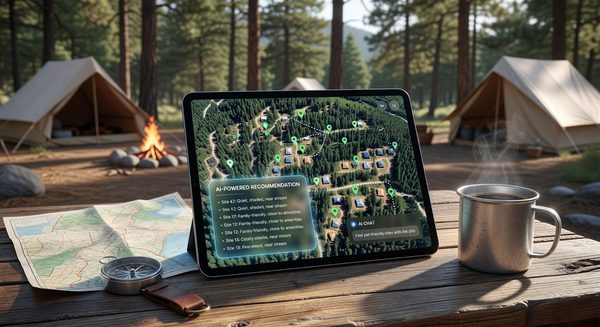
AI-powered chatbots and virtual assistants are increasingly embedded in campground reservation and management systems.
Guest-facing chatbots: AI chatbots on campground websites can answer common pre-booking questions (availability, rates, pet policies, site types), reducing the volume of phone calls and emails that require staff response. More sophisticated implementations guide guests through the booking process and handle simple modification requests.
Operational voice assistants: AI assistants that allow staff to interact with management systems through natural language — “What sites are available for a 40-foot RV this weekend?” — reduce the time spent navigating software interfaces.
Current limitations: Chatbot reliability for complex or unusual guest inquiries remains imperfect. Guest frustration with chatbots that can’t answer their specific question — and the absence of a clear path to a human alternative — can damage the experience these tools are intended to improve. Ensuring that AI-assisted guest communication always has a clear escalation path to human support is essential.
AI for Review Management and Sentiment Analysis
Managing guest reviews across multiple platforms (Google, TripAdvisor, Campendium, The Dyrt) is time-consuming and important. AI tools help campground operators manage this at scale.
Review aggregation and sentiment analysis: Tools that pull reviews from multiple platforms, categorize feedback by topic (cleanliness, facilities, staff, value), and identify sentiment trends give operators structured feedback without reading hundreds of individual reviews.
Response drafting: As noted above, AI tools can draft review responses for staff review and editing — accelerating the response process while maintaining human judgment and personalization.
Competitive intelligence: AI tools that monitor competitor review activity — tracking sentiment trends, common complaints, and service differentiators at competing campgrounds — provide market intelligence that helps operators understand where they’re winning or losing on specific dimensions.
What AI Can’t Replace in Campground Operations
Amid the genuine utility of AI tools, it’s worth being explicit about what AI doesn’t do well in campground operations:
Human relationship and hospitality: The warmth of a genuine human interaction — a staff member who remembers a returning guest, notices a family struggling with their tent and offers to help, or handles a difficult situation with grace — is the core of hospitality. AI tools support the operational infrastructure; they don’t substitute for human connection.
Physical operational tasks: Setting up sites, maintaining equipment, cleaning facilities, and providing on-property service are physical work that AI doesn’t directly affect.
Judgment in complex situations: Guest complaints with ambiguous facts, conflicts between guests, unusual reservation situations that don’t fit standard policies — these require human judgment that AI can assist but can’t replace.
Frequently Asked Questions
How do I start using AI tools without getting overwhelmed? Start with one high-value, low-risk use case: generate draft responses to your most common guest inquiry types and review them. This builds intuition for what AI does well (generating readable, contextually appropriate prose) and where it needs more human editing (specific factual details, brand voice calibration). Add use cases gradually as you develop confidence.
Are there AI tools designed specifically for campgrounds? Campground-specific AI features are beginning to appear in reservation and management platforms, but general-purpose AI tools (ChatGPT, Claude, Gemini) are currently more capable and accessible than campground-specific products. The campground software industry is likely to incorporate more AI features over the next 2–3 years.
How much time can AI tools realistically save in campground operations? For content creation, email drafting, and review response, operators who actively use AI tools report saving 2–5 hours per week — significant for small operations. For more complex applications (predictive analytics, automated scheduling), the time savings are harder to estimate independently because they’re embedded in platform features.
Should I be concerned about AI taking over campground operations jobs? The campground jobs most affected by AI automation are content creation and routine communication tasks. Front desk interactions, guest hospitality, physical operations, and complex judgment work remain fundamentally human. AI is more accurately described as a tool that changes how work is done rather than a replacement for the people doing it.
Further Reading from Authoritative Sources
- ARVC campground technology adoption and AI operations resources — ARVC tracks technology adoption trends across the campground industry and provides guidance on emerging tools including AI applications, making it the most relevant trade authority for the AI adoption landscape described in this article.
- Machine learning and AI pricing model fundamentals — Wikipedia’s machine learning article provides authoritative background on the algorithmic approaches underlying AI dynamic pricing and predictive maintenance tools, supporting readers who need foundational context before evaluating campground AI products.