AI-powered pricing has gone from a 2023 industry talking point to a shipped feature across three of the major campground reservation platforms. Campspot, Firefly Reservations, and Insider Perks each now offer some version of algorithmic pricing recommendations — but the capabilities, how much is actually automated, and what operators need to do themselves differ substantially.
Here’s what each platform currently delivers and what operators should realistically expect.
What “AI Pricing” Actually Means in Campground Software
Before comparing platforms, it helps to be precise about terms. Most campground software marketed as “AI pricing” operates in one of two modes:
Rule-based dynamic pricing adjusts rates according to operator-defined thresholds: when occupancy exceeds 70%, increase Friday rates by 15%; when a site type has fewer than five nights available in a window, raise the rate by $10. This is automation, not machine learning — the algorithm follows your rules, it doesn’t learn from patterns or generate its own recommendations.
Machine learning pricing recommendations use historical booking data, pace signals, seasonal patterns, and sometimes external data (local events, competitor rates) to generate recommended rates rather than just executing predefined rules. The system develops a model of your specific property’s demand and surfaces suggestions the operator reviews and approves — or that adjust automatically within bounds the operator sets.
Most platforms deployed “AI pricing” in 2024–2025 that is closer to the first category with elements of the second. The genuine machine learning layer is newer and, in some cases, still rolling out to all customers.
Campspot: Occupancy Prediction + Rate Recommendations
Campspot unveiled its AI-Powered Occupancy Prediction and Pricing Recommendations feature at its inaugural Camp Campspot user conference, and it has continued rolling out through 2025 into 2026. The feature is available on the Growth Package tier.
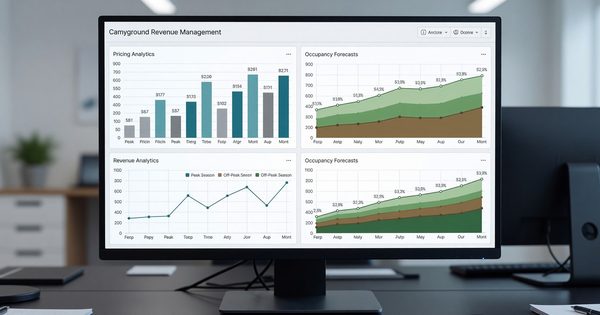
The system does two things: it forecasts occupancy trends for upcoming periods using historical data and booking pace, and it surfaces recommended rates within the same dashboard view. The intent is that operators can review both the forecast and the recommended rate adjustment together — seeing why a rate change is suggested (projected occupancy in 10 days is trending 20 points above this same period last year) alongside what the system recommends doing about it.
Campspot’s own year-in-review materials have reported meaningfully higher average revenue among campgrounds using dynamic pricing versus those that don’t, and a similar gap for parks actively using the platform’s analytics tools versus peers. These figures aggregate a wide range of operators and don’t isolate AI-specific pricing recommendations from rule-based dynamic pricing, and vendor-published performance data should generally be treated as directional rather than a guaranteed outcome for any individual property — but they’re broadly consistent with the general industry pattern that systematic rate management outperforms static, unmanaged pricing.
What operators should understand about Campspot’s AI pricing: the recommendations are suggestions, not automatic adjustments. Operators review them and confirm or override. The system is also relatively new — it will improve as it accumulates more property-specific data and as Campspot refines the model.
Firefly Reservations: Analytics-Forward Approach
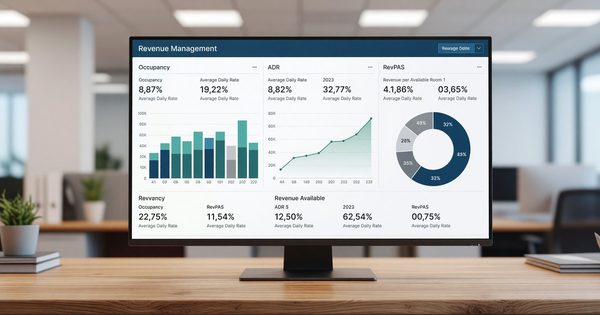
Firefly Reservations has built toward more sophisticated analytics rather than positioning a single feature as “AI pricing.” The platform gives operators access to revenue per available site (RevPAS), booking pace comparisons against prior years, source attribution, and guest lifetime value metrics — a reporting layer that supports manual rate decisions.
Firefly’s 2026 technology trends report, published on their blog, identifies AI-powered pricing recommendations that adjust rates based on occupancy pace, day of week, season, local events, and weather forecasts as a direction the industry is moving — which reads more as a category description than a feature announcement for a currently shipped Firefly product.
Operators evaluating Firefly for dynamic pricing should verify directly with the sales team which pricing automation is available in their tier. The platform’s strength is in its clean interface and transparent per-reservation pricing model (no marketplace commissions), which makes it popular with operators who want a simpler cost structure alongside reservation management.
Insider Perks and the Campy Ecosystem
Insider Perks operates differently from Campspot and Firefly — it’s a services and AI tooling layer that sits alongside a campground’s existing reservation software rather than replacing it. Its AI chatbot Campy handles 24/7 guest inquiries and can complete reservations directly in the chat interface, including checking real-time availability and walking guests through site options based on size, amenities, and preferences.
On the pricing side, Insider Perks has documented dynamic pricing work through its CampVantage program, with pricing algorithms optimized around seasonal fluctuations as part of the broader revenue strategy it implements for clients. The company has publicized strong guest-inquiry resolution rates for its AI chat and voice agents and reduced manual administrative task time for clients, though as with any vendor-published figure, operators should ask for methodology and request references before treating a marketed percentage as representative of their own property.
Insider Perks has also moved toward usage-based pricing for its Campy chatbot in recent years, shifting away from a flat monthly fee toward a lower per-chat rate for members of its broader CampVantage program. Exact current pricing tiers should be confirmed directly with the vendor, since SaaS pricing structures in this space have changed more than once in a short period. For operators who want AI-assisted guest communication and are willing to keep their existing reservation system, this model is worth evaluating separately from the question of AI pricing automation.
What the Platforms Converge On
Across all three, several patterns are consistent:
Recommendations, not automatic rate-setting. None of these platforms are setting your rates without your input, at least not by default. The operator reviews suggestions and confirms. This is appropriate for a technology that is still building track records with individual properties — operators who know their market should be reviewing algorithmic suggestions against their own judgment, not running fully automated pricing without oversight.
Historical data is the core input. Machine learning pricing models are only as good as the booking history they’re trained on. A park in its first year on a new platform will see weaker recommendations than one that has three seasons of data for the algorithm to work with. Expect the first year to be calibration.
Integration with your PMS matters. Pricing recommendations only work if they connect to where reservations are actually made. Campspot’s AI pricing is native — it reads from and writes to your Campspot reservation system automatically. If you’re using Insider Perks tools alongside a different reservation system, verify the data flow between the systems before assuming recommendations will stay in sync.
What Operators Should Evaluate
When a vendor pitches “AI pricing,” ask these specific questions before signing:
Is the pricing recommendation engine rule-based or does it generate recommendations from a learned model? The answer determines whether you’re automating your own rules or getting genuine algorithmic suggestions.
What data does the system train on — my property’s history, network averages, or both? Network-based models may smooth over the idiosyncrasies that make your market unique (a local event that always fills your park, a competitor situation that changed). Property-specific models take longer to be useful.
At what tier is AI pricing available, and what does moving to that tier cost? Campspot’s AI pricing feature requires the Growth Package — this may represent a meaningful cost increase for operators currently on lower tiers.
How do I review and override recommendations? A system that makes rate changes without a clear approval workflow creates risk. Understand the oversight mechanism before you set it loose on a holiday weekend.
Where This Technology Is Headed
The campground industry is roughly 5–7 years behind hotel revenue management in AI pricing sophistication, which means the tools available today are early versions of what will eventually become standard. The gap between rule-based dynamic pricing and genuinely predictive demand modeling is closing, but it hasn’t closed yet.
The operators getting the most out of current tools aren’t treating AI pricing as a fully automated revenue engine — they’re using it as a faster way to surface the same demand signals they’d track manually (booking pace, occupancy trajectory, prior-year comparison) and acting on those signals more consistently than they could without software assistance. That’s a useful improvement even before the genuine machine learning layer matures.
ARVC (National Association of RV Parks and Campgrounds) continues to track technology adoption across its membership base and is a useful source for industry-wide data on pricing tool adoption as these features evolve.
Frequently Asked Questions
Is AI pricing the same thing as dynamic pricing? Not exactly. Dynamic pricing can be purely rule-based — the operator sets thresholds and the system executes them. AI pricing implies the system is generating recommendations from a learned model of demand patterns rather than just following predefined rules, though many products marketed as “AI pricing” today are still closer to the rule-based end of that spectrum.
How much historical data does a park need before AI pricing recommendations are useful? There’s no fixed threshold, but most platforms need at least one to two full booking seasons of property-specific history before recommendations meaningfully outperform generic, network-wide benchmarks. A park in its first year on a new platform should expect a calibration period.
Should operators trust vendor-published performance statistics for these tools? Treat vendor-published figures as directional rather than a guaranteed outcome for any specific property. Ask the vendor for the methodology behind any percentage improvement claim, and where possible request references from operators with a similar property size and market before you factor any single number into your own revenue projections.
Does adopting AI pricing mean giving up manual control over rates? No — every major platform currently on the market frames AI pricing as a recommendation the operator reviews and approves, not an automatic rate-setting engine running without oversight. Understanding the specific approval workflow before adoption is one of the more important evaluation questions.
What should an operator ask before committing to an AI pricing feature at a higher software tier? Confirm exactly what the upgraded tier includes, what it costs relative to the current plan, whether the model trains on property-specific data or network-wide averages, and what the override and approval process looks like before rates change. It is also worth asking how long the vendor expects the calibration period to run on a property like yours.
Further Reading from Authoritative Sources
- ARVC campground technology and revenue management resources — ARVC tracks technology adoption trends and pricing strategy across its membership, making it the most relevant trade authority for understanding where AI pricing tools fit in the broader campground operator landscape.
- Campspot AI-Powered Occupancy Prediction and Pricing Recommendations announcement — Campspot’s own feature announcement provides the clearest description of what the platform’s AI pricing tools currently do and which plan tier includes access.