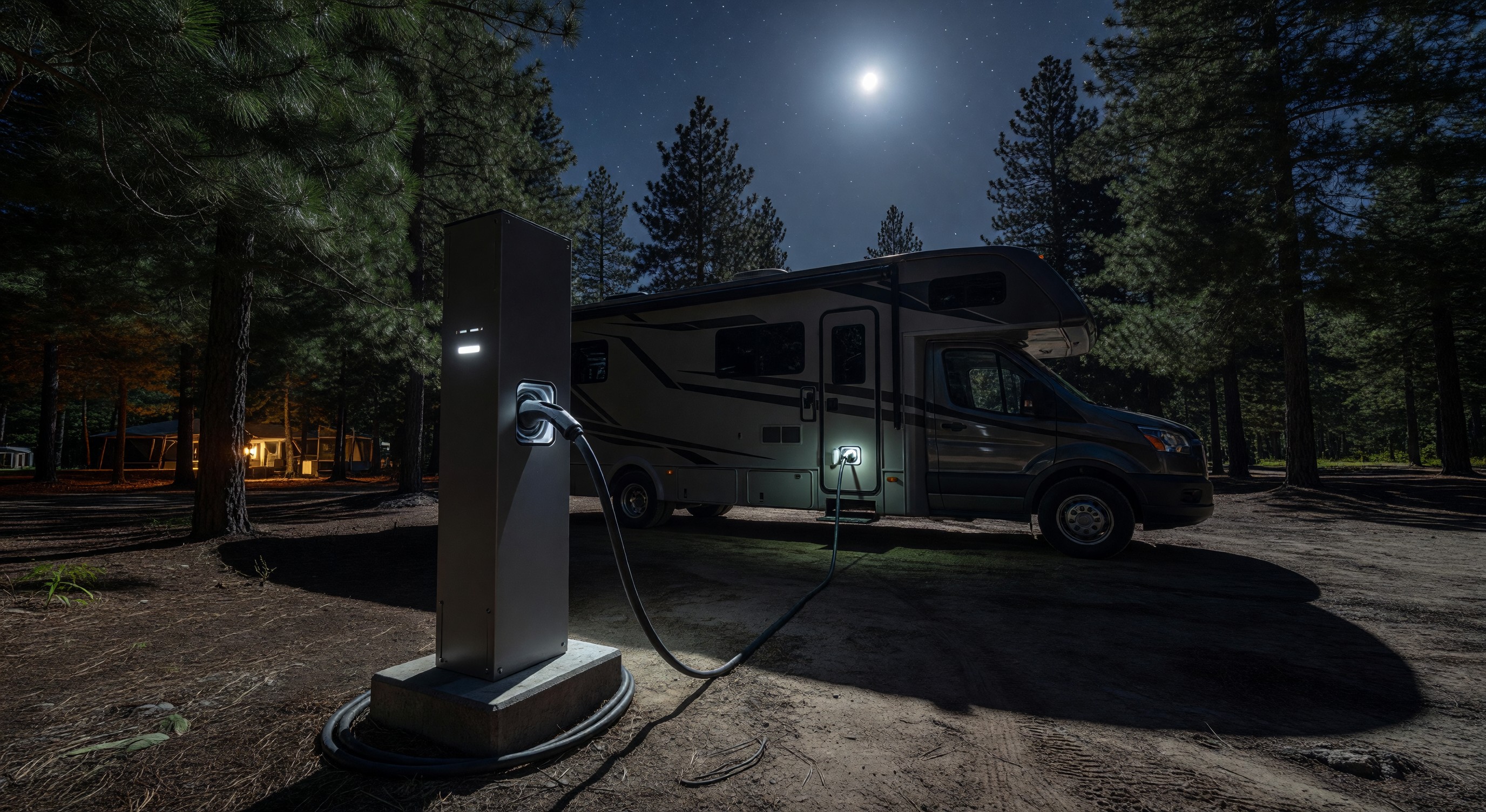
Electric vehicle adoption is accelerating, and campground operators are beginning to see the implications in their guest base — questions about charging capability, complaints about insufficient amperage on standard hookup sites, and requests for dedicated EV charging infrastructure.
Installing EV charging at your campground isn’t simply buying a charging unit and plugging it in. It involves understanding the right equipment for the application, assessing your electrical infrastructure’s capacity, and making a business case for the investment. This guide covers all three.
EV Charging Levels Explained
Level 1 (120V AC): Standard household outlet. Provides approximately 3–5 miles of range per hour of charging. Adequate for plugin hybrid vehicles (PHEVs) with small batteries but essentially useless for battery electric vehicles (BEVs) needing substantial overnight charging.
Level 2 (240V AC): The practical standard for overnight EV charging. Provides 15–30 miles of range per hour, depending on the charger amperage and vehicle’s onboard charger capacity. A BEV arriving with 30% battery can typically fully charge overnight on Level 2.
DC Fast Charging (Level 3): Provides 100–200+ miles of range per hour. Designed for en-route charging at highway stops, not overnight campground applications. Installation cost ($50,000–$150,000+ per station) and electrical demand (50–350 kW) make Level 3 impractical for most campgrounds.
For campground applications, Level 2 is the right answer. It matches the overnight charging pattern of campground guests and is cost-effectively installable.
Level 2 Equipment Options
EVSE (Electric Vehicle Supply Equipment) — commonly called “EV chargers”: Level 2 chargers convert the 240V AC supply into the charging protocol the vehicle uses. The physical unit includes a power supply, safety electronics, a charging cable, and a connector.
Connector standards (2024):
The EV connector landscape has standardized significantly. The North American Charging Standard (NACS), originally Tesla’s connector, is being adopted across the industry. Most new EVs and new charging installations are NACS-capable. J1772 (the previous standard for Level 2) connectors remain compatible through adapters. Ensure new installations include or are compatible with NACS.
Networked vs. non-networked chargers:
Non-networked chargers simply provide power when plugged in — no usage tracking, no remote management, no billing capability. Lower cost to purchase but limited operational control.
Networked chargers connect to the internet and allow: remote status monitoring, usage data collection, per-session energy metering, remote enabling/disabling, and — critically for campgrounds — per-session billing to recover electricity costs.
For campground deployment, networked chargers are strongly preferable. The ability to meter usage and bill guests prevents your EV charging amenity from becoming an unlimited free power subsidy.
Assessing Your Electrical Infrastructure
Before ordering equipment, assess your electrical panel capacity:
Service capacity: What is the total amperage of your main electrical service? Adding Level 2 chargers with 30–50A circuits per charger adds significant load.
Feeder capacity to specific areas: Even if your main service is adequate, the feeders running to specific areas of your campground may be undersized for additional load.
Transformer capacity: In RV parks with pad-mounted distribution transformers, the transformer’s KVA rating limits total load. Adding EV chargers may require transformer upgrade.
Electrical engineering assessment: For any campground planning more than 2–3 EV charging installations, an electrical engineering assessment of your existing infrastructure is worth the $500–$2,000 cost. It prevents costly surprises during installation and can identify the most efficient infrastructure improvement path.
Load Management for Multiple EV Chargers
If you install multiple Level 2 chargers, smart load management becomes important:
Dynamic load balancing: Software that monitors total electrical load and automatically adjusts individual charger output to stay within your capacity limits. If you have 10 chargers on a circuit with a 200A limit, and 8 vehicles are charging, the system distributes 200A across the 8 active chargers (25A each) rather than each charger independently drawing 30A (which would exceed the limit).
This technology allows you to install more chargers than your unmanaged infrastructure could support, by assuming not all will be simultaneously at full draw.
Business Case for EV Charging Investment
The business case has multiple components:
Direct revenue: If you meter usage and charge per kWh, EV charging can generate direct revenue. Charging $0.35–$0.45/kWh for overnight charging of a vehicle using 40 kWh is $14–$18 per charge. At meaningful utilization, the ROI is calculable.
Rate premium for EV-ready sites: Sites with dedicated EV charging capability command premium nightly rates — typically $10–$25/night premium.
Market differentiation: As EV adoption grows, parks with EV charging will attract guests that parks without cannot serve.
Grant availability: Federal infrastructure funding and state energy programs have offered grants for EV charging installation at hospitality properties. Check availability in your jurisdiction before planning your project — grants can offset 50%+ of installation costs.
Frequently Asked Questions
Can my existing 50A RV hookup sites charge electric vehicles? Yes, with an adapter. The 50A/240V RV outlet (NEMA 14-50) provides the same power as many Level 2 chargers. Guests can use an adapter to connect their vehicle to the RV outlet. The limitation is that RV outlets weren’t designed for continuous high-amperage draw from EV charging — verify your pedestal wiring and connections are in good condition before relying on them for this purpose.
How long does it take to install Level 2 chargers at a campground? Installation time depends heavily on whether infrastructure upgrades are needed. If existing wiring supports the load, installation of a few chargers might take 2–3 days. Infrastructure upgrades (new feeder runs, transformer work) can extend a project to 2–4 weeks.
Should I charge guests for EV charging or include it in the site rate? Metered, cost-recovery pricing is strongly recommended. Electricity costs for EV charging are significant (a vehicle charging 40 kWh/night at $0.12/kWh = $4.80/night in electricity, every night). At scale, unmetered “free” EV charging becomes a meaningful operating expense.
What’s the ROI timeline for EV charging installation? This depends heavily on utilization, your electricity rate, the revenue model, and installation cost. Parks in high-EV-adoption markets with moderate utilization typically see 3–6 year payback periods on the equipment investment. Grant funding significantly improves the ROI.
Further Reading from Authoritative Sources
- U.S. Department of Energy Alternative Fuels Data Center EV charging standards — The Department of Energy’s Alternative Fuels Data Center is the definitive US government resource for EV charging equipment standards, connector specifications, and installation guidance.
- RVIA data on electric RV adoption and campground charging demand — RVIA tracks the growth of electric RVs and EV-towing vehicles among their industry members and publishes data that campground operators use to project future demand for EV charging infrastructure.