Campground WiFi infrastructure continues to evolve rapidly. WiFi 6 (802.11ax) has become the standard for new installations, WiFi 6E — which adds the 6 GHz spectrum band — is now available in commercial-grade outdoor equipment, and the first WiFi 7 commercial deployments are beginning to appear in high-density hospitality environments.
Understanding where wireless technology is headed helps operators make investment decisions that won’t be obsolete within a few years.
What WiFi 6 Brought to Campgrounds
WiFi 6, which became commercially widespread in 2021–2023, delivered several improvements that specifically benefit the high-density, high-concurrent-user campground environment:
OFDMA (Orthogonal Frequency Division Multiple Access): WiFi 6 can divide a channel into smaller sub-channels and serve multiple clients simultaneously rather than one at a time. In high-density environments like a campground with 200+ simultaneous devices, this significantly improves efficiency.
BSS Coloring: A mechanism that reduces interference between nearby access points operating on the same channel. In campgrounds where many APs are in relative proximity, this improves per-client throughput.
Target Wake Time (TWT): Allows APs to schedule when devices wake to transmit or receive, reducing power consumption on battery-powered devices and reducing congestion on the channel.
Higher peak throughput: WiFi 6 supports higher theoretical maximum speeds than WiFi 5 — meaningful in practice for the subset of clients that can take advantage of it.
For campgrounds that were still operating WiFi 5 (802.11ac) infrastructure in 2024, the case for upgrading to WiFi 6 compatible equipment is strong — particularly if purchasing new access points for coverage expansion.
WiFi 6E: The 6 GHz Band
WiFi 6E extends WiFi 6 capabilities into the 6 GHz frequency band (5.925–7.125 GHz in the US, with variations by country). This is significant because:
Less congestion: The 6 GHz band is new to WiFi — no legacy devices exist there, and the band isn’t shared with existing 2.4 GHz or 5 GHz devices. A clean 6 GHz channel carries less interference than crowded lower bands.
More channels: The 6 GHz band has 59 additional 20-MHz channels available (compared to 25 in the 5 GHz band). More non-overlapping channels means neighboring APs can operate without interference.
Range limitations: The higher frequency of 6 GHz has shorter range than 2.4 GHz. Outdoor 6 GHz coverage typically extends 100–150 feet in open conditions — shorter than 5 GHz. This means 6 GHz access points need denser deployment for the same coverage area.
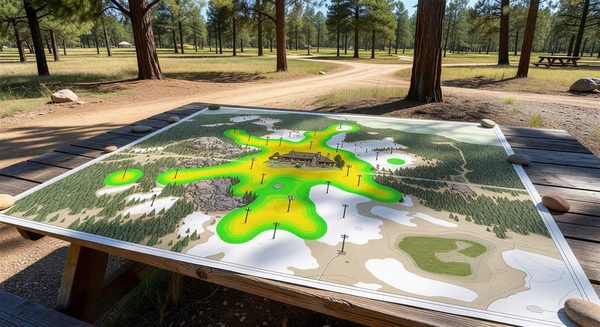
For campground applications, 6 GHz is most valuable in high-density areas — pavilions, hookup site areas, pool areas — where many clients are close to the AP and the less-congested spectrum provides a meaningful benefit. Lower-density areas may be adequately served by 5 GHz or even 2.4 GHz.
Managed WiFi Service Models
As campground WiFi infrastructure has matured, managed service models have become more common:
Managed WiFi-as-a-Service: The operator pays a monthly fee; a managed service provider designs, installs, monitors, and maintains the campground WiFi network. The operator doesn’t purchase hardware outright — it’s included in the service. Network monitoring, troubleshooting, and equipment replacement are handled by the provider.
This model trades upfront capital cost for ongoing operating expense and eliminates the internal expertise requirement. For smaller parks without IT staff, managed WiFi is increasingly the preferred model.
Hardware-as-a-Service with managed monitoring: Some vendors offer hardware on a subscription (leased rather than purchased) with managed monitoring and alerts, but leaving configuration and maintenance to the operator. A middle ground that reduces upfront cost without fully outsourcing the management burden.
Frequently Asked Questions
Should I wait for WiFi 7 before upgrading my campground network? WiFi 7 commercial-grade outdoor equipment for campground applications is still limited in availability and carry-premium pricing as of early 2026. For most operators, WiFi 6 is the right investment tier now. WiFi 7 improvements (primarily higher throughput via multi-link operation) are most beneficial in extremely high-density environments that campground APs don’t typically encounter.
Is the 6 GHz band usable with most guest devices in 2026? WiFi 6E client support has grown rapidly. Most smartphones released since 2022 support 6 GHz, as do most recent laptops. However, older devices — particularly budget tablets and older phones — may not support 6 GHz. Ensure your network still maintains strong 2.4 GHz and 5 GHz coverage for backward compatibility.
How often should campground WiFi equipment be replaced? Commercial-grade wireless equipment typically has a useful life of 5–7 years before it becomes significantly obsolete relative to current technology or begins requiring maintenance. Plan for a full refresh cycle of 5–6 years rather than running equipment to failure.
What’s the most common reason campground WiFi fails during peak hours? In 2026, the most common failure mode is insufficient backhaul bandwidth — the ISP connection to the property, not the wireless equipment, is the bottleneck. Wireless technology has advanced faster than many campground ISP service agreements have been upgraded. If your WiFi hardware is recent and properly configured but performance still degrades at peak, the ISP contract is likely the limiting factor.
Further Reading from Authoritative Sources
- FCC broadband standards and WiFi spectrum regulations — The FCC regulates spectrum allocation for WiFi frequencies and publishes broadband speed standards relevant to the connectivity benchmarks cited in this article, making it the appropriate regulatory authority for campground WiFi infrastructure discussions.
- ARVC campground amenity standards and guest expectations research — ARVC tracks guest expectation research and amenity adoption trends across the campground industry, providing the authoritative industry context for claims about how WiFi expectations have evolved.