Campground lighting is a balancing act. Adequate lighting on pathways and at facilities is a safety requirement and an accessibility expectation. Too much lighting — high-intensity overhead lights that flood the campground at night — destroys the darkness that many campers specifically seek, undermines dark sky quality, and creates light trespass into neighboring campsites.
Smart lighting technology helps operators achieve both safety and dark sky goals through targeted, controllable illumination.
The Problem With Traditional Campground Lighting
Traditional campground lighting — sodium vapor or fluorescent fixtures on high utility poles — creates broad illumination pools that eliminate darkness across wide areas. This approach:
- Washes out star visibility in the lit zones
- Creates glare that affects neighboring campsites
- Runs continuously regardless of occupancy or ambient light conditions
- Consumes significant electrical power
Modern LED technology and smart controls offer a better approach.
LED Pathway Lighting
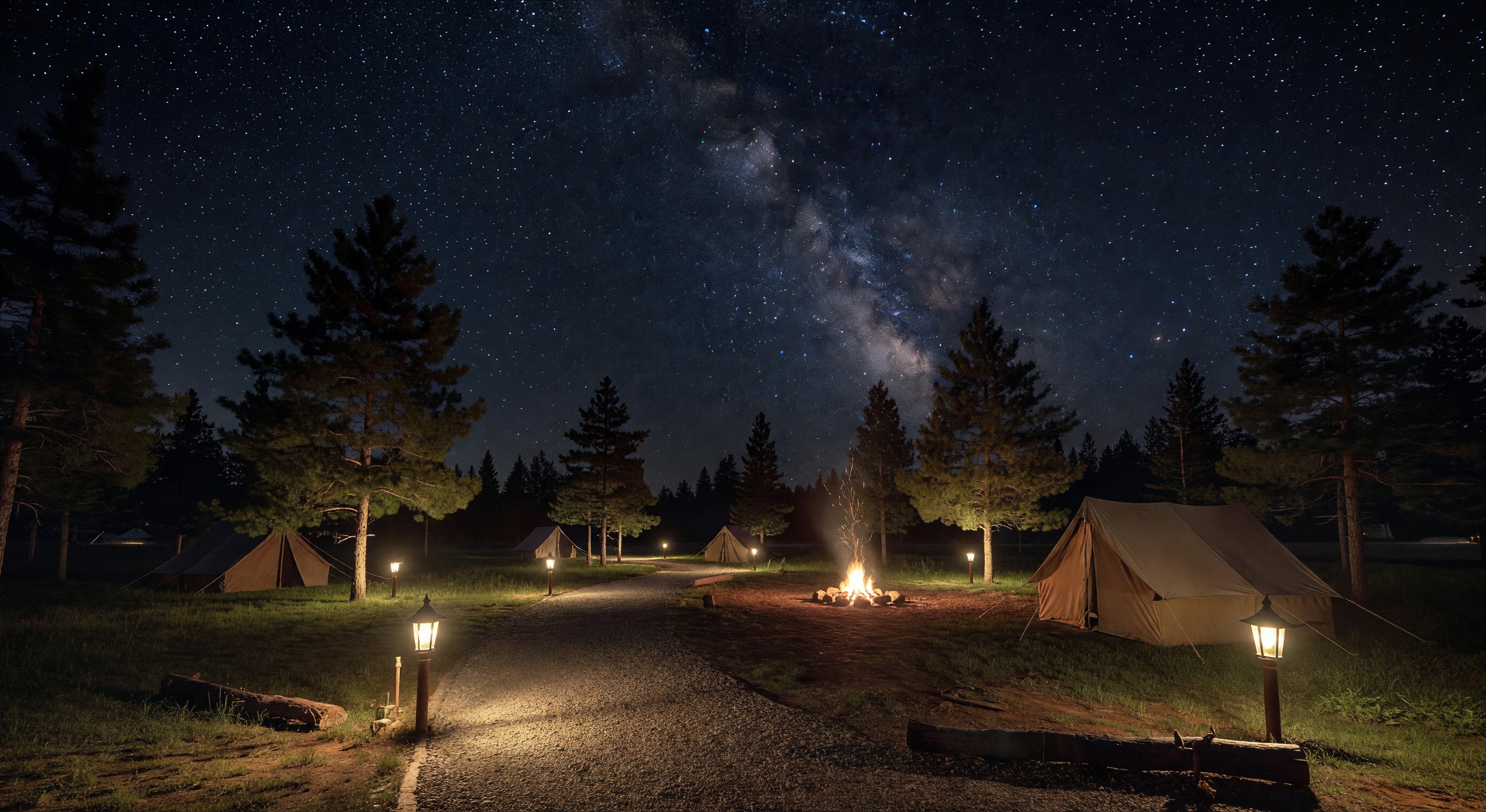
LED pathway lights at low mounting heights (2–3 feet) illuminate where guests walk without projecting upward into the night sky. These are the best option for campground pathway and roadway lighting:
Warm color temperature: Choose LED fixtures at 2200K–2700K (warm white). Cooler color temperatures (5000K+, which appear blue-white) are more disruptive to natural circadian rhythms and appear harsher in an outdoor setting.
Downward-directed (full cutoff) fixtures: Fixtures that direct all light downward prevent upward light emission that contributes to light pollution. This is the key design characteristic for dark-sky-friendly outdoor lighting.
Motion activation: Pathway lights that activate when a pedestrian approaches and dim back to a minimal standby level (or off entirely) when no motion is detected reduce energy consumption and light pollution without compromising safety.
Solar-powered pathway lights: For pathways distant from electrical infrastructure, solar pathway lights eliminate the cost of wiring runs. Modern solar pathway lights with LiPO batteries perform reliably through the night on a full day’s charge.
Smart Lighting Controls
Scheduling: Lights at common facilities (bathhouses, pavilions) should run at full brightness during active hours and dim or turn off after quiet hours when only guests returning from late activities are likely to use them.
Motion-triggered site area lighting: For campgrounds where some sites are in darker areas without ambient illumination, motion-activated lights at the pedestal or site post provide safety lighting when guests approach and turn off between uses.
Dimmers for atmosphere: Covered pavilions and lodge areas benefit from dimmable LED fixtures that can be set to full brightness for daytime programs and reduced to ambient lighting levels for evening gatherings.
Centralized control: A smart lighting controller or app allows the park manager to adjust lighting across the property remotely — brightening pathways during a late event, dimming after the event concludes, or turning off specific zones for seasonal closure.
Dark Sky Certification
International Dark-Sky Association (IDA) certification recognizes parks that meet lighting standards for dark sky preservation. For campgrounds in dark sky regions (many rural parks already have naturally dark skies), certification:
- Validates the quality of nighttime experience
- Provides marketing differentiation — star-gazing and astrophotography are growing outdoor recreation activities
- Requires meeting specific lighting guidelines (fixture type, color temperature, shielding)
Certification requirements are not onerous for parks that start with appropriate LED fixtures. The process involves documenting existing fixtures, replacing non-compliant fixtures, and submitting for IDA review.
Frequently Asked Questions
Can I retrofit existing campground light fixtures to be dark sky compliant? Some fixtures can accept replacement bulbs or LED retrofit kits that improve their dark sky characteristics. However, the fixture housing itself determines whether light is directed appropriately — a fixture designed to project light broadly can’t be dark-sky compliant with a bulb swap alone. Assessment on a fixture-by-fixture basis is needed.
What’s the energy savings from switching to LED pathway lighting? LED pathway lights typically consume 60–80% less energy than the incandescent or sodium vapor fixtures they replace. For a campground with 50 pathway lights running 8 hours per night, the annual energy savings are measurable and the payback period on LED replacement is typically 2–4 years.
Do guests actually care about dark sky quality at campgrounds? Yes, and increasingly so. Astrophotography, star parties, and nighttime nature observation are growing outdoor recreation activities. Reviews that specifically mention excellent dark sky conditions attract a segment of guests who actively seek dark sky destinations. Campgrounds near designated dark sky parks or reserves can market this connection effectively.
How do I handle guests who want outdoor string lights on their sites that create light spillover to neighbors? Define a policy on guest-installed lighting and include it in your park rules. A reasonable policy allows downward-directed, warm-temperature lighting below a certain mounting height and prohibits bright uplighting or lights directed at neighboring sites. Site-appropriate string light strands are a reasonable amenity for guests; high-powered spotlights are not.
Further Reading from Authoritative Sources
- Department of Energy LED lighting efficiency and outdoor lighting guidance — The Department of Energy publishes LED lighting efficiency data and outdoor lighting guidance for commercial facilities, providing the performance specifications and energy savings figures cited for campground lighting technology decisions.
- National Park Service dark-sky lighting standards and light pollution reduction — The National Park Service has implemented dark-sky lighting standards across its campground properties and published guidance on outdoor lighting design that minimizes light pollution, making it the authoritative reference for the dark-sky-friendly lighting approach recommended for private campgrounds.