The Wi-Fi problem at campgrounds has never been the infrastructure during the off-season. It’s the infrastructure during the third weekend of July — when the park is at 100% occupancy, every site has a family with four devices, and guests are streaming movies while the kids play games outside.
A network designed for average demand fails at peak. And peak demand at a campground isn’t a rare edge case — it’s Memorial Day weekend, the Fourth of July, Labor Day, and every summer Friday through Sunday from late June through August. These are your highest-revenue days and your highest-demand days simultaneously. A Wi-Fi failure during peak occupancy is a review problem and a return-customer problem.
This guide covers how to calculate bandwidth requirements for your peak occupancy, why some infrastructure choices fail at high device density, and what operators should have in place before summer starts.
The Bandwidth Math for Peak Occupancy
Bandwidth planning that starts from “our park has X sites” is incomplete. The meaningful number is simultaneous connected devices at peak occupancy — and that number is larger than most operators assume.
Device count per site in 2026. The average camping party brings significantly more connected devices than it did five years ago. Smartphones are universal. Tablets are common. Smart TVs in RVs are increasingly standard, and newer RV models often include multiple streaming-capable screens. Laptops for remote workers are frequent at extended-stay sites. A conservative estimate for a family site at peak is 4–6 simultaneous connected devices; a remote-worker or retiree site may have 2–3 devices but with heavier per-device bandwidth usage.
Usage pattern at peak. Peak bandwidth demand at a campground occurs in the evening hours — typically 7–11 PM — when guests are at their sites after outdoor activities. This is the streaming window. A single 4K streaming session uses 15–25 Mbps. A household with two streaming sessions plus background device activity (app updates, cloud sync, social media) routinely uses 30–50 Mbps per site during the evening peak.
The bandwidth calculation. Multiply your peak site occupancy by your estimated simultaneous usage per site, then apply a concurrency factor — not every site peaks simultaneously, but the overlap is high during the 7–11 PM window. A practical planning formula:
- 100-site park at full occupancy
- 5 devices per site average = 500 connected devices
- 30% simultaneous active streaming assumption = 150 concurrent high-demand sessions
- 25 Mbps per active streaming session = 3,750 Mbps required
That’s roughly 4 Gbps of bandwidth to serve peak demand without degradation. A park running on a 500 Mbps connection will be materially degraded during this window. Most legacy campground Wi-Fi infrastructure was sized for 2015 usage patterns — well below what 2026 peak demand requires.
OHI (the Outdoor Hospitality Industry association, formerly National ARVC) tracks internet quality as a leading guest satisfaction factor across the industry, and the gap between guest expectations and park infrastructure is widest at this demand point.
Why Cellular-Based Wi-Fi Fails at Peak Occupancy
Many campgrounds — particularly those in rural or semi-rural locations — use cellular-based solutions as their primary internet connection: bonded cellular routers, single-carrier LTE gateways, or fixed wireless services built on carrier infrastructure.
Cellular-based connections have two failure modes at peak campground occupancy that fixed-line connections don’t share.
Tower congestion. Cellular capacity is shared infrastructure. When your park is full for a summer holiday weekend, the cellular tower serving your park is also serving the cellular data of every guest’s smartphone, every surrounding property, and any other business in the coverage area. The additional bandwidth from your bonded cellular gateway competes for spectrum on a tower that may already be at or near capacity. This is a known issue — it’s not a product defect, it’s the physics of shared spectrum. Fixed-line fiber connections scale to handle peak loads through network design; cellular connections get slower when everyone needs them simultaneously.
Upstream capacity limits. Even bonded multi-SIM solutions that aggregate multiple cellular connections are capacity-limited at peak. Four bonded 4G LTE connections might deliver 200–400 Mbps under optimal conditions. Under tower congestion on a summer weekend, the same configuration may deliver 40–80 Mbps — a 5x reduction in available bandwidth during the moment of highest demand.
The practical implication: if your park relies on cellular as its primary internet connection and you have more than 30–40 sites, you are almost certainly providing degraded service during peak summer occupancy. The solution is a fixed-line connection (fiber is preferred; fixed wireless from a dedicated service provider — not a shared cellular tower — is a viable alternative) sized for your peak demand calculation.
Bandwidth Management: Making the Most of Available Capacity
Even with adequate total bandwidth, an unmanaged network allows a small number of heavy users to consume a disproportionate share of capacity, degrading the experience for other guests. Bandwidth management is the layer that distributes available capacity equitably.
Per-device bandwidth limits. Most enterprise-grade Wi-Fi management platforms support per-device bandwidth caps — maximum download and upload speeds per connected device. Setting a per-device limit of 25–30 Mbps prevents any single device from monopolizing bandwidth while still supporting 4K streaming. Per-device limits are more equitable than per-site limits in an environment where site occupancies vary.
Traffic shaping and QoS (Quality of Service). QoS policies prioritize latency-sensitive traffic (video calls, VoIP, live streaming) over bulk background traffic (large downloads, cloud backup, OS updates). For campground guests, a well-configured QoS policy means that a guest on a video call with family gets consistent bandwidth even when another guest in the same zone is downloading a software update.
Scheduled bandwidth policies. Some campground Wi-Fi management platforms support time-of-day bandwidth policies. During the daytime off-peak window (9 AM – 5 PM), per-device limits can be relaxed or removed. During the evening peak window (7–11 PM), tighter per-device limits activate automatically. This approach maximizes available capacity during the high-demand evening period without artificially limiting daytime usage when demand is lower.
Blocking high-bandwidth applications during peak. Some operators configure policies that block or throttle peer-to-peer file sharing, large BitTorrent traffic, and other applications that consume sustained high bandwidth without a guest experience benefit. This is a policy decision with guest communication implications — if you throttle certain applications, communicating that policy proactively (in the guest Wi-Fi portal, on check-in documentation) prevents complaints from guests who encounter unexpected throttling.
Network Segmentation: Guest Traffic vs. Operations
A peak-occupancy campground Wi-Fi network should segment guest traffic from operational traffic on separate VLANs. This is a security requirement and an operational reliability requirement.
Why segmentation matters at peak. When a guest’s device is on the same network as your reservation system, point-of-sale terminals, utility metering controllers, and access control systems, peak guest traffic load can degrade the connectivity those operational systems depend on. A bandwidth saturation event caused by 200 simultaneous guest streams shouldn’t affect your ability to process a reservation or collect a utility payment.
Guest isolation. Within the guest network, peer-to-peer traffic between guest devices should be blocked. Guest isolation prevents one guest’s device from communicating directly with another’s — a basic security measure that also prevents the accidental bandwidth consumption and network interference that can occur between devices in high-density environments.
Separate SSID for remote-work guests. Some campgrounds with significant remote-worker clientele are implementing a dedicated “work” SSID with higher per-device bandwidth guarantees and explicit SLA language — marketed as a premium or add-on service. This generates ancillary revenue while managing the bandwidth allocation between the general guest pool and guests with higher requirements. For the connectivity expectations of this segment, see campground connectivity for remote workers.
Access Point Density and Coverage for Peak Occupancy
Bandwidth capacity determines total throughput. Access point density and placement determine whether that throughput reaches every site.
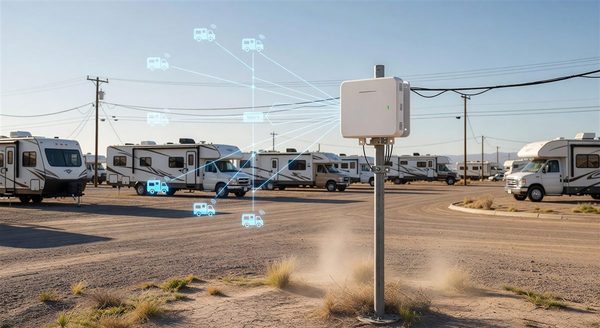
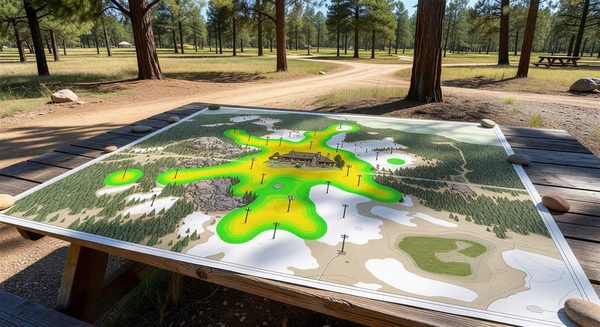
Coverage planning for outdoor environments. Outdoor Wi-Fi access points have longer theoretical ranges than indoor units, but campground environments have specific propagation challenges: RV bodies are metal and block signals, trees attenuate 5 GHz frequencies significantly, and dense site packing during peak occupancy creates interference between devices. A coverage plan that works during off-peak with 30% occupancy may have dead zones when 100% of sites are occupied and their RVs are acting as RF blockers.
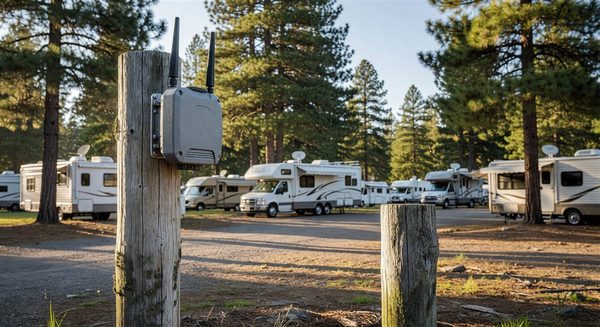
Access point placement. For RV parks and campgrounds, access points typically mount on posts at 8–12 foot height, placed to provide coverage to a defined number of sites per access point. Enterprise outdoor access points can cover 15–30 sites per unit under real-world conditions; manufacturer specifications for range assume open-air conditions that don’t apply in dense campground environments. Size your access point count based on real-world coverage tests, not spec sheet range numbers.
5 GHz vs. 2.4 GHz. Modern access points support both bands. The 5 GHz band provides faster speeds but shorter range and more attenuation by physical obstacles. The 2.4 GHz band has longer range but is more congested (overlaps with Bluetooth, microwave ovens, and other 2.4 GHz devices common in campground environments). For most campground deployments, a dual-band configuration with band steering — the network guides capable devices toward 5 GHz — provides the best balance. During peak occupancy, the 2.4 GHz band will be more congested; this is a normal outcome that band steering partially mitigates.
For the infrastructure foundation layer, campground Wi-Fi infrastructure basics covers access point hardware selection and outdoor deployment considerations.
Before Summer: The Pre-Season Wi-Fi Checklist
Bandwidth problems during peak season are not resolved during peak season — they’re identified and addressed before the season starts.
Test at simulated peak load. Before Memorial Day, run a load test: have staff connect 10–15 devices per access point zone simultaneously and run streaming tests. This surfaces coverage gaps, channel interference issues, and bandwidth limitations that won’t appear at normal operating conditions.
Review your ISP contract. Verify that your current service agreement’s committed information rate (CIR) — the guaranteed bandwidth, not the “up to” burst rate — is adequate for your peak calculation. Many campgrounds are on business internet plans with bursted bandwidth that performs fine on average but degrades under sustained peak load. If your CIR is significantly below your peak calculation, the solution is a higher-tier service agreement, not more access points.
Update firmware and configurations. Access point and gateway firmware updates should be applied before peak season, not during it. Pre-season is also the time to review and update bandwidth management policies — per-device limits, QoS configuration, and scheduled policies — while you have time to test changes without affecting guests.
Check physical hardware. Outdoor access points experience UV exposure, temperature cycling, and moisture infiltration over multiple seasons. Inspect each access point before summer for physical damage, corrosion at cable connections, and mounting hardware integrity. Hardware that looks functional may be underperforming due to antenna degradation — a load test will surface this; a visual inspection alone won’t.
Frequently Asked Questions
How much bandwidth does a campground need per site?
Planning for 25–30 Mbps per site at peak occupancy is a reasonable starting point for 2026 usage patterns. Apply a 25–30% concurrency factor for simultaneous peak demand. A 100-site park at full occupancy needs roughly 625–900 Mbps of committed bandwidth to serve the simultaneous evening peak — more if your guest population includes significant remote-worker or streaming-heavy demographics.
Why does campground Wi-Fi get slow on busy weekends?
Usually one or both of: insufficient total bandwidth for the number of connected devices, or no per-device bandwidth management allowing heavy users to saturate available capacity. Cellular-based connections have an additional failure mode — tower congestion when shared spectrum is overloaded by holiday weekend volume.
What is the best way to manage campground Wi-Fi during peak season?
A combination of adequate total bandwidth (sized from peak demand calculation, not average demand), per-device bandwidth limits (25–30 Mbps prevents monopolization while supporting streaming), QoS policies (prioritize latency-sensitive traffic), and network segmentation (guest network isolated from operations) produces the most consistently good guest experience under peak load.
Should I upgrade to fiber internet for my campground?
If you’re within a fiber service area and your cellular or fixed-wireless performance degrades noticeably during peak periods, fiber is worth serious evaluation. The consistent committed bandwidth of fiber, unaffected by shared-spectrum congestion, is the most reliable solution for high-occupancy peak demand. Cost and availability vary significantly by location.
How many Wi-Fi access points does a campground need?
Depends on site density, physical environment, and access point model. A rule of thumb for outdoor campground environments: 15–25 sites per enterprise-grade outdoor access point, with points placed at 8–12 foot height. Dense RV park environments with metal RV bodies blocking signal may need one access point per 10–15 sites.
How do I prevent one guest from slowing down the whole network?
Per-device bandwidth caps in your Wi-Fi management platform prevent any single device from consuming more than its share. Set the cap at a level that supports streaming (25–30 Mbps) but prevents bulk downloads or unlimited-use sessions from saturating the connection. Most enterprise campground Wi-Fi management systems support this natively.