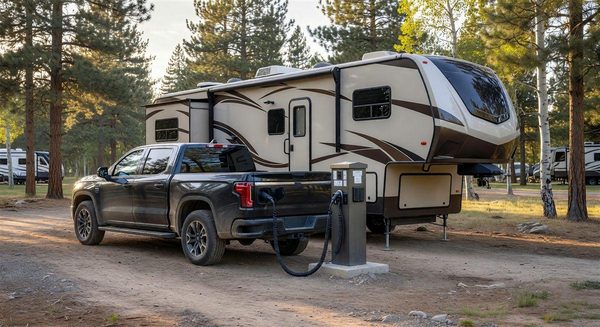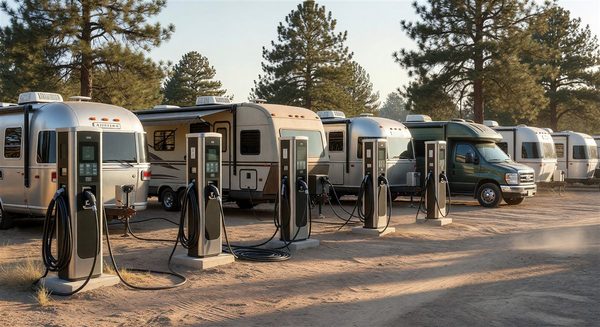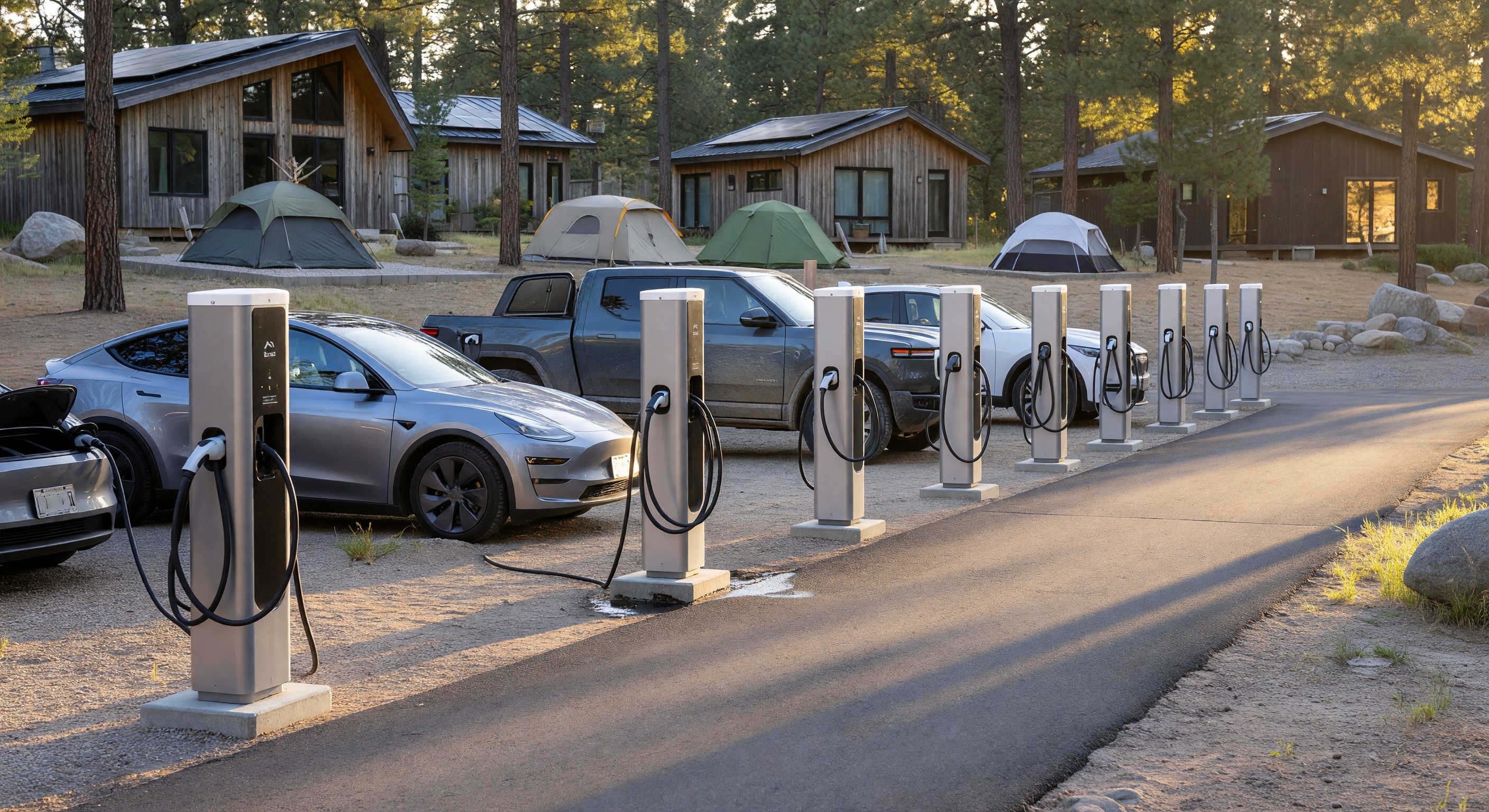
The year 2024 marked a genuine inflection point for EV charging at campgrounds. The arrival of the Ford F-150 Lightning, the Chevrolet Silverado EV, and the Ram 1500 REV as viable production tow vehicles put EV camping firmly on the mainstream radar. Simultaneously, the NACS (North American Charging Standard) consolidation resolved the connector confusion that had complicated campground infrastructure decisions.
Operators who had been waiting on the sidelines began investing. And the early deployments produced valuable lessons about what works, what doesn’t, and how campground EV charging actually performs in practice.
What 2024 Installations Confirmed
Level 2 is right for campgrounds. The debate about whether campgrounds should invest in DC fast charging vs. Level 2 is largely settled in 2024. The overnight dwell time that defines campground stays is perfectly matched to Level 2 charging rates. A vehicle arriving with 30% battery and charging at a 48A Level 2 (11.5 kW) circuit will be at 90%+ in the morning regardless of battery size for all current EV tow vehicles.
DC fast charging (Level 3) belongs on highways — for en-route top-ups, not overnight stays. The $80,000–$150,000 per-station installation cost and enormous electrical demand make it impractical for campground deployment.
Electrical infrastructure was the bottleneck. The most common installation challenge in 2024 was existing electrical infrastructure. Parks that had been slowly upgrading their electrical service over decades found that their distribution transformers, panel capacity, and feeder runs weren’t sized to accommodate the additional load of multiple 50-amp EV charging circuits simultaneously.
Operators who underestimated the electrical upgrade portion of their installation budget experienced cost overruns. The lesson: get an electrical engineering assessment early, before finalizing the project budget.
Consumption billing is the right revenue model. Parks that attempted flat-rate “EV fee” pricing discovered that heavy EV users (those towing large trailers who arrive with depleted batteries) can draw 60–80 kWh overnight — significantly more than the $10–$20 flat fee recovered. Metered consumption billing at $0.35–$0.45/kWh is the model that makes the economics sustainable.
Load management software worked as advertised. Dynamic load balancing systems that automatically distribute available amperage among active chargers performed reliably in real deployments. Parks that installed 10 EVSE units on infrastructure sized for 6 simultaneous full draws saw the load management software effectively prevent capacity overruns.
Connector Transition: NACS Adoption
The industry’s transition to NACS as the standard connector for Level 2 and DC fast charging advanced significantly in 2024:
Tesla, Ford, GM, Rivian, and other manufacturers completed or announced NACS adoption. New CCS (the previous North American EV standard) vehicles are increasingly rare among new purchases.
For campground installations:
New installations should use NACS connectors with J1772 adapters available for the remaining CCS vehicles. Within 2–3 years, virtually all EV charging demand at campgrounds will be NACS.
Retrofit kits exist for J1772 EVSE units to convert to NACS connectors. If you installed J1772 equipment in 2022 or 2023, check with your equipment manufacturer about retrofit options.
Grant Funding Landscape in 2024
Federal funding through the Bipartisan Infrastructure Law has provided grant opportunities for EV charging at campgrounds. The 2024 landscape:
NEVI formula grants are primarily targeting highway corridor charging — not campground applications. Campground operators aren’t the primary target for NEVI funding.
USDA Community Facilities and Rural Development programs have funded EV charging installations at rural hospitality properties including campgrounds. If your park serves a rural area, these programs are worth exploring.
State-level programs vary significantly. Some states have robust grant and incentive programs for commercial EV charging installation; others have minimal support. Your state energy office and state tourism agency are good starting points for program research.
Utility company incentives are often the most accessible funding source. Many utilities offer commercial EV charging rebates that can offset 20–50% of equipment costs.
Frequently Asked Questions
How many EV charging stations should I add for a 200-site park? Demand is still developing, but forward-looking planning for 2024–2025 suggests 8–15% of sites served by EV charging is a reasonable target for the near term. For a 200-site park, 16–30 EV-capable sites is a planning target. Phase the installation to match actual demand rather than building the full capacity upfront.
Should I retrofit my existing 50A RV pedestal sites for EV charging or add dedicated charging equipment? Retrofitting requires assessing whether existing wiring supports continuous 48A draw (required for full EVSE rate). Many campground RV pedestals use 6 AWG wiring designed for average RV loads, which may not be rated for the continuous EV charging duty cycle. A licensed electrician should assess before assuming existing wiring supports EV applications.
Can I charge for EV charging through my reservation system? Some campground PMS platforms now support electrical billing integration for EV charging. If yours doesn’t, some EV charging network platforms provide separate billing capability. Evaluate whether the billing flows need to integrate or can operate as a separate guest-facing payment at checkout.
What EV charging network should I join? Several EV charging networks (ChargePoint, Blink, Enel X) provide both hardware and network services for commercial campground installations. Joining a network gives your stations visibility in EV driver route-planning apps, which can generate booking interest from EV travelers actively seeking campgrounds with charging.
Further Reading from Authoritative Sources
- U.S. Department of Energy EV charging infrastructure standards and incentives — The Department of Energy’s Alternative Fuels Data Center and EV infrastructure programs are the primary federal resource for campground operators researching EV charging standards, load management requirements, and available federal incentives for commercial charging installations.
- RVIA data on electric RV tow vehicle adoption and campground charging demand — RVIA tracks EV adoption among RV buyers and towable-vehicle purchasers, providing the industry data on EV tow vehicle growth that underpins campground operators’ infrastructure investment decisions.