The campground front desk fields the same questions, repeatedly, every day: What time is check-in? Do you allow pets? Is there cell service? What’s your cancellation policy? Can I get a site with 50-amp power?
AI-powered chatbots that can answer these questions — accurately, instantly, at any hour — are an increasingly practical option for campground operators who want to reduce routine call volume while improving response time for guests.
What Campground Chatbots Can and Can’t Do
Can do well:
- Answer frequently asked questions about your park (policies, amenities, facilities, location)
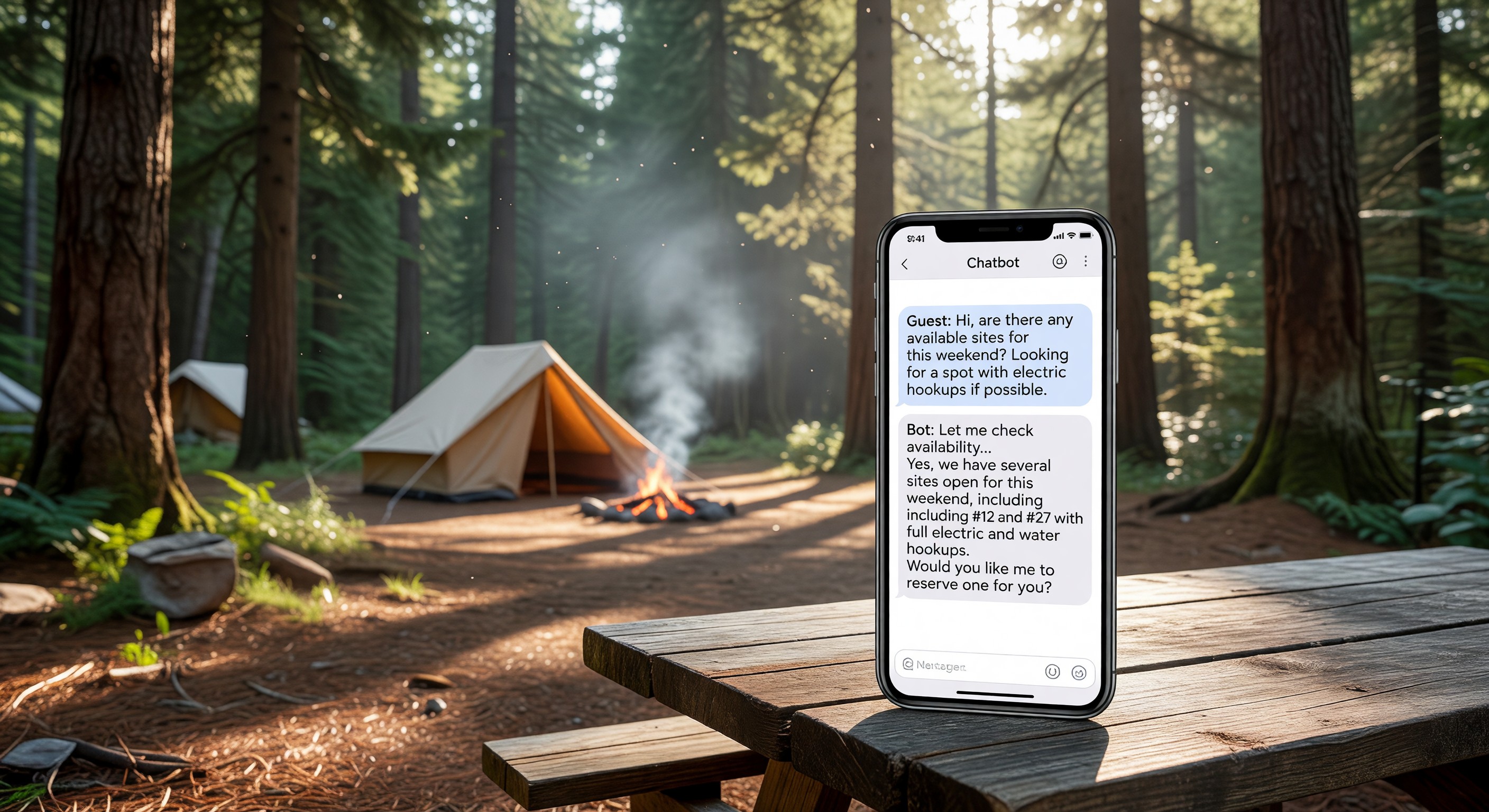
- Check availability for specified dates and redirect to booking
- Explain your cancellation policy, deposit requirements, and check-in procedures
- Provide directions to the park
- Answer questions about pet policies, campfire rules, noise hours, and guest limits
- Escalate to a human when the question is beyond the chatbot’s capability
Cannot do well:
- Handle nuanced or unusual situations (a guest with a complex booking issue, a medical emergency, a conflict between guests)
- Guarantee accurate answers when underlying information changes (if your pet policy changed last month and the chatbot wasn’t updated, it will give wrong answers)
- Replace the human element for guests who explicitly want to talk to a person
- Make judgment calls (is this exception warranted?)
Understanding these boundaries before deployment prevents both staff frustration (when the chatbot passes problems it shouldn’t have) and guest frustration (when the chatbot fails on something it should handle).
How Campground Chatbots Are Built
Pre-built campground chatbots: Some campground PMS platforms and third-party vendors offer pre-built chatbots trained on common campground information. You configure them with your park-specific details (your policies, your hours, your amenity list). This is the fastest implementation path.
Custom chatbots on general AI platforms: Using platforms like Intercom, Drift, or Tidio — or more directly through OpenAI or Anthropic APIs — you can build a custom chatbot trained specifically on your park’s documentation. More flexible but requires more configuration and maintenance.
Retrieval-augmented generation (RAG) chatbots: More sophisticated implementations connect the AI to a knowledge base of your documents (your FAQ, your rules, your site descriptions) and generate answers from those specific sources rather than from general training data. These are more accurate and updatable — when your policies change, you update the knowledge base and the chatbot answers correctly.
Placement and Deployment
Website chatbot: The most common placement. A chat bubble in the corner of your booking or contact page that guests can activate with questions.
Pre-arrival email assistant: A chatbot accessible through a link in the pre-arrival email where guests can ask specific questions about their upcoming stay.
Text/SMS chatbot: Guests can text your campground number and receive AI-assisted responses. This requires a more sophisticated setup but serves guests who prefer texting to website browsing.
Measuring Effectiveness
Track these metrics to understand whether your chatbot is working:
Resolution rate: Percentage of conversations where the chatbot answers the question without requiring escalation to a human. A well-configured campground chatbot should resolve 60–80% of routine inquiries.
Escalation quality: Are the escalations that reach humans genuinely complex, or is the chatbot failing on questions it should handle?
Guest satisfaction with chatbot interactions: A brief rating at the end of chatbot conversations (Was this helpful? Yes/No) provides direct feedback.
Volume of calls and emails after chatbot deployment: Did inbound call/email volume decrease after deploying the chatbot? This is the ultimate measure of workload reduction.
Frequently Asked Questions
Will guests be frustrated that they’re talking to a bot? Guests who get accurate, fast answers to their questions don’t typically care whether the answer came from a bot or a human. Guests get frustrated when the bot gives wrong answers, can’t understand their question, or pretends to be human. Be transparent that the initial response is automated and make escalation to a human easy.
How do I keep the chatbot’s information current? Establish a process for updating chatbot content when policies change. If you update the FAQ on your website, update the chatbot simultaneously. Some chatbot platforms automatically sync with your website content; others require manual updates.
Can the chatbot handle languages other than English? Modern AI chatbots can communicate in multiple languages. If you have a significant portion of guests whose first language isn’t English, multilingual capability is worth specifically evaluating in platforms you consider.
What does it cost to add a chatbot to a campground website? Simple pre-built chatbot platforms with campground-relevant features run $50–$200/month. Custom implementations with sophisticated RAG or complex integrations cost more — $200–$500/month for managed platforms, plus implementation costs. For a park that receives 500+ routine inquiries per month that the chatbot could handle, even higher-cost implementations offer clear ROI.
Further Reading from Authoritative Sources
- ARVC campground technology adoption and guest communication resources — ARVC’s member communications and technology adoption tracking provide campground operators with industry-wide data on how peers are implementing AI guest service tools and what results they’re achieving — essential context for operators evaluating chatbot investment.
- Go RVing camper research on guest communication preferences — Go RVing publishes consumer research tracking what information RV travelers seek before and during trips, which directly informs chatbot training priorities.