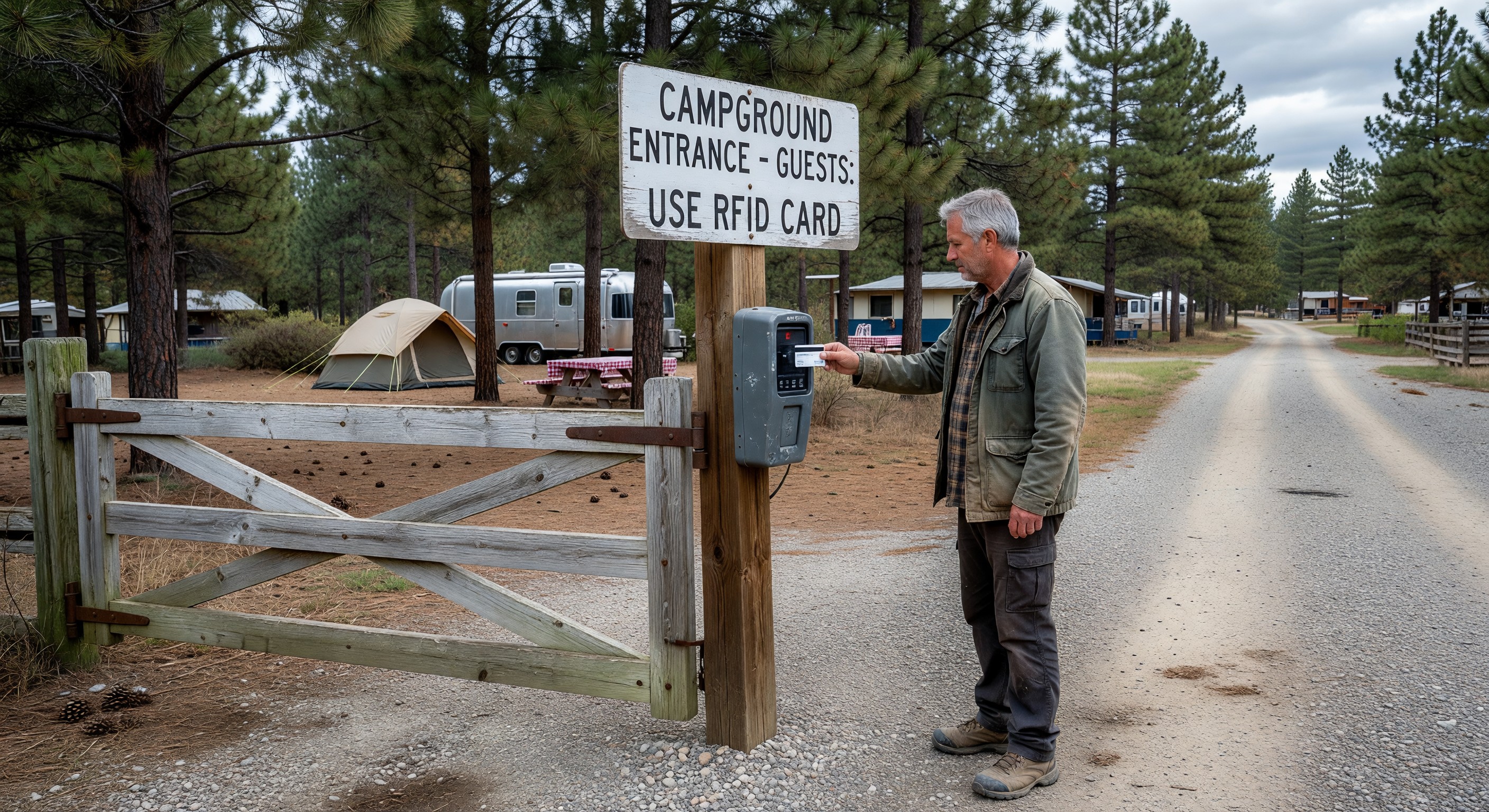
RFID (Radio Frequency Identification) access control is one of the most widely adopted technologies in campground security. Instead of fumbling with a paper code or waiting for staff to open a gate, guests simply tap or wave a card or fob near a reader and the gate opens automatically. The experience is smooth, the credential is unique and trackable, and the system logs every entry and exit.
For campgrounds that want to provide a professional arrival experience while maintaining genuine access control, RFID is often the right technology to build around.
How RFID Access Control Works
The RFID system has three core components:
The RFID credential: A card, key fob, or sticker that contains a small microchip and antenna. The chip stores a unique identifier (a number) that the reader can detect without physical contact. Low-frequency (125 kHz) systems are simpler and cheaper but less secure. High-frequency (13.56 MHz, often called NFC) systems support encryption and are more secure.
The reader: Mounted at the gate or entry point, the reader emits a radio frequency field that powers the credential’s antenna. When a credential enters the field (typically within 1–4 inches for standard readers, farther for long-range systems), the chip transmits its ID number to the reader.
The controller: The reader passes the ID number to the controller, which checks it against an authorized access list and determines whether to open the gate. The controller also logs the event with the credential ID and timestamp.
Types of Credentials for Campground Use
RFID cards (ISO card format): The same size as a credit card, these are easy to carry and can be branded with your park’s logo. Durable for short-term use (a season of camping), but they can be lost, bent, or damaged.
RFID key fobs: Smaller and often clip to a keychain. Guests are more likely to have them available when they approach the gate. More durable than cards in outdoor conditions.
Windshield transponders: Similar to highway toll transponders, these mount on the vehicle’s windshield and are read by long-range readers as the vehicle approaches. No action required from the guest — ideal for campgrounds where frictionless entry is the priority.
Mobile credentials (NFC/Bluetooth): Newer systems allow credentials to be stored on smartphones, eliminating the need for a physical card entirely. The guest holds their phone near the reader or within Bluetooth range to open the gate.
Managing Credentials at Your Campground
The operational backbone of RFID access is credential management:
Issuing credentials: For short-term guests, credentials are typically issued at check-in (pre-loaded with the guest’s credential data) or mailed/distributed in a pre-arrival packet. For long-term residents, credentials are issued once and managed with a longer validity window.
Programming validity windows: Credentials should be programmed to work only during the guest’s reservation dates — arriving the day before the check-in date should not grant access. This requires integration between your RFID system’s access list and your reservation management system.
Credential return: For reusable credentials (cards and fobs), establish a return process at checkout. A deposit system (typically $5–$10 per credential) incentivizes returns and helps recover costs when credentials aren’t returned.
Deactivating lost credentials: When a guest reports a lost credential, deactivate it immediately in the access control system. RFID systems that require logging into a physical controller to make changes create a delay risk — cloud-connected systems allow immediate remote deactivation.
Long-Range RFID for Vehicle Entry
Standard RFID readers require guests to stop their vehicle and hold the credential near the reader. Long-range RFID systems (ultrahigh frequency, 900 MHz) can read windshield transponders from 10–20 feet — enough distance that a vehicle doesn’t need to fully stop to be read.
This is particularly valuable at campgrounds with high traffic volume where a lineup at the gate creates operational problems. The vehicle slows but doesn’t stop; the gate opens as they approach; traffic flow is maintained.
Long-range systems cost more than standard RFID and require a windshield transponder distributed to each vehicle (an additional per-credential cost), but for busy parks the throughput advantage is significant.
Integration With Gate Hardware
Your RFID reader must be compatible with your gate controller. The most common integration protocols:
Wiegand: A legacy signaling protocol that is nearly universal for security access control. Most RFID readers and gate controllers support Wiegand.
OSDP (Open Supervised Device Protocol): A newer, encrypted protocol that offers higher security and two-way communication between reader and controller.
For campground applications where security requirements are moderate (you’re not protecting a data center), Wiegand-compatible readers and controllers are the most cost-effective choice and offer the widest equipment compatibility.
Frequently Asked Questions
How many RFID credentials do I issue per reservation? Standard practice is one credential per registered vehicle. Multi-vehicle reservations (common for families with cars and a towed boat) may need two credentials per reservation.
Can RFID credentials be cloned or duplicated? Low-frequency (125 kHz) credentials can be cloned with commercially available equipment. High-frequency (13.56 MHz) credentials with encryption are significantly harder to clone. For most campground applications, the risk of credential cloning is low relative to the cost of high-security credentialing.
Can I use RFID for internal access points beyond the main gate (bathhouse, amenity areas)? Yes, and this is a growing application. RFID readers on amenity buildings — pool gates, laundry rooms, premium bathhouse facilities — restrict access to registered guests and eliminate the need for staff to verify access. This is particularly useful for parks with amenities that non-guests would otherwise use.
What’s the expected lifespan of RFID credentials? Cards typically last 3–5 years before the chip or antenna fails from wear. Fobs are more durable and can last 10+ years. For single-season use, even budget credentials perform reliably.
Further Reading from Authoritative Sources
- ARVC campground security technology adoption guidance — ARVC is the leading trade organization for the campground industry and provides technology adoption guidance relevant to the campground operators evaluating RFID versus PIN access control systems.
- RFID technology fundamentals and frequency overview — Wikipedia’s RFID article is the authoritative neutral reference for the frequency bands, range characteristics, and technology categories discussed in this article, supporting readers who need foundational knowledge before evaluating campground-specific RFID products.