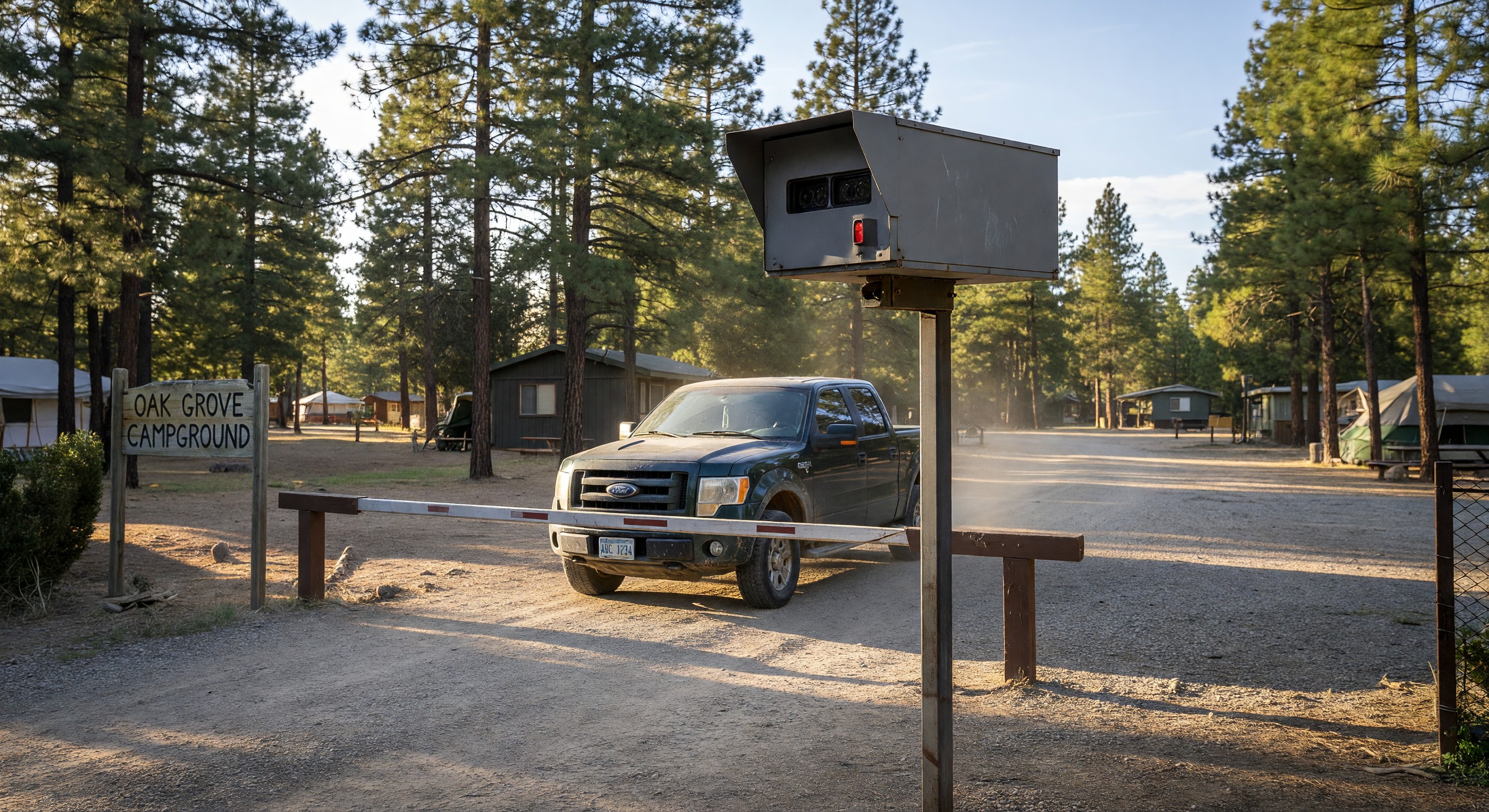
License plate recognition (LPR) technology — which automatically reads vehicle license plates and matches them against an authorized list — is moving from commercial parking facilities into campground access control applications. For parks looking to provide a completely frictionless arrival experience, LPR-based gate automation is an increasingly accessible option.
Instead of presenting a code or card, a registered guest simply drives up to the gate, the camera reads their plate, the system confirms it matches an active reservation, and the gate opens. No credential exchange, no fumbling with a keypad — the vehicle itself is the credential.
How Campground LPR Systems Work
The core workflow:
- When a guest makes a reservation and provides their vehicle’s license plate number, that plate is added to the authorized access list with the reservation’s valid dates
- As a vehicle approaches the gate, an LPR camera captures an image of the license plate
- Image processing software extracts the plate characters from the image
- The extracted plate is compared against the authorized access database
- If a match is found for a valid reservation, the gate controller receives an open signal
- The gate opens and the entry is logged with timestamp and plate image
The process takes 1–3 seconds from plate read to gate open — fast enough that vehicles typically don’t need to fully stop.
What Makes LPR Work Well in an Outdoor Environment
LPR in outdoor environments is technically more demanding than in controlled indoor settings. Variables that affect performance:
Lighting conditions: Plates must be read in early morning darkness, midday glare, direct headlights at night, and every lighting condition in between. Quality LPR systems include IR illumination that makes plates legible regardless of ambient light.
Camera angle and mounting height: Plates read best from a low angle (3–5 feet off the ground, directly in front of the vehicle) rather than from overhead. Camera positioning is critical for reliable reads.
Vehicle approach speed: Most campground LPR applications assume vehicles that approach slowly (under 10 mph). High-speed reads are possible with more sophisticated systems but aren’t necessary for typical campground entry.
Plate condition and jurisdiction variation: Dirty, damaged, or unusual plates affect read accuracy. Plates from US states and Canadian provinces vary in layout, font, and character set — a system that handles North American plate variation well is important for parks in border regions or popular destination parks.
Processing accuracy: LPR systems vary in read accuracy. A system that correctly reads 95% of plates may still produce significant errors — 1 in 20 vehicles getting a false rejection, requiring manual override. Look for systems with demonstrable 98%+ accuracy in real-world conditions.
Guest Plate Collection and Data Handling
LPR access control requires collecting vehicle plate data from guests at or before booking. This is a data handling consideration:
Collection point: Plate data can be collected at booking (via a field in the reservation form) or in the pre-arrival registration process. Collecting at booking is more convenient for the integration workflow; collecting pre-arrival allows guests who change vehicles to update easily.
Privacy disclosure: Guests should be informed that their plate data will be used for gate access and logged for security purposes. Include this in your booking terms.
Data retention: Plate read logs are security records. Define how long you retain them (30–90 days is typical) and implement deletion practices.
Secure storage: Plate data is personal information and should be stored and transmitted securely.
LPR vs. RFID vs. PIN Code: Which Is Right for Your Park?
These aren’t mutually exclusive — many parks use multiple credential types in parallel — but each has trade-offs:
LPR advantages: Most frictionless guest experience, no physical credential to lose or forget, vehicle-based rather than person-based (eliminates the problem of a guest leaving their credential in the car).
LPR disadvantages: Higher upfront cost, requires plate data collection at booking, read failures require a fallback (intercom, staff override), accuracy can be affected by challenging lighting or unusual plates.
RFID advantages: Very reliable in all conditions, works for pedestrian access as well as vehicles, mature technology with wide equipment compatibility.
PIN code advantages: Zero hardware cost per credential, easy to change or revoke, no physical item to lose.
Many campground implementations use LPR as the primary vehicle access method with a PIN code as the backup — allowing staff to give guests a code if their plate wasn’t pre-registered or if an LPR read fails.
For commercial-grade barrier gate hardware that supports LPR integration and high-cycle operation, commercial barrier gate manufacturers produce systems used in vehicle control applications that campground operators have adopted for entry lane management.
Frequently Asked Questions
What does a campground LPR system cost? A basic LPR camera system with software can start around $3,000–$5,000 for the camera and processing hardware, plus installation. More sophisticated multi-lane systems with high-accuracy cameras in challenging lighting conditions run higher. Total installed cost including gate hardware for a single-lane entry typically ranges from $8,000–$20,000.
Can LPR handle rental vehicles and guests who arrive in different vehicles than they registered? This is one of the most common LPR edge cases. Guests who rent a vehicle, borrow a car, or arrive in a spouse’s vehicle don’t have the plate they registered. Best practice is to build in a simple plate update workflow in your pre-arrival communication (“Please update your vehicle plate if your arriving vehicle has changed”) and have a staff override process for guests who arrive with an unregistered plate.
Do I need internet connectivity at the gate for LPR to work? Systems vary. Some LPR systems require real-time cloud connectivity to process plates and check access lists. Others store the access list locally and can operate offline (syncing when connectivity is available). For campground gates in areas with spotty connectivity, local processing capability is important.
Can the same LPR system read plates in both the US and Canada? Yes, if you select a system that explicitly supports multi-jurisdiction plates. This is relevant for parks near the US-Canadian border or parks that attract guests from multiple regions. Confirm with vendors that their OCR model is trained on plate formats from all relevant jurisdictions.
Further Reading from Authoritative Sources
- FCC wireless spectrum and networking standards for outdoor sensor systems — FCC regulations govern the wireless spectrum used by LPR cameras and their network communication equipment in outdoor campground deployments.
- ARVC campground technology adoption resources and operator guidance — ARVC tracks technology adoption trends across its member campgrounds and provides guidance on evaluating and implementing new access technologies.