The campground security technology landscape is evolving faster in 2025 than at any point in the previous decade. AI-powered surveillance, cloud-native access control, mobile credentials, and integrated property management platforms are converging to make sophisticated security capabilities accessible to parks that couldn’t have afforded them five years ago.
Here’s a tour of the technologies worth watching — and evaluating — in 2025.
AI-Enhanced Video Surveillance
Standard security cameras capture everything but analyze nothing. AI-enhanced surveillance changes this by applying machine learning to video streams in real time:
Behavioral detection: Cameras can flag specific behaviors — a person loitering near the perimeter fence, a vehicle moving slowly through the park after midnight, a group gathering in a restricted area — rather than simply recording motion.
Object classification: AI distinguishes between humans, vehicles, animals, and environmental motion (blowing vegetation). This dramatically reduces false alerts, which have historically been the biggest adoption barrier for motion-triggered notification systems.
Real-time alerts with context: Instead of “motion detected at Camera 4,” an AI-enhanced system might alert “unrecognized vehicle in staff parking area at 11:43pm, click to view.”
Crowd analytics: For larger parks with event programming, AI-powered crowd analytics can monitor density at amenity areas, identify queue buildup at the gate, and help staff anticipate resource needs before they become problems.
Cloud-Managed Access Control
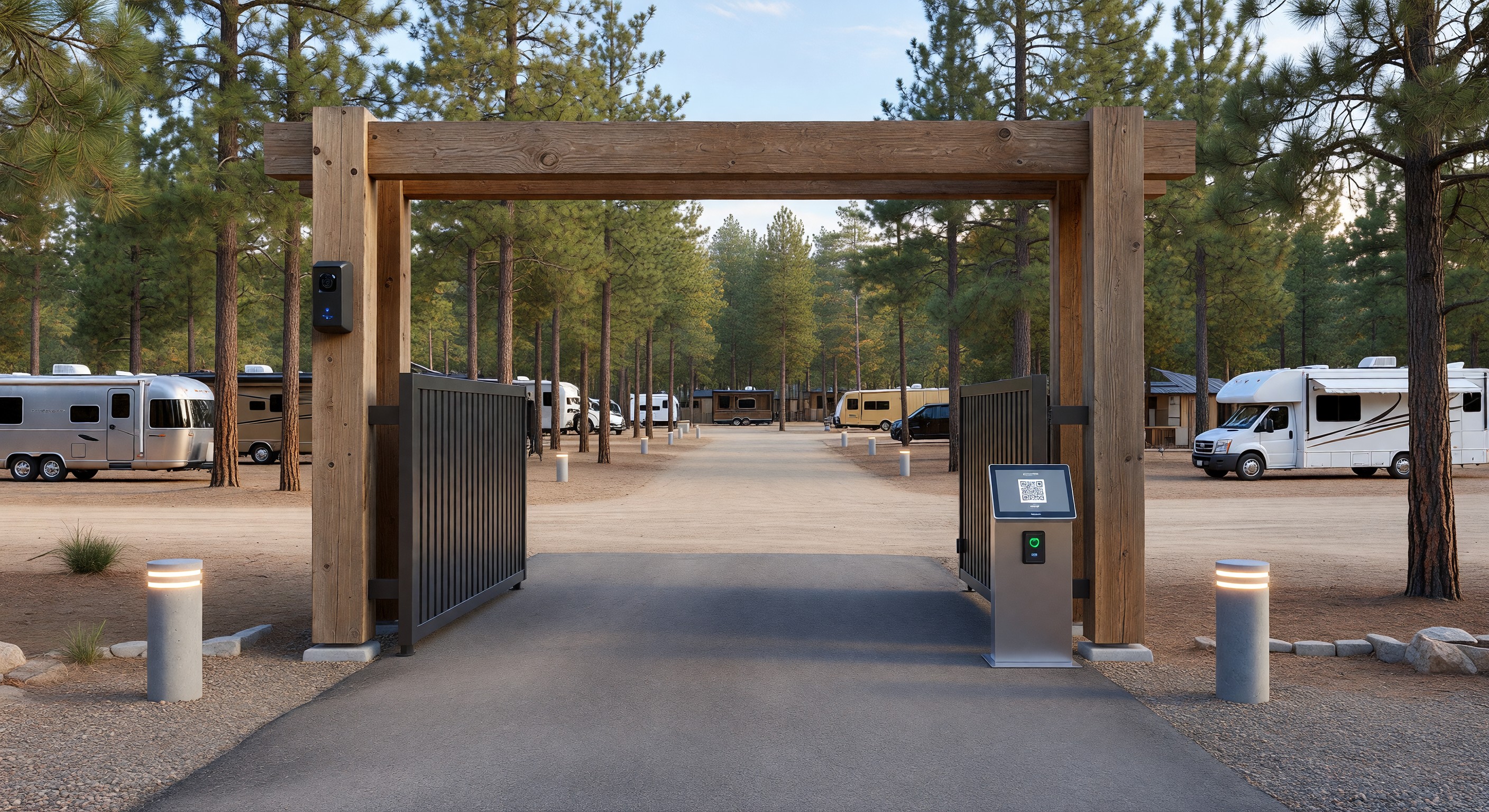
Cloud-native access control platforms have moved from novelty to mainstream in 2025. The advantages over on-premise systems:
Remote management from anywhere: Add or revoke credentials, view access logs, and configure access rules from any device with internet access. No VPN, no on-site access to the controller required.
Automatic software updates: Security patches and feature updates deploy automatically without requiring technician visits.
Scalability: Adding doors, gates, or readers to a cloud-managed system typically requires adding hardware — the software subscription scales automatically.
API-first design: Modern cloud access control platforms are built around APIs, making PMS integration straightforward.
Audit and compliance tools: Cloud platforms provide immutable audit logs with tamper detection — valuable for incident investigations and insurance documentation.
Mobile Credentials Replacing Physical Keys
The smartphone is becoming the universal access credential. In 2025, mobile credential adoption is growing rapidly across both access control and smart lock applications:
NFC (Near Field Communication): iPhones and modern Android phones support NFC credentials. Guest holds phone near a compatible reader to unlock. Works even in airplane mode.
Bluetooth Low Energy (BLE): Longer-range option that doesn’t require the phone to be positioned precisely against a reader. Works from a greater distance, enabling hands-free approach patterns.
Digital wallets: Apple Wallet and Google Wallet now support access credentials that can be provisioned and revoked remotely. A campground that uses Apple Wallet credentials can issue, update, and revoke guest access through the wallet API without a separate app download.
The guest experience benefit is significant: a guest whose access code is in their Apple Wallet never needs to remember a number or carry a physical card. Their phone is always with them.
Integrated Property Management Platforms
The clearest trend in 2025 is the integration of security and property management into unified platforms:
Access control, reservation management, utility monitoring, maintenance scheduling, and communication tools are increasingly available in integrated packages from single vendors — reducing the number of systems operators need to manage and the number of integrations they need to maintain.
For operators tired of juggling five different software subscriptions that partially talk to each other, the single-platform proposition is compelling — even if no single platform yet does everything perfectly.
What to Evaluate Now
For operators planning security technology investments in 2025:
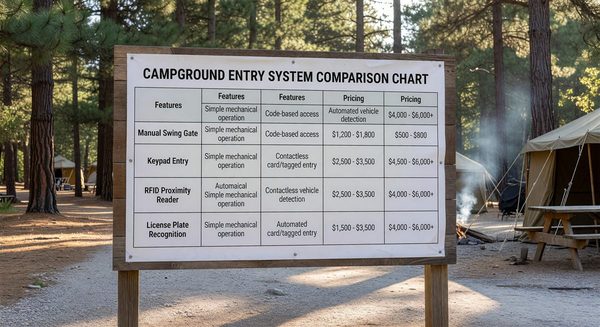
- Evaluate cloud-managed systems — the total cost advantage over on-premise systems with annual maintenance contracts is now clear for most campground sizes.
- Consider mobile credentials for new installations — the ecosystem is mature enough to be reliable, and guest adoption is high for properties that market to tech-comfortable demographics.
- Pilot AI camera analytics at a high-priority location (main gate, boat storage) before committing to full property deployment.
- Assess PMS integration quality as the primary decision filter — a security system that doesn’t integrate with your reservation system adds manual work that erodes its value.
Frequently Asked Questions
Are AI security tools reliable enough for real campground operations? AI camera analytics are mature enough to be useful — they significantly reduce false alerts and add context to real alerts. They’re not perfect, and false positives still occur. The right mindset is AI as an attention-focusing tool for humans, not as an autonomous security decision-maker.
Do mobile credentials work if a guest’s phone battery dies? This is the most common concern. NFC credentials stored in Apple Wallet function even when the phone’s main battery is depleted (for a limited period). For Bluetooth credentials, the phone must have sufficient battery. A PIN code backup access path remains important for any mobile credential implementation.
How much more expensive are cloud-managed systems versus traditional on-premise access control? Cloud-managed systems typically have lower upfront hardware costs but ongoing software subscription costs (typically $30–$150/month per site). Over 5 years, the total cost is often comparable or lower than on-premise systems with maintenance contracts. The operational benefits (remote management, automatic updates, remote diagnostics) are typically worth any premium.
Is AI surveillance in an outdoor campground setting a privacy concern for guests? Yes, and it’s worth addressing proactively. Post notice of AI-enhanced video surveillance in your campground information materials. Clearly state what the system does (monitors for security events, vehicle detection at the gate) and what it doesn’t do (individual site monitoring, personal behavior tracking beyond security purposes). Transparency reduces guest concern and demonstrates responsible use.
Further Reading from Authoritative Sources
- ARVC campground security and technology trends — ARVC tracks technology adoption trends across the campground industry and is the appropriate authority for statements about what campground operators are adopting and why.
- License plate recognition technology and how it works — Wikipedia’s license plate recognition article provides authoritative background on how LPR technology functions, supporting readers who need to understand the technology before evaluating campground-specific implementations.