After-hours security is one of the most challenging aspects of campground management. The hours between midnight and 6am are when noise complaints are most disruptive, when unauthorized visitors are most likely to attempt access, and when incidents requiring intervention are hardest to staff for. Yet many campgrounds address this period with minimal investment in training, tools, or systems.
Effective campground security isn’t primarily about hardware — though cameras and gate systems play an important supporting role. It’s fundamentally about having prepared people with the right tools and clear authority to handle the situations that arise.
Defining the Security Role at Campgrounds
Campground security staff occupy a specific position between hospitality and safety enforcement. They’re not police — they have no law enforcement authority and shouldn’t attempt to fill that role. But they’re also not simply guest services staff. They need to handle confrontational situations, enforce campground rules, document incidents, and make judgment calls about when to escalate to law enforcement.
This middle ground requires specific training that addresses:
- Rules enforcement without legal authority
- De-escalation techniques for noise complaints and rule violations
- Documentation procedures that create useful records
- Clear escalation paths when situations exceed the security officer’s authority
- Communication with law enforcement when called
Many campground operators deploy security staff who are well-intentioned but undertrained for the specific situations they encounter. Investing in appropriate training reduces the risk of mishandled incidents and improves consistency.
Communication Technology for Patrol Staff
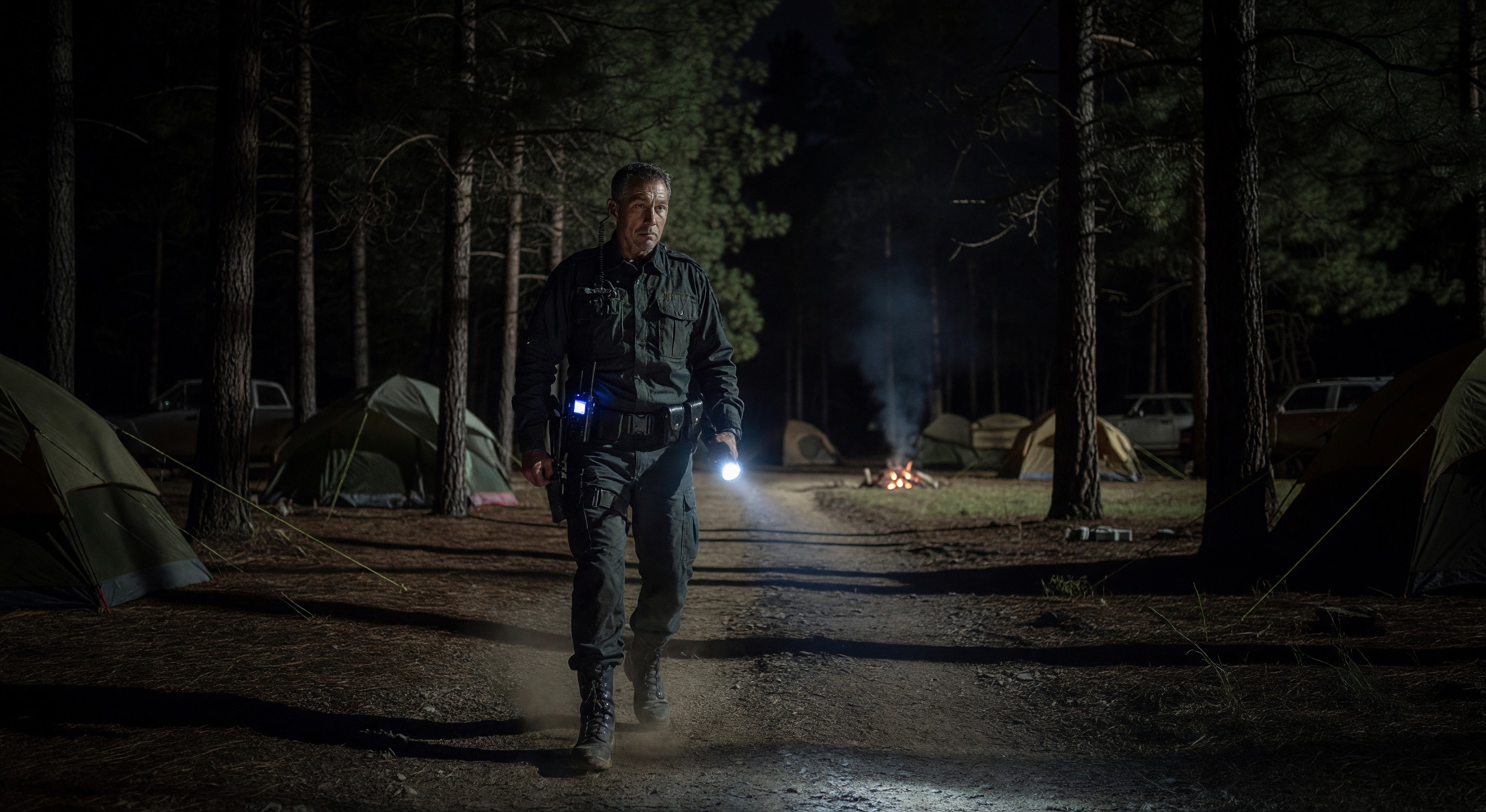
Security staff patrolling a campground — particularly at night — need reliable communication with the office, with each other, and with emergency services.
Two-way radios: Walkie-talkies or digital two-way radios remain the most reliable communication tool for on-site security patrol in campground environments where cellular coverage may be inconsistent. Digital systems with encryption and GPS tracking add capability for larger operations.
GPS patrol tracking: Mobile patrol tracking systems — typically a smartphone app or dedicated device carried by the patrol officer — log patrol routes against a time-stamped track. This creates a verifiable patrol record and allows supervisors to confirm that all areas of the property are being covered at the right frequency.
Incident reporting apps: Dedicated incident reporting apps allow patrol staff to document incidents in real-time — with time stamp, GPS location, photos, and narrative — rather than writing paper reports after the fact. Digital incident reports are immediately accessible to management and create a searchable database of events over time.
Body cameras: Body cameras worn by security staff provide video evidence of interactions that can be invaluable during disputes about what occurred. Some campground security programs have adopted body cameras for the same reasons law enforcement has: accountability, evidence preservation, and behavior modification (people generally conduct themselves better when they know they’re being recorded).
Patrol Checkpoints and Coverage
Physical patrol — walking or driving through the campground at regular intervals — is the core of most campground night security programs. The challenge is ensuring coverage is consistent and complete without requiring staff to maintain robotic schedules that become predictable.
NFC checkpoint tags: Small NFC (Near-Field Communication) tags can be mounted at discreet locations throughout the campground — near the main gate, at the pool, at the bathhouse, at the far end of each loop. Patrol staff tap their phone or a dedicated reader to each tag during patrol, creating a time-stamped record confirming they visited each checkpoint.
This simple technology solves a significant accountability problem: without checkpoints, there’s no way to verify that a patrol officer actually covered all areas of a large property. With checkpoint records, both accountability and documentation are automatic.
Variable patrol timing: Security experts generally recommend randomizing patrol intervals rather than patrolling on a predictable schedule. If the patrol passes every loop at exactly 1am, 2am, and 3am, anyone intending disruptive behavior can simply time their activities around the known patrol pattern. Randomized patrols between defined windows maintain coverage unpredictability.
Handling Common Security Situations
Well-prepared security staff have clear protocols for the most common situations they’ll encounter:
Noise complaints: Approach calmly, identify the source, explain the quiet hours rule clearly and without confrontation, document the interaction, follow up to confirm compliance. Second violations warrant escalation to campground management and potential site removal.
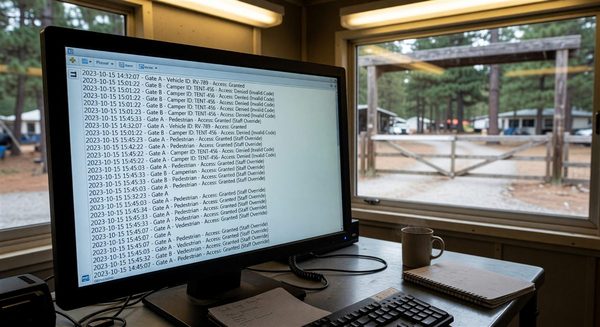
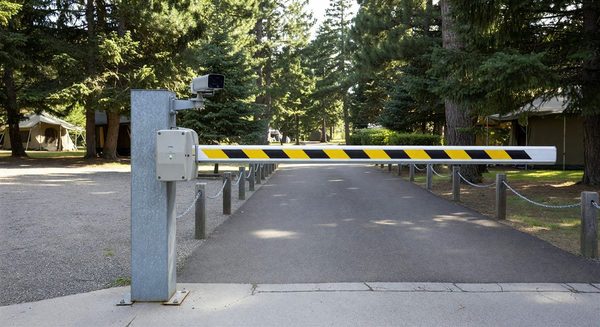
After-hours gate interception: Someone approaching the gate after hours without a valid credential may be a legitimate guest who forgot or lost their code, or may be an unauthorized individual. Have a clear protocol for verification: can they provide name and site number matching a reservation? If not, they need to wait until office hours or contact the on-call line.
Intoxicated guests: Intoxicated guests who are contained to their site and not disturbing others are generally a wait-and-see situation with a welfare check. Intoxicated guests who are confrontational or putting themselves or others at risk require law enforcement contact.
Medical emergencies: Security staff should be trained in basic first aid and know how to access AED devices on the property. Clear protocols for initiating 911 and directing emergency responders to specific site locations — with updated site maps readily available to responding agencies — are essential.
Documentation and Incident Reporting
Every security interaction, however minor, should be documented. Discipline around documentation:
- Creates a record of chronic problem guests or locations
- Provides evidence if incidents escalate to legal proceedings
- Demonstrates that management was aware of and responding to security issues
- Creates data for operational improvement — time of day, location, and type of most frequent incidents
At minimum, document: date/time, site number or location, names if provided, nature of the incident, action taken, and outcome. Digital incident reporting systems automatically capture location and timestamp data; patrol officers only need to enter the narrative and classification.
Legal Limits of Campground Security
Training must include clear instruction on what campground security staff are and are not authorized to do. Common misconceptions:
Physical restraint: Campground security staff generally have no authority to physically detain anyone. The exception would be a clear case of self-defense or protecting others from imminent harm. Attempting to physically restrain a guest creates significant legal liability.
Search and seizure: Security staff have no authority to search guests or their property.
Property removal: Removing a guest from the campground typically requires following a legal process (notice to vacate, potentially police assistance for trespass enforcement) rather than simply telling them to leave.
Clear instruction on these boundaries — combined with training on de-escalation techniques that make physical confrontation less likely — produces more effective and legally appropriate security operations.
Frequently Asked Questions
How many security staff do I need for a campground of X sites? There’s no universal standard, but common practice is one patrol officer per 200–300 sites for overnight security. Properties with higher incident rates, more complex layouts, or higher guest turnover may need more coverage. Properties with robust access control and camera systems can often staff at the lower end of the range.
Should campground security staff be armed? This is a serious decision with legal, liability, and operational implications. Most campground security programs operate unarmed. If armed security is being considered, consult with your insurance carrier and legal counsel before proceeding. Staff must have appropriate licensing and training for their jurisdiction.
How do we handle security during the off-season? Off-season security can typically be addressed through camera monitoring, motion-triggered alerts, periodic patrol by maintenance staff, and coordination with local law enforcement for regular drive-bys. Many campgrounds with significant off-season property have camera monitoring contracts that alert a monitoring center to unusual activity.
What’s the best way to communicate security incidents to day management staff? Digital incident reporting systems that allow reports to be reviewed remotely — and that send summary notifications to management at the end of each patrol shift — keep day staff informed without requiring manual handoff meetings. Incidents above a defined severity threshold should trigger immediate notification to the on-call manager, not just a morning review.
Further Reading from Authoritative Sources
- OSHA worker safety standards for security personnel in hospitality settings — OSHA’s general industry standards and recordkeeping requirements apply to campground security employees.
- ARVC campground security training and workforce resources — ARVC provides member campgrounds with workforce development resources including training materials relevant to outdoor hospitality security situations.