For most campground operators, the gate at the front entrance is the most expensive piece of access control infrastructure on the property — and the technology choice you make there shapes guest experience for years. Two credentialing methods now dominate new installs and major retrofits: RFID (radio-frequency identification) using stickers, cards, or fobs, and LPR (license plate recognition) using overhead cameras that read the plate as the vehicle approaches.
Both work. Neither is universally better. The right answer depends on your guest mix, your stay length distribution, your gate-lane geometry, and how much friction you’re willing to tolerate at the entry point. This comparison walks through the operational realities so you can make an informed choice — not just the marketing pitch.
How Each Technology Actually Works
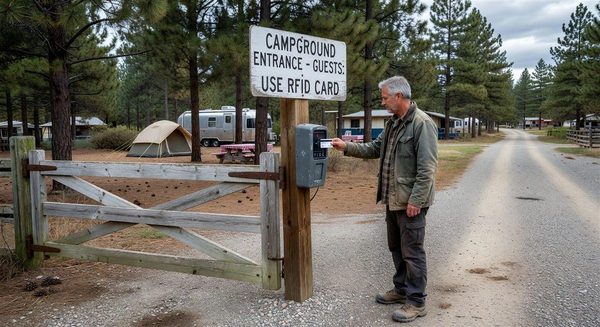
RFID is the older, more battle-tested approach. A small chip embedded in a windshield sticker, key fob, or proximity card emits a radio signal when it passes a reader. The reader looks up the credential in your access database, confirms the registration is current, and triggers the gate. Read range varies from about three feet for proximity cards to fifteen-plus feet for UHF windshield stickers used in long-term resident applications.
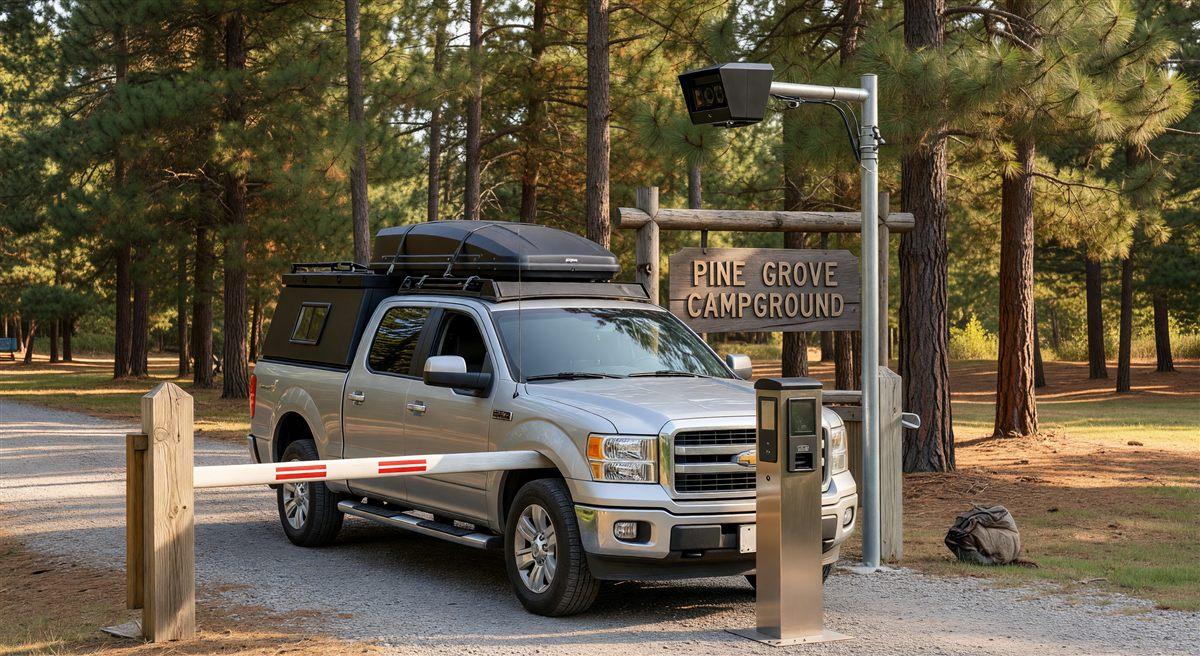
LPR uses one or more cameras with infrared illumination and onboard optical character recognition. As a vehicle approaches the gate, the camera captures the plate, the OCR engine returns a text string, and the system matches that string against the registered plate list. Modern LPR systems read accurately in rain, snow, and full darkness, and the better units handle stacked plates, motorcycle plates, and most state and provincial formats.
Both technologies sit downstream of your reservation or property management system. The integration — not the reader hardware — is usually where deployments succeed or fail.
Read Reliability Under Real Conditions
In a controlled lab environment, both technologies report read rates above 99 percent. Real campground conditions are a different test.
RFID strengths: Once a sticker is applied correctly, it reads almost every time. Snow, ice, mud on the bumper, dirty plates — none of this matters. The credential is bound to the windshield and is positioned exactly where the reader expects it. Long-term residents and seasonal guests who don’t change vehicles benefit most from this consistency.
RFID weaknesses: Stickers fall off after a season or two, especially in extreme heat or with aggressive car washing. Guests forget cards or leave fobs in the wrong vehicle. Replacement workflows have to be staffed, because every lost or transferred credential is a help-desk call. Multi-vehicle households are an ongoing administrative headache.
LPR strengths: Nothing for the guest to carry, lose, or forget. Self-registration through a reservation portal can capture the plate at booking, so by the time the rig arrives, the system already knows the vehicle. For transient and short-stay guests, this is significantly less friction than mailing or distributing a credential.
LPR weaknesses: Damaged plates, vanity plates with unusual fonts, dealer paper plates on new vehicles, snow or salt accumulation, and rear-mounted bike racks blocking the plate all cause misreads. A 98 percent read rate sounds excellent until you realize that on a busy Friday check-in with 200 arrivals, four guests are stuck at the gate. Read confidence thresholds and fallback workflows matter as much as the camera spec.
Guest Experience and Friction
For seasonal and long-term residents, RFID stickers create the smoothest experience possible. Drive up, gate opens, drive through. There is no plate to register, no app to install, no card to fish out of the console.
For transient guests — weekend campers, holiday travelers, one-night stopovers — LPR wins on first impression. The guest books online, enters their plate during checkout, and the gate opens on arrival without any physical credential exchange. No after-hours desk pickup, no lost-card calls at 11 PM.
Hybrid parks — those with a mix of seasonal sites and transient sites — often benefit from running both technologies on the same lane. Seasonal residents get RFID stickers, transient guests get LPR. The reader on the pedestal handles seasonals; the camera overhead catches everyone else. This is more expensive at install but it matches the credential to the use case.
Install Cost and Lane Layout
A single-lane RFID install with a pedestal reader, gate operator, loops, and basic management software typically lands in a tighter cost band than an equivalent LPR install. LPR adds the cost of the camera, the dedicated processor or NVR, more aggressive lighting requirements, and usually a longer cable pull.
Where LPR pulls ahead on cost is in retrofits where the cable infrastructure already exists for cameras. If your park already has a managed network drop near the gate, adding an LPR camera is incremental. Pulling new conduit for an RFID reader pedestal in concrete is not.
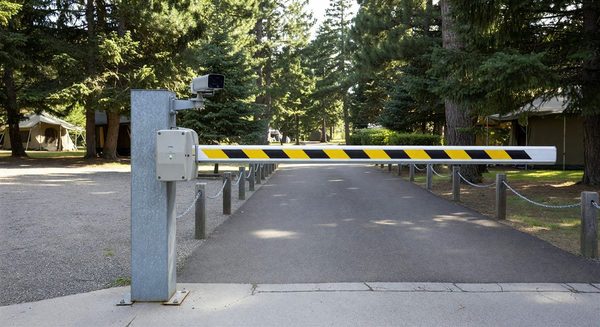
Lane geometry matters more than most operators realize. RFID readers want the credential to pass within their zone — that means windshield stickers need to be at the right height, and proximity readers need the driver to lean out the window. LPR cameras want a clean sight line to the plate at the right approach angle, which usually means a mounting position eight to twelve feet above the lane and offset slightly so the camera looks down at the plate rather than straight on.
Maintenance and Lifecycle Costs
RFID readers are largely solid-state and have very long mean time between failures. The consumable costs are stickers, cards, or fobs — typically a few dollars per credential. The hidden cost is staff time issuing and replacing them.
LPR cameras have moving parts in the form of cooling fans and IR illumination LEDs that degrade over five to seven years. The camera and its OCR engine need firmware updates. Lens cleaning becomes a meaningful maintenance task in dusty environments or anywhere road salt is used. The hidden cost is bandwidth and storage if you’re keeping plate read images for incident review.
Over a ten-year horizon, total cost of ownership tends to be similar for the two technologies in transient-heavy parks. RFID is usually cheaper for parks with a stable, long-term resident base because credential turnover is low.
Privacy and Data Considerations
LPR collects more data, and that data has different legal weight than an anonymous credential ID. License plates are personally identifiable in most jurisdictions, and how long you retain plate read logs, who can access them, and what you disclose in your privacy notice all become operational questions. Some states regulate commercial LPR retention directly.
RFID generates access logs too, but the credential ID is internal to your system and isn’t tied to a public registry the way a plate is. For most campgrounds, this distinction is academic. For parks operating in jurisdictions with active LPR legislation, it’s worth a conversation with counsel before specifying.
Integration With Your PMS
Whichever credentialing method you pick, the integration with your property management or reservation system is what determines whether the deployment is smooth or painful. Modern PMS platforms increasingly offer native integration with both RFID and LPR providers — but the depth of that integration varies.
Questions worth asking the vendor before you sign:
- When a reservation is canceled or shortened, does the credential or plate automatically deactivate, or does staff have to do it manually?
- Can guests update their plate through the reservation portal if they swap vehicles mid-stay?
- How are dependents and second drivers handled — multiple plates per reservation, or one primary?
- What’s the fallback when a guest’s plate doesn’t read or their RFID credential fails? Intercom to a staffed station? PIN code? Self-service kiosk?
A weak fallback workflow is the single biggest reason access-control deployments generate guest complaints.
Which One Should You Pick?
The shortest decision framework looks like this:
- Mostly long-term and seasonal residents: RFID stickers, with a basic intercom for visitor exceptions.
- Mostly transient, short-stay guests: LPR, with self-service plate registration during the booking flow.
- Mixed park with both populations: Hybrid lane running both readers, RFID for seasonals and LPR as the universal fallback.
- Tight retrofit budget with existing camera infrastructure: LPR is usually the lower incremental investment.
- Heavy privacy regulation in your jurisdiction: RFID by default, with LPR added only if the integration value is clear.
The technology is mature enough on both sides that either choice will work for most parks. The differences that matter aren’t in the readers — they’re in the registration workflow, the PMS integration depth, and the fallback experience when something doesn’t read on the first try. Specify those carefully and the front gate becomes the asset it should be, rather than the bottleneck guests remember.
Frequently Asked Questions
What is the fundamental difference between RFID and LPR campground access control? RFID access control requires the guest to present a physical credential (card, fob, or windshield transponder) to a reader at the gate — an active action. License plate recognition (LPR) cameras identify the vehicle automatically from the plate without any guest action, enabling completely frictionless entry where the gate opens as the vehicle approaches and the plate is recognized. LPR requires no guest training or credential distribution, but does require plate registration at booking.
Which access control technology is more appropriate for a high-volume campground? For campgrounds with peak arrival periods where many vehicles need to enter quickly — Friday afternoon holiday weekend arrivals, for example — LPR provides significantly faster throughput than RFID, because it eliminates the time for each driver to locate, present, and tap a credential. LPR can process 30–60 vehicles per hour per lane without any driver action; a well-designed RFID system processes 20–40 per hour with driver cooperation. The throughput advantage of LPR is most significant at high-volume sites.
What are the limitations of license plate recognition at campground gates? LPR accuracy is affected by plate condition (dirty, damaged, or obstructed plates fail to read), lighting conditions (nighttime performance varies by camera quality), unusual plate formats (specialty plates, some international plates, temporary paper plates), and tow vehicle situations where the plate visible to the camera belongs to the tow vehicle while the reservation is under a different vehicle. Most LPR deployments include a backup credential method (intercom or PIN pad) for cases where plate recognition fails.
How does LPR for campground access control integrate with the reservation system? When a guest completes a reservation, the PMS collects their license plate number (either at booking or via pre-arrival form) and transmits it to the LPR platform’s whitelist. When the vehicle arrives, the LPR camera reads the plate, confirms it against the whitelist, verifies the reservation dates are active, and opens the gate automatically. The PMS can update the whitelist in real time — adding plates for last-minute bookings and removing them at checkout — without any staff intervention.
What are the relative costs of RFID versus LPR access control systems? RFID systems have lower initial hardware costs — a quality reader and controller for a single lane runs $1,000–$3,000 — but carry ongoing consumable costs for cards or fobs ($1–$5 each, with 10–20% annual replacement for lost or damaged credentials). LPR cameras for a single lane run $2,000–$8,000 depending on camera quality and reading range, with no credential consumable cost and typically a software subscription for the recognition and management platform.
Further Reading from Authoritative Sources
- ARVC campground access technology adoption and operations guidance — ARVC tracks access control technology adoption across the campground industry and provides operational guidance relevant to the throughput and implementation trade-offs that campground operators must evaluate when choosing between RFID and LPR.
- Automatic number plate recognition technology and accuracy factors — Wikipedia’s automatic number plate recognition article provides authoritative technical background on LPR accuracy factors, environmental limitations, and operational characteristics that campground operators need to understand before deploying the technology.