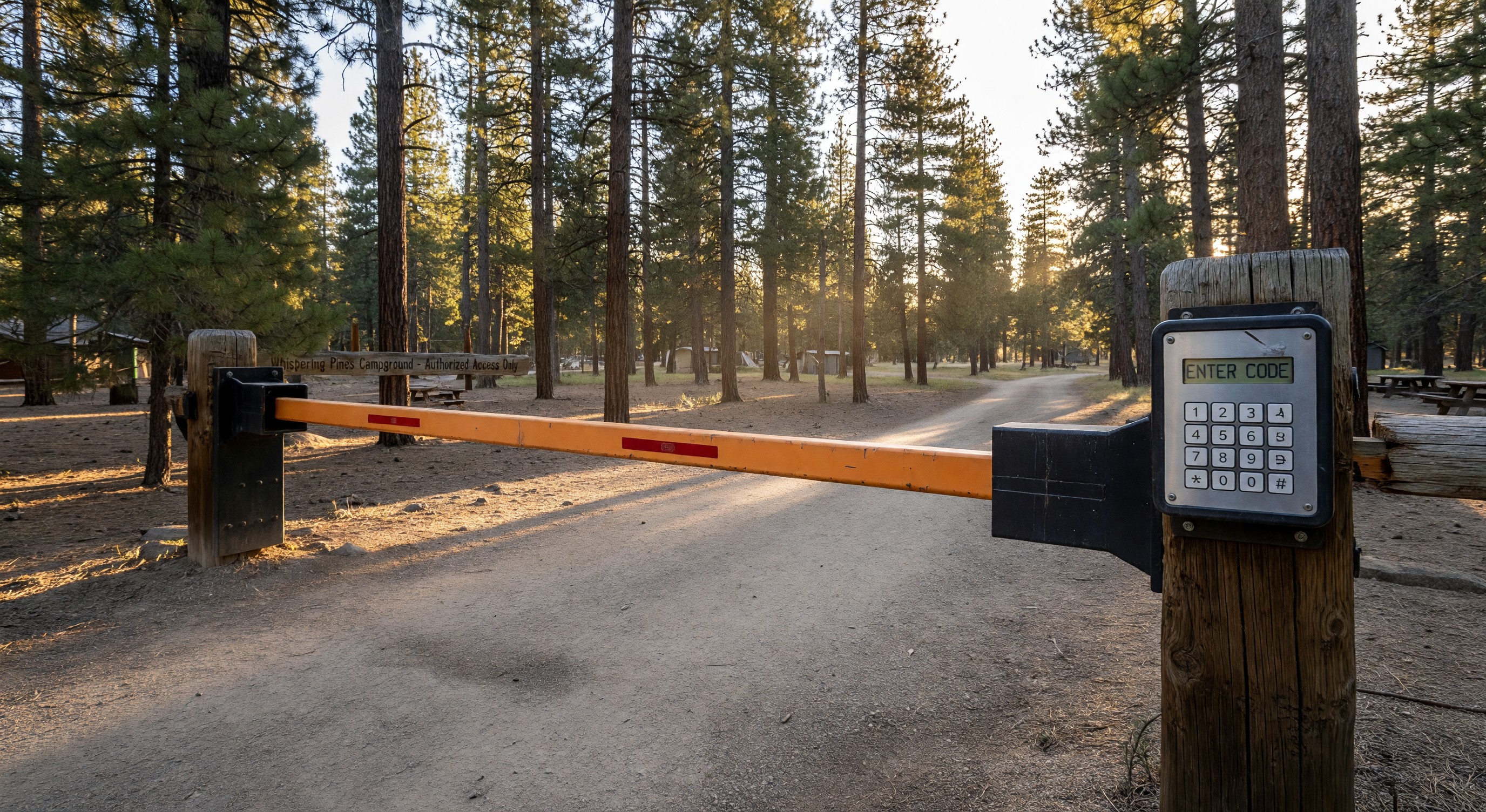
A campground gate system does more than keep unauthorized vehicles out. It establishes a clear boundary between your guests and the public, discourages after-hours entry, gives you a record of who comes and goes, and provides the infrastructure for contactless check-in workflows. For parks that have operated without gate control, the change in atmosphere — and in security incidents — is typically immediate.
This guide covers the fundamentals: what campground gate systems consist of, the types available, and how to think through the decision before making a significant infrastructure investment.
What a Campground Gate System Actually Includes
A complete gate system has several components working together:
The barrier arm (or gate): The physical mechanism that blocks vehicle entry. Barrier arms are the most common configuration for campground entrances — they extend horizontally across the lane and raise to allow authorized vehicles through. Full gates (swing or sliding) provide a more physical barrier but are slower to operate and more expensive to install and maintain.
The controller: The electronic brain that manages the gate’s operation — receiving access credentials, communicating with the barrier mechanism, and logging activity.
The access credential interface: How guests and staff provide their credential to trigger gate opening. Options include keypad (PIN code), card reader (RFID card or fob), QR code scanner, license plate recognition camera, or intercom with remote staff control.
The power system: Gates require reliable power. Most installations include a primary power connection and a battery backup that allows a defined number of cycles in the event of power loss.
The safety system: Loop detectors buried in the pavement prevent the barrier from lowering on a vehicle. Safety edges on the barrier arm stop movement if an obstruction is detected. These safety systems are required for code compliance in most jurisdictions.
Gate System Types for Campgrounds
Single-lane barrier gate: The most common configuration. One barrier arm controls one entry lane. Simple, relatively affordable, and appropriate for most mid-size campgrounds. Typical cost: $3,000–$8,000 installed.
Dual-lane barrier gate: Separate entry and exit lanes, each with its own barrier. Better traffic flow for larger parks or those with high peak-hour volume. Prevents entry-exit conflicts at the gate.
Full perimeter fencing with gated entry: Some parks invest in chain-link or privacy fencing around the entire perimeter, with the gated entry as the only authorized vehicle access point. This provides much higher security but is a significant infrastructure investment appropriate for parks with serious security concerns.
Crash-rated bollards or gates: For parks in high-risk locations or those that need to meet commercial security standards, crash-rated systems prevent vehicle ramming attacks. These are rarely necessary for recreational campgrounds but are mentioned for completeness.
Integration With Your Reservation System
A gate that operates in isolation — where staff manually program access codes — creates significant operational overhead. The most valuable gate systems integrate with your reservation management system:
- When a reservation is confirmed, a unique access code is automatically generated and sent to the guest
- The code is valid only for the guest’s reservation dates
- When the reservation ends, the code automatically expires
- All gate entries and exits are logged against guest records
This integration reduces staff workload, improves security, and enables the contactless arrival experience that modern guests expect. When evaluating gate systems, confirm what integration options exist with your specific PMS.
For campgrounds evaluating barrier gate equipment, operators in this space use purpose-built campground access systems as well as commercial-grade barrier gate equipment designed for high-cycle-count vehicle control applications. Commercial barrier gate manufacturers produce systems built for demanding entry control environments that campground operators have adapted to their access control needs.
Planning Your Installation
Before purchasing, work through:
Entry lane configuration: How many vehicles enter per hour at peak? How many entry lanes do you have or plan to build? A single-lane gate at a park with 10+ simultaneous peak arrivals will create a bottleneck.
Site preparation: Gates require a concrete pad, conduit runs for power and data, and induction loop installation in the pavement. These site prep costs can add $1,000–$3,000 to the installation budget and require a contractor.
Communication needs: Does the gate need a built-in intercom for guests who need help? Where will the intercom route to — a staffed booth, an office, or a remote answering service?
Frequently Asked Questions
How long do campground gate systems last? Commercial-grade barrier gates are designed for high-cycle life — often 1–3 million cycles before major service is needed. At a campground processing 50 gate cycles per day, that’s 20,000+ days of operation. With proper maintenance, a quality gate system should provide 15–25 years of service.
Can I install a gate system myself to save money? The barrier arm and controller installation is feasible for mechanically capable operators. The pavement induction loops and electrical work typically require licensed contractors. Attempting to save money by skipping the loop installation is a significant safety risk — without vehicle detection, the gate can lower on vehicles in the lane.
What happens to guests when the power goes out? Battery backup systems allow a defined number of gate cycles (typically 50–200) during a power outage. Most installations are configured to fail-open (gate raises and stays up during power loss) so guests aren’t trapped. Verify the fail-safe configuration when you install.
How do I handle guests who tailgate through the gate behind authorized vehicles? Tailgating is the most common workaround for campground gates. Options include: installing a second gate with an anti-tailgate sensor on a separate lane, adding security cameras at the gate to identify tailgaters, and addressing it through policy enforcement rather than hardware. In practice, most campground operators accept some level of tailgating as an inherent limitation of single-barrier-arm systems.
Further Reading from Authoritative Sources
- ARVC campground security and access control guidance — ARVC is the national trade association for RV parks and campgrounds and provides the most directly relevant industry authority for campground gate system decisions, including security standards and operational best practices.
- NFPA electrical and safety code requirements for gate installations — NFPA 70 (National Electrical Code) governs the electrical work required for gate installations, including conduit runs, power connections, and loop detector wiring.