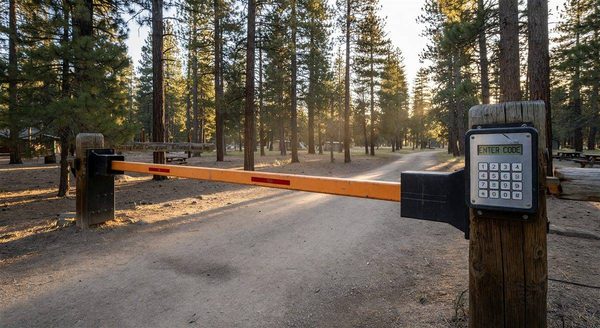
A campground gate system that fails during a power outage can strand guests inside the property, prevent emergency vehicle access, or leave the entry uncontrolled during a critical period. Power backup planning is not an optional consideration — it’s a core component of a reliable gate installation.
The right power backup solution depends on your gate system’s power requirements, your grid reliability, and whether grid power is available at the gate location at all.
Understanding Your Gate’s Power Requirements
Before designing a backup system, know your gate’s power specifications:
Standby power consumption: The current your gate controller, readers, and electronics draw when idle (no motor running).
Peak power consumption: The current drawn when the motor is actively operating the gate arm. This is typically 2–5x the standby current and is brief (the motor runs for 1–3 seconds per cycle).
Battery backup cycles: Most gate manufacturers rate their integrated battery backup by cycles — how many open/close operations the gate will complete on backup power before the battery is depleted.
Recharge time: After a power outage, how long does the battery require to fully recharge once grid power is restored?
These specifications should be in your gate’s documentation. If you’ve lost the documentation, the manufacturer’s tech support can provide them.
Integrated Battery Backup (Standard Configuration)
Most commercial-grade gate controllers include an integrated battery backup — typically a 12V or 24V sealed lead-acid or lithium battery housed in the control cabinet alongside the controller.
This battery is maintained at full charge while grid power is available. When power is lost, the gate automatically switches to battery operation. The integrated backup is designed for short-duration outages — typically 50–200 gate cycles (enough for guests to exit and emergency vehicles to access during a several-hour outage).
Verify the cycle count rating and ensure it meets your minimum requirements:
- How many vehicles need to exit the property in a potential outage scenario?
- How long are typical outages in your area?
If the integrated backup is insufficient, supplement with an external UPS.
External UPS (Uninterruptible Power Supply)
An external UPS sits between the wall power and your gate’s control cabinet, providing:
Longer backup duration: A larger UPS battery bank provides more backup power than the integrated battery, supporting longer outages.
Cleaner power transition: A UPS provides seamless transition between grid and battery — the gate doesn’t experience a momentary power interruption that might cause a controller reset.
Surge protection: A UPS also conditions incoming power and protects against surges that can damage gate electronics.
Size the UPS based on your gate’s power draw and desired backup duration. A gate with a 200W peak load that you want to operate for 8 hours in an outage needs a UPS with significantly more capacity than one you want to run for 2 hours.
Solar Power for Remote Gate Locations
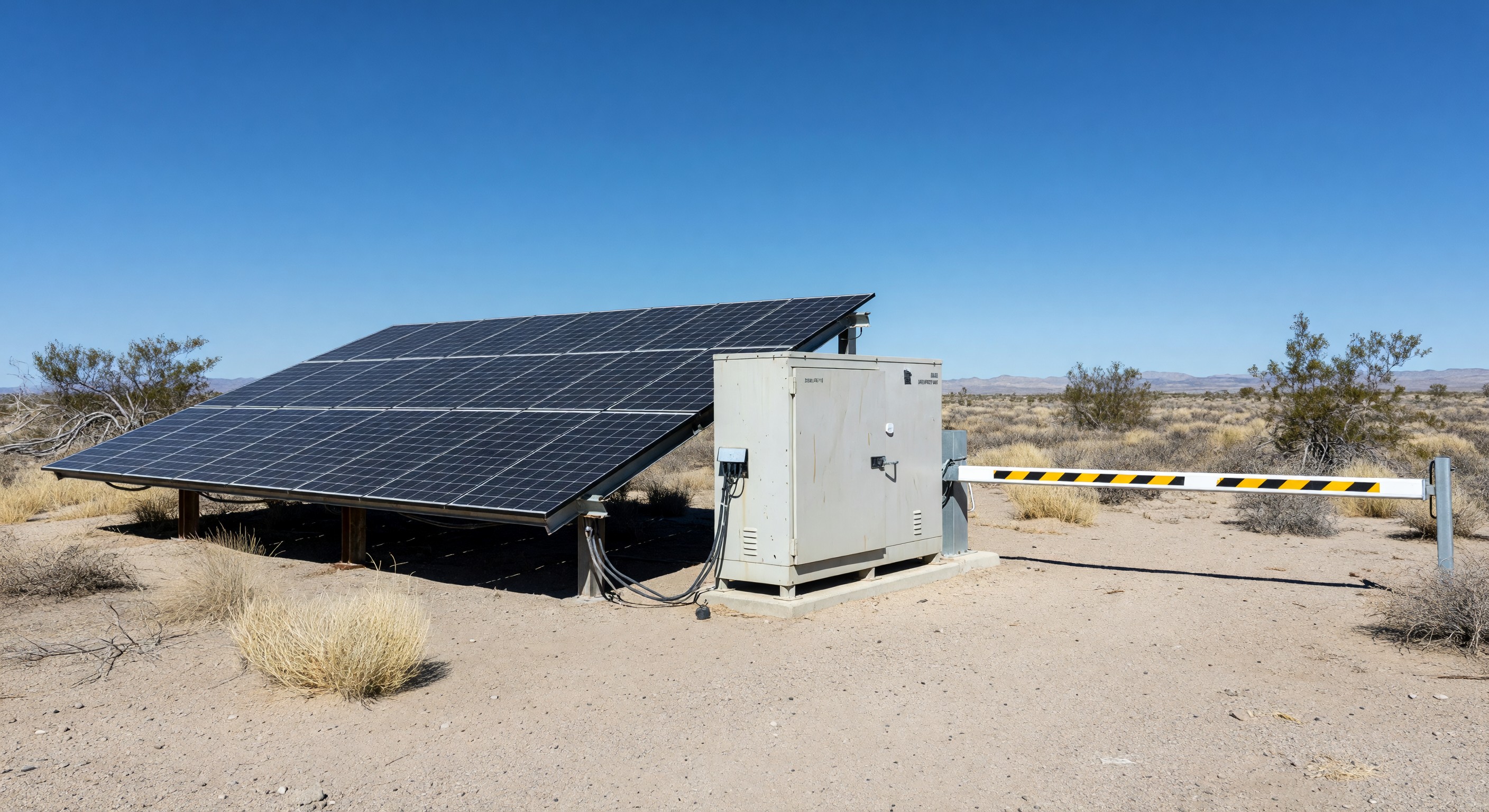
For gates at entry points distant from the main electrical service — a remote secondary entrance, a trailhead access gate, a boat launch barrier — solar power with battery storage is often more practical and less expensive than running new electrical service.
A solar-powered gate system requires:
Solar panel(s): Sized to generate sufficient power for daily gate operation plus recharge the battery bank. Gate power consumption is low (typically 10–50W average), making solar practical even in partially shaded locations.
Battery bank: Stores energy from the solar panels and provides power during nights and cloudy periods. Lithium phosphate (LiFePO4) batteries are preferred for outdoor applications — they’re tolerant of temperature variation and have longer cycle life than lead-acid.
Charge controller: Manages the flow of energy between solar panels, battery, and gate equipment — preventing overcharge and managing battery state.
Gate controller compatibility: Most gate controllers operate on 24V DC, which aligns well with solar/battery power systems.
Solar-powered gates at remote campground locations have become increasingly common as battery and panel costs have decreased. A well-designed solar gate system operates reliably for years with minimal maintenance.
For campground access lane equipment designed to operate reliably across power configurations, commercial barrier gate manufacturers produce systems compatible with various power configurations including backup power setups.
Frequently Asked Questions
How often should I test my gate’s backup power system? Monthly testing is appropriate. Test by disconnecting the main power (with staff aware and ready to manually assist if the gate doesn’t function as expected) and verifying the gate operates correctly on backup power. Also verify the system correctly switches back to grid power when it’s restored.
What’s the failure mode when backup power is exhausted? Configure your gate to fail-open when power is fully depleted — the barrier arm raises and stays up. This prevents guests from being trapped and ensures emergency vehicle access. Verify this configuration explicitly; some gate controllers default to fail-locked.
Can I use a generator as backup power for a gate? Yes, though generators introduce their own reliability considerations (fuel, starting, maintenance). A generator may make more sense as a full property backup that incidentally powers the gate than as a dedicated gate backup solution. The switchover time from grid to generator (typically 10–30 seconds) means the gate may experience a brief power interruption — confirm the controller handles this gracefully.
What’s the expected lifespan of backup batteries in gate systems? Standard sealed lead-acid batteries in integrated gate backup systems typically last 3–5 years before capacity degrades enough to warrant replacement. Lithium batteries in standalone UPS or solar systems typically last 8–12 years. Plan and budget for battery replacement as a routine maintenance item.
Further Reading from Authoritative Sources
- Department of Energy battery backup systems and UPS technology guidance — The Department of Energy publishes technical guidance on battery storage technologies, including performance comparisons between lead-acid and lithium chemistries for backup power applications relevant to the gate power backup decisions discussed in this article.
- NFPA emergency power and fail-safe gate requirements — NFPA 1 (Fire Code) and NFPA 101 (Life Safety Code) establish fail-safe access requirements for gated facilities, including the fail-open configuration requirement that ensures emergency vehicle access during power failure events.