A campground entry gate is infrastructure — critical, high-use equipment that operates in outdoor conditions year-round. Like any infrastructure, it requires regular maintenance to perform reliably and to avoid the failure scenarios that create operational crises: a gate that won’t open at peak arrival hour on a holiday Friday, or one that won’t close at 11pm, allowing unauthorized vehicles to enter all night.
Most gate maintenance is not complex. It’s simply consistent — scheduled inspections and service that catch issues before they become failures.
Understanding Your Gate’s Failure Modes
To maintain a gate effectively, you need to understand how it fails:
Mechanical wear: The barrier arm’s pivot mechanism, counterbalance spring, and motor/gearbox experience wear from millions of cycles over years of operation. Worn components eventually fail. Scheduled lubrication and component inspection extends service life.
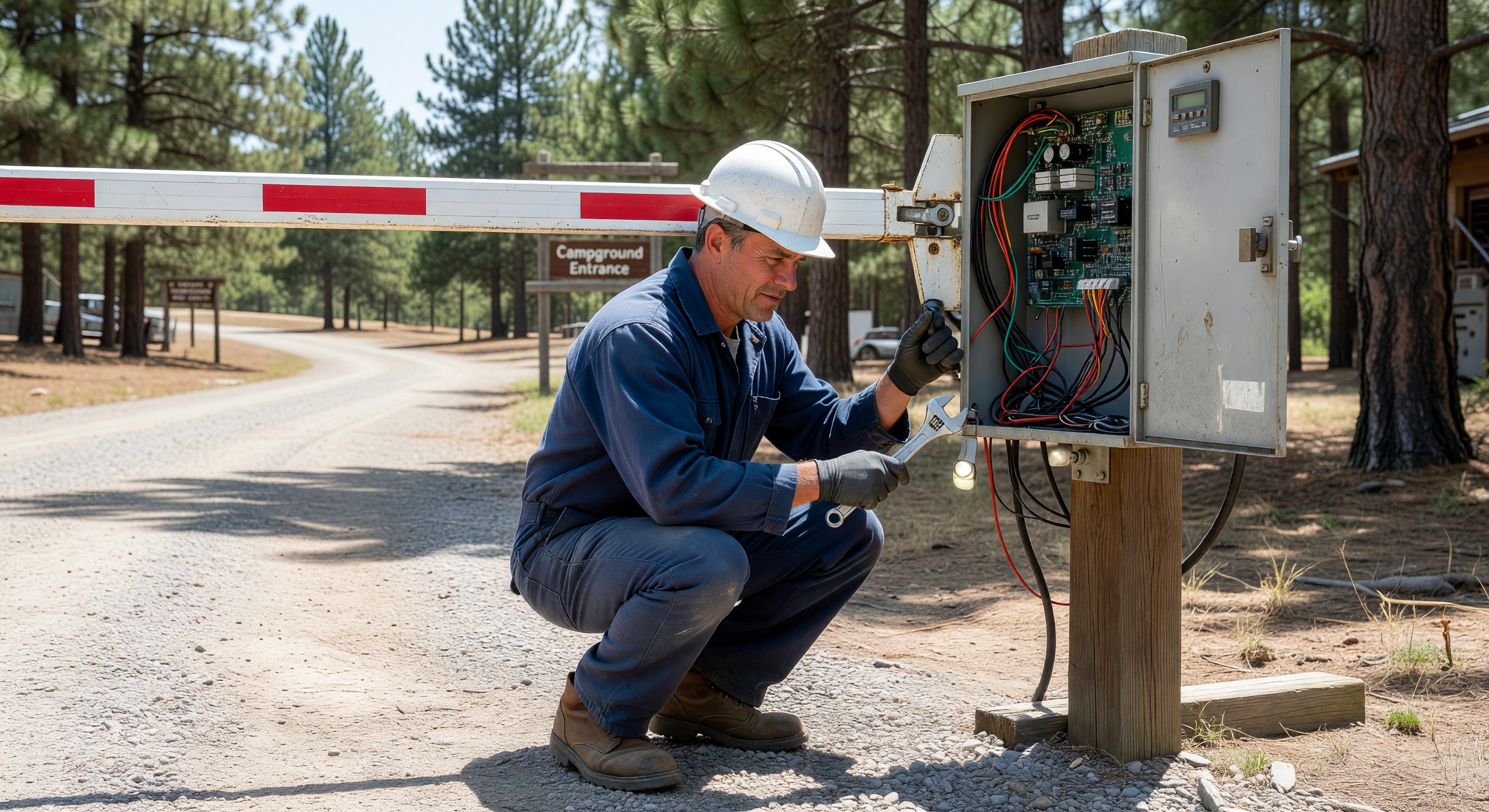
Electrical faults: Gate controllers, reed switches, safety sensors, and wiring can fail from moisture intrusion, corrosion, UV degradation, or physical damage. Electrical faults are often intermittent before they become permanent failures — a gate that “acts weird occasionally” is usually warning you that a failure is coming.
Pavement loop failure: Induction loops embedded in the pavement detect vehicles. They can be damaged by pavement cracking, improper installation, or thermal expansion. A failed loop may cause the gate to not open for approaching vehicles (false rejection) or to not detect a vehicle in the lane (unsafe lowering risk).
Access control software/credential issues: Incorrect credential programming, system synchronization failures, or software bugs cause access control failures that look like gate failures but are actually software issues.
Physical damage: Barrier arms are designed to break away on impact rather than damaging the vehicle — but the arm itself is then broken and needs replacement. Arm breakages are the most common acute maintenance event for campground gates.
Preventive Maintenance Schedule
Monthly:
- Test all entry lanes by presenting credentials that should grant access — confirm all work correctly
- Test safety loops by slowly driving through the lane with the gate programmed to close — verify the gate stops when the loop detects the vehicle
- Visually inspect barrier arm for cracks, deformation, or mounting issues
- Check control cabinet for moisture, pest intrusion, or wiring issues
- Check battery backup status indicator
Quarterly:
- Apply manufacturer-recommended lubricant to arm pivot, counterbalance mechanism, and any exposed moving metal parts
- Test battery backup by disconnecting main power — verify the gate completes defined cycle count on battery
- Clean camera lenses (if LPR or security cameras are installed at the gate)
- Review access log for anomalies (frequent failed access attempts, unusual access patterns)
- Check that seasonal access credentials are current (expired credentials from previous season sometimes remain in the system)
Annually:
- Full inspection by a qualified gate technician
- Replace lubricant in gearbox per manufacturer specification
- Test all safety devices (safety edge, loop detectors, presence sensors) with documented results
- Check hardware torque on arm mounting, foundation bolts, and control cabinet mounting
- Review warranty status and maintenance contract coverage
Keeping Replacement Parts On Hand
The most expensive element of gate failure is downtime, not parts cost. For a gate that’s critical to your operation, keep common replacement parts on hand:
- Replacement barrier arms (breakaways happen)
- Loop detector modules (vulnerable to pavement movement)
- Safety edge replacement (rubber edge that stops barrier arm movement on contact)
- Spare circuit boards or controller units if the manufacturer stocks them
Know your gate manufacturer’s model number and your controller’s firmware version. When you need parts or tech support, this information cuts resolution time significantly.
When to Call a Technician vs. Handle Internally
Handle internally: Barrier arm replacement (typically a mechanical attachment), credential re-programming, control cabinet external inspection, lubrication.
Call a technician: Loop detector installation or replacement (requires cutting pavement), electrical fault diagnosis, gearbox service, controller replacement, any work inside the control cabinet on live circuits.
Frequently Asked Questions
How often do campground gates need professional service? Annual professional service is appropriate for most gates in year-round or heavy-use operation. Parks with seasonal operation (open 6 months/year) can stretch to every 18–24 months with diligent internal monthly checks. Higher cycle counts (busier parks) justify more frequent professional service.
What’s the most common cause of a gate that opens but won’t close? Usually a vehicle detection issue — either a failed loop detector that’s registering a vehicle as always present, or a misaligned presence sensor. The gate system’s safety logic prevents closing when it believes a vehicle is in the lane. Check loop detector status indicators in the control cabinet for fault codes.
Should I have a maintenance contract with the gate installer? For most campground operators, an on-call service agreement (pay for service when needed, at a defined rate) is more cost-effective than a comprehensive annual maintenance contract unless your gate is a high-cycle system in a location where downtime is especially costly. Get service pricing in writing from your installer and evaluate against the annual contract cost.
Can I get parts for an older gate that may no longer be manufactured? Older gates often use standard components (motors, limit switches, loop detectors) that are interchangeable across brands. An experienced gate technician can often source compatible replacement parts for discontinued models. Maintain your original documentation and model numbers — they’re invaluable when sourcing parts for older equipment.
Further Reading from Authoritative Sources
- ARVC campground facility maintenance standards — ARVC publishes operational best practices for campground facilities, making it the appropriate authoritative reference for maintenance standards in the RV park and campground industry.
- NFPA safety requirements for automated gate systems — NFPA standards address entrapment protection and safety device requirements for automated gate systems.