Gate access control and reservation management are two separate technology systems in most campgrounds — and that separation creates manual work. Staff look up a reservation, generate a code, enter it into the gate system, then send it to the guest. Every time a reservation is modified or cancelled, that process may need to repeat. With dozens or hundreds of reservations moving through your park each week, the cumulative overhead is significant.
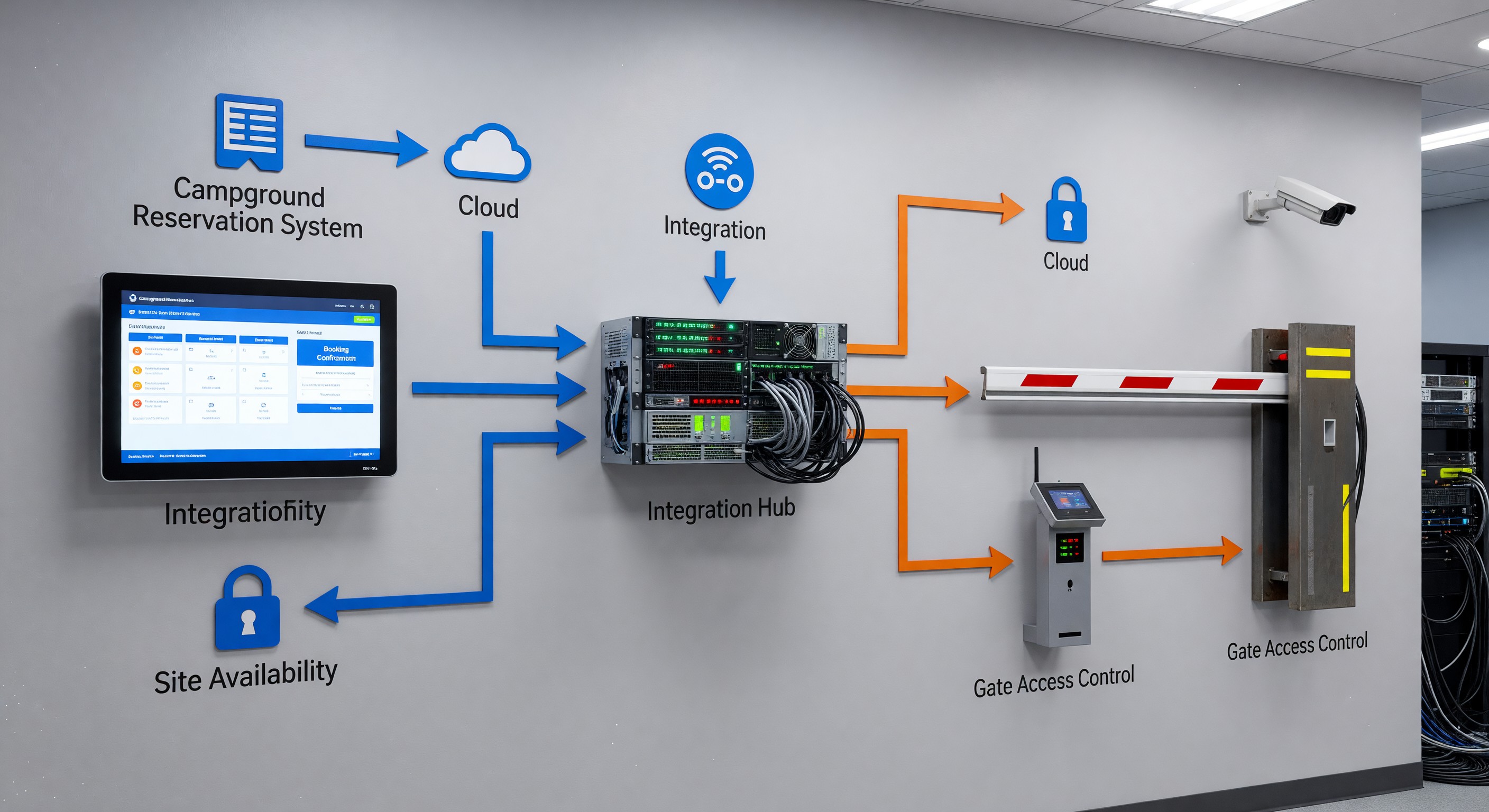
Integration — connecting your reservation management system and your access control system so they share data automatically — eliminates most of this manual work and makes contactless check-in reliably sustainable.
What Integration Actually Does
At a basic level, a reservation-access control integration:
Creates access credentials automatically when a reservation is confirmed. A unique PIN code, RFID code, or digital credential is generated and linked to the reservation record without staff action.
Sets valid date windows automatically. The credential is active starting at check-in time on the arrival date and deactivates at checkout time on the departure date. No manual credential management required.
Sends credentials to the guest automatically in the confirmation email or pre-arrival communication. No staff needs to call, email, or text a code separately.
Revokes credentials automatically on cancellation or early checkout. A guest who cancels two weeks before arrival has their gate credential deactivated without manual intervention.
Logs access events against reservation records. When a guest uses their code or credential at the gate, that event is logged and associated with their reservation. You can see when they arrived, when they left, and how many gate uses their credential has had.
Integration Architecture Options
Native PMS-gate integration: Your reservation platform has a built-in, pre-configured connection to your gate system. This is the cleanest approach when available — both systems are configured to communicate, and the integration is maintained by the vendors rather than requiring custom development.
The limitation is availability. Native integrations only exist between specific PMS platforms and specific gate systems. Confirm that your PMS and gate vendor have an existing integration before assuming this is possible.
API-based custom integration: If a native connection doesn’t exist, a custom integration can be built using the APIs of both systems. Your gate controller needs an API that allows credential management via software commands; your PMS needs an API that can trigger events (new reservation, cancellation, modification). A developer connects them.
This is more expensive upfront but possible with most modern systems that expose APIs.
Middleware integration platforms: Services like Zapier (for simpler automations) or custom middleware can bridge systems that don’t have native connections or full APIs. These are more limited in capability but lower-cost than full custom development.
Manual-with-automation hybrid: Some parks use a limited automation — the PMS sends a webhook notification to an email address when reservations are created or modified, and a staff member handles credential management from that notification. This isn’t true integration but reduces the risk of missed credential management steps.
What to Verify Before Implementation
Before committing to a specific gate system or PMS expecting them to integrate, verify explicitly:
- Does the gate system’s controller expose an API for remote credential management?
- Does the API support: create credential, set validity window, deactivate credential, query access log?
- Does the PMS have API endpoints for: new reservation event, cancellation event, modification event?
- Has this specific combination been done before? Ask both vendors for reference customers.
Even with “integration” advertised, the actual depth of connection varies. A system that syncs once daily is very different from one that syncs in real time.
Security Implications of Integration
An integrated system has new attack surface considerations. The API endpoint that allows the PMS to create gate credentials is a capability that, if exploited, could generate unauthorized access credentials.
Standard security practices apply:
- API authentication using secure tokens (not just a username/password)
- HTTPS-only communication between systems
- Logging of all credential management API calls
- Least-privilege access (the PMS can only create/deactivate credentials, not reconfigure the gate system)
For most campground gate systems, these risks are modest in the context of recreational camping. But they’re worth discussing with your gate system vendor before integration.
Commercial vehicle control and access systems used in campground entry lane applications often include API access capability that supports PMS integration workflows for automated credential management.
Frequently Asked Questions
My PMS vendor says they’re “working on” gate integration — what does that mean for my timeline? “Working on” can mean anywhere from actively in development (available in 3–6 months) to a feature requested by multiple customers that hasn’t been prioritized. Ask for a specific estimated release date and whether you can participate in a beta program. If integration is a critical requirement, don’t wait — evaluate gate systems that have existing integrations with your current PMS.
Can I integrate my gate system with multiple PMS platforms? If your gate controller has an open API, yes — any PMS that can call that API can potentially integrate. Gate vendors who want to serve the campground market broadly are incentivized to make their APIs accessible. This is worth asking about when evaluating gate systems.
What happens if the integration breaks (the API goes down)? Credential management falls back to manual processes until the integration is restored. Your gate system should continue to operate with whatever credentials were last synced — credentials already programmed remain valid even if the API is temporarily unavailable. Have a documented manual fallback process that staff know.
How much does PMS-gate integration implementation typically cost? Native integrations, if they exist, typically have no incremental cost beyond the two platforms’ base pricing. Custom API integration development runs $2,000–$10,000 depending on complexity. Middleware automation setups (Zapier-style) are lower cost but more limited.
Further Reading from Authoritative Sources
- ARVC campground operations and technology standards — ARVC (National Association of RV Parks and Campgrounds) is the primary trade association for the campground industry and publishes operational standards that inform integration requirements.
- Property management system overview and integration architecture — Wikipedia’s PMS article provides neutral background on property management system architecture and API integration patterns that support the technical explanation in this article, serving as a fallback authority for readers unfamiliar with the terminology.